
Download Official Form CT33D (PDF)
Opens the official government PDF in a new tab
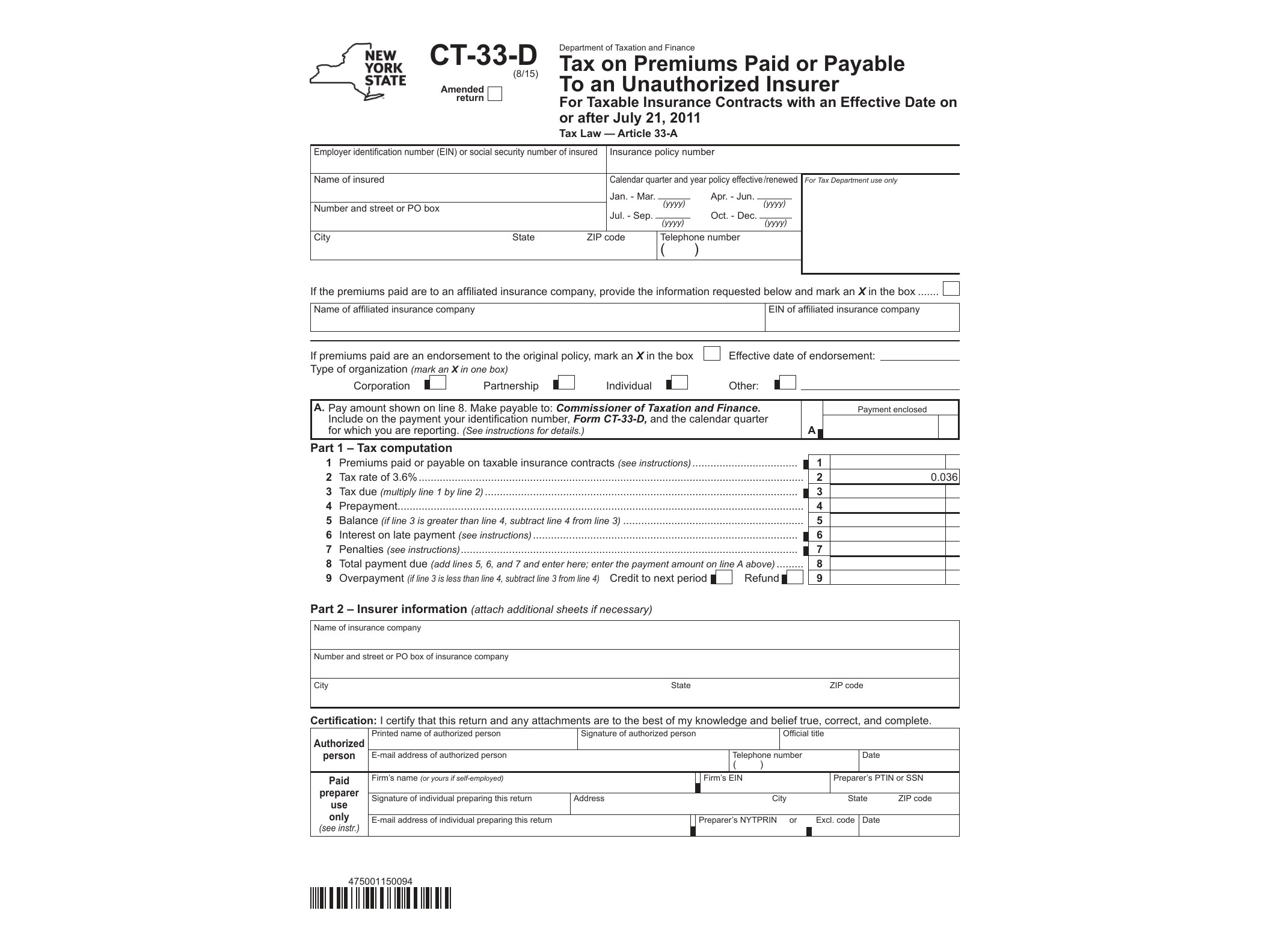
Form CT-33-D is issued by the New York State Department of Taxation and Finance to collect tax on premiums paid or payable to an unauthorized insurer. “Unauthorized” in this context means an insurance company that is not licensed to do business in New York State. When a New York policyholder purchases coverage from one of these insurers, the state still expects tax to be paid on those premiums, and Form CT-33-D is the mechanism for reporting and remitting it.
This particular version of the form applies to taxable insurance contracts with an effective date on or after July 21, 2011. If your policy was issued before that date, a different version of the form or a different set of rules may apply, so it’s worth confirming the effective date on your contract before you start filling anything out.
Who Needs to File Form CT-33-D
This form is typically required by New York residents, businesses, or other entities that have purchased insurance coverage directly from an insurer not authorized to transact business in the state. This often happens with specialty or surplus lines coverage that isn’t readily available through licensed carriers operating in New York. If you or your business paid premiums to such an insurer, and no licensed broker or agent already handled the tax withholding on your behalf, the obligation to report and pay this tax generally falls on you as the policyholder.
It’s worth noting that this is different from cigarette or tobacco-related tax filings that New York also administers, such as the Nonresident Agent Cigarette Tax Report or the Cigarette Use Tax Return. Form CT-33-D deals exclusively with insurance premium taxation, not excise taxes on goods, so don’t confuse the two categories even though both fall under the state’s tax administration umbrella.
When This Form Applies
You generally need to file Form CT-33-D after paying premiums on a taxable insurance contract from an unauthorized insurer during the applicable tax period. The state requires this reporting regardless of whether the policy was purchased for personal or business purposes, as long as the insurer lacks the proper authorization to operate in New York. The tax is calculated based on the total premiums paid, and the form walks you through determining the taxable base and applying the correct rate.
Because this form covers a fairly narrow situation, many taxpayers only encounter it once or twice in their lifetime, usually when a business needs coverage that standard New York-licensed insurers don’t offer. Surplus lines brokers sometimes handle part of this process, but the ultimate responsibility for filing often rests with the insured party if the broker doesn’t already remit the tax.
How to Get and Complete the Form
Form CT-33-D is not available as a fillable PDF. You’ll need to download it, print it out, and complete it by hand using black or blue ink. Make sure your handwriting is legible, particularly for numerical entries, since illegible figures can delay processing or trigger follow-up requests from the Department of Taxation and Finance.
When filling out the form, you’ll need details about the insurance contract itself, including the insurer’s name, the effective date of the policy, and the total premium amount paid. Double-check the effective date against the July 21, 2011 threshold mentioned earlier, since using the wrong version of the form or misapplying the tax rate is a common mistake.
Once completed, the form should be mailed to the address specified in the instructions accompanying the CT-33-D. Keep a copy for your own records, along with any documentation related to the insurance contract, in case questions arise later. If your situation involves multiple contracts or ongoing premium payments to unauthorized insurers, you may need to file this form periodically rather than as a one-time event, so check the instructions for the specific filing frequency that applies to your circumstances.
If you’re unfamiliar with New York’s broader compliance requirements around specialty tax filings, reviewing related guidance like the certification of compliance instructions for other tax categories can give you a sense of how the state structures these processes, even though the subject matter differs. When in doubt about your specific filing obligation under Form CT-33-D, it’s reasonable to consult with a tax professional familiar with New York insurance premium taxes before submitting your paperwork.
Download Official Form CT33D (PDF)
Opens the official government PDF in a new tab