
Download Official Form IT268 (PDF)
Opens the official government PDF in a new tab
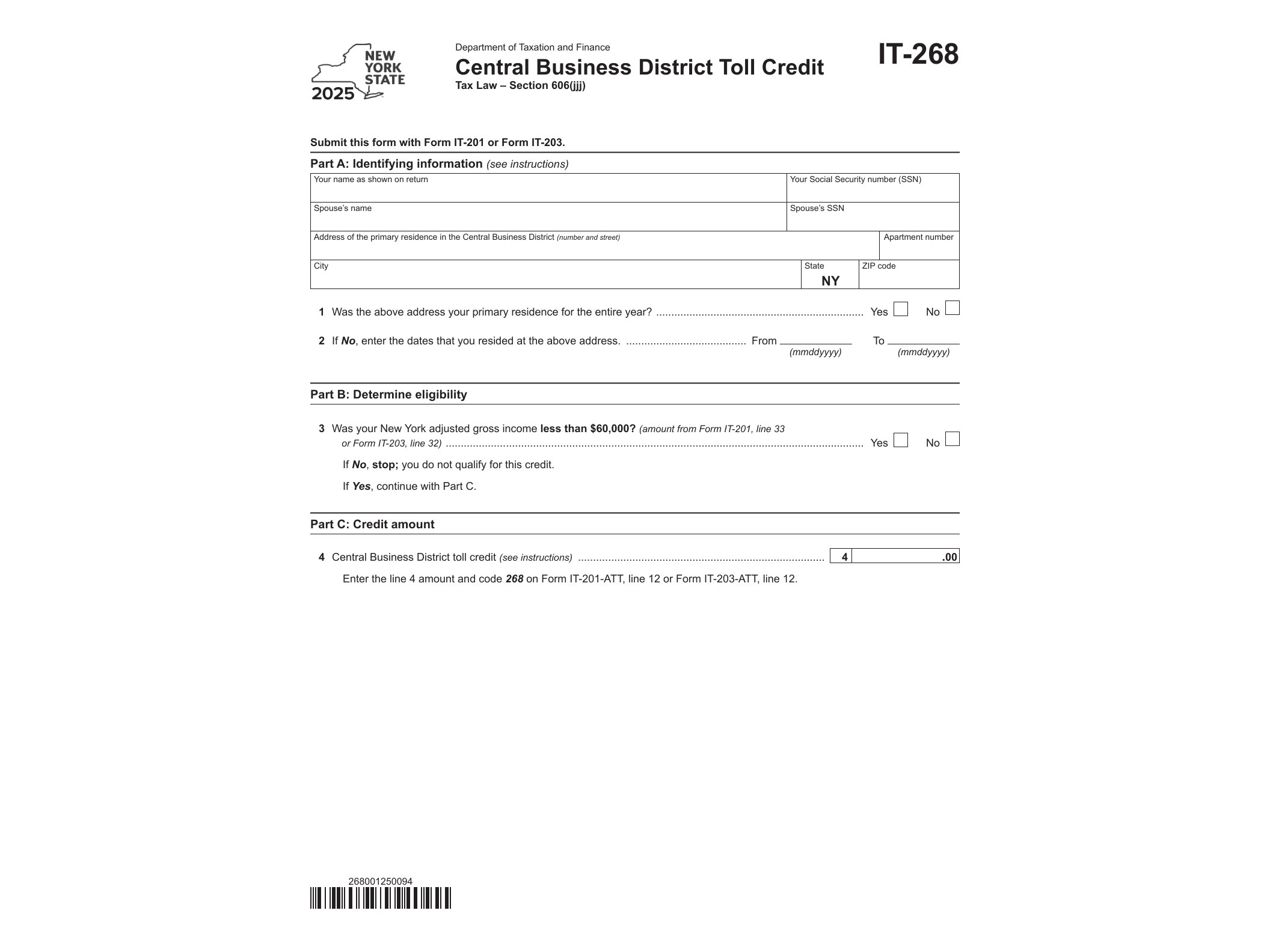
Form IT-268 is a New York State tax credit form tied directly to the Manhattan congestion pricing program. Officially titled the Central Business District Toll Credit, it lets certain taxpayers who pay tolls under the MTA’s Central Business District Tolling Program offset a portion of that cost against their New York State personal income tax. The New York State Department of Taxation and Finance issues this form specifically for tax year 2025, the first full year the toll credit becomes broadly relevant to filers.
The credit exists because tolls collected from vehicles entering Manhattan’s Central Business District (generally at or below 60th Street) can add up quickly for people who drive into that zone regularly for work or business. Rather than leaving that cost entirely unaddressed at tax time, the state built in a mechanism so qualifying drivers can recover a portion of what they paid, provided they meet the residency and usage requirements spelled out in the instructions.
Who needs Form IT-268
This form is meant for individual taxpayers, not corporations or partnerships, who paid CBD tolls during the tax year and meet New York’s eligibility rules. Typically that means full-year or part-year New York State residents who drove a vehicle registered to them into the tolling zone and paid the associated congestion charges. If you never entered the Central Business District, or you only used public transit, this form has no relevance to your return.
It’s also worth noting that the credit is nonrefundable in most configurations, meaning it can reduce your tax liability but won’t generate a refund beyond what you owe. Anyone claiming it should keep toll payment records, E-ZPass statements, or MTA billing summaries handy since the state can request documentation to substantiate the claimed amount.
When you use it
Form IT-268 gets filed alongside your New York State personal income tax return for tax year 2025, meaning it will typically be submitted in early 2026 when the annual filing season opens. You attach it to your IT-201 or IT-203, depending on whether you’re a full-year or part-year/nonresident filer. There’s no standalone filing deadline separate from your regular income tax return, so it follows the same due date, usually April 15, unless the state grants an extension.
Taxpayers who also deal with other New York-specific credits or business filings, such as those working through Form IT-2659 for estimated tax penalties, should treat IT-268 as a separate calculation that doesn’t interact with penalty computations. It’s strictly a credit against tax owed, not a payment or penalty form.
How to get and complete the form
The New York State Department of Taxation and Finance publishes Form IT-268 as a fillable PDF, which means you can type your information directly into the form on your computer before printing or attaching it electronically through approved tax software. The official version is hosted on the state’s own tax.ny.gov site, and using that source ensures you’re working with the correct year’s form and instructions rather than an outdated copy circulating elsewhere.
Filling it out generally requires entering your total qualifying toll payments for the year, confirming your residency status, and carrying the calculated credit amount to the appropriate line on your main income tax return. The instructions that accompany the form walk through how to calculate the credit percentage and what documentation to retain in case of an audit.
If you’re used to filing multi-state returns or handling separate state-specific credits, this form will feel familiar in structure, similar to how California’s Form 109 or extension forms like Form 3537 require attaching a supplemental schedule to a main return. The key difference is that IT-268 addresses a very specific, geographically limited toll program rather than a general business or extension filing.
Because congestion pricing rules and toll rates can shift from year to year as the MTA program evolves, it’s worth checking the instructions each filing season rather than assuming the prior year’s rules still apply. Even small changes in toll zone boundaries or rate structures can affect how much credit a taxpayer is eligible to claim.
Download Official Form IT268 (PDF)
Opens the official government PDF in a new tab