
Download Official Form IT2659 (PDF)
Opens the official government PDF in a new tab
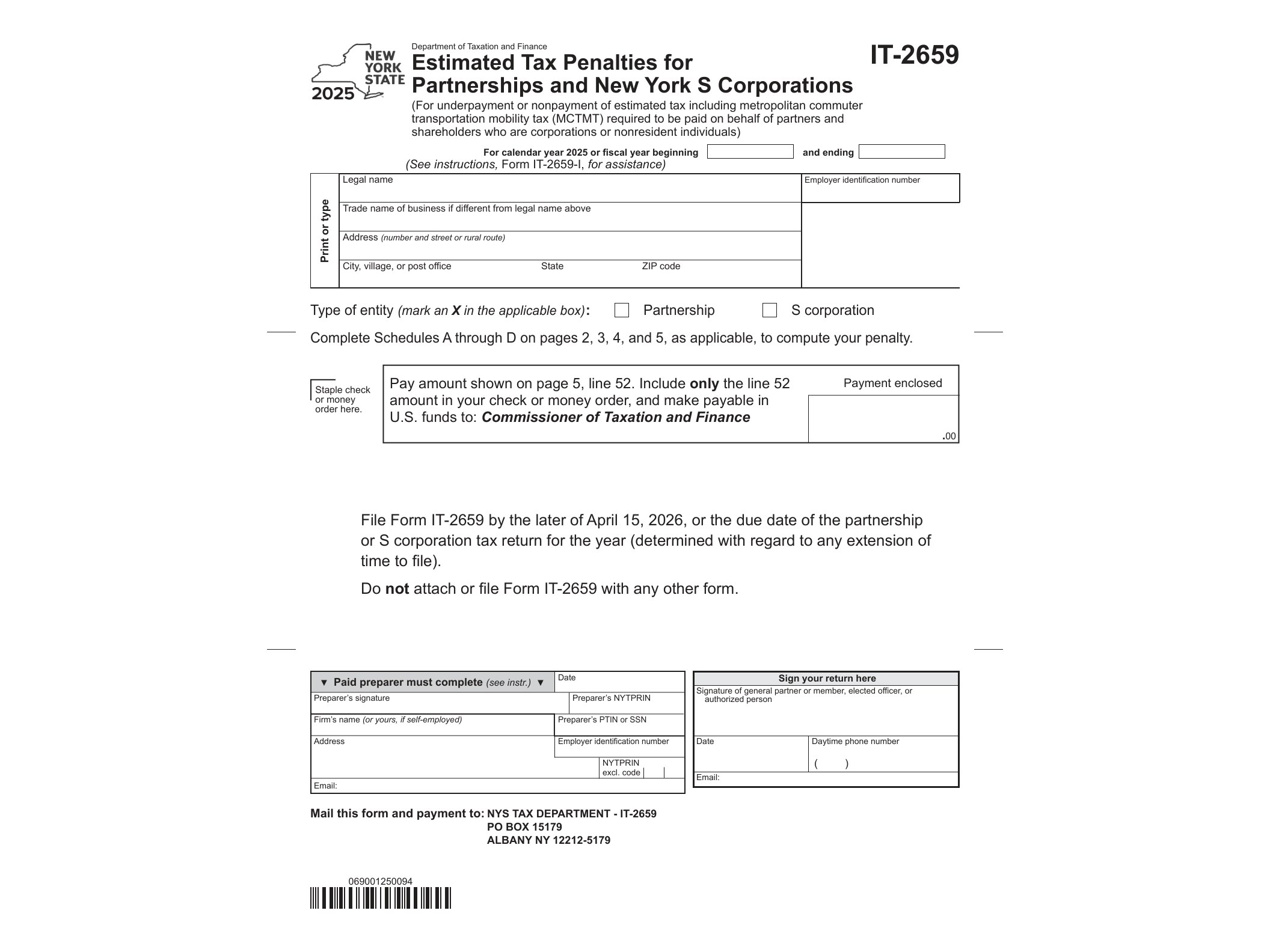
Form IT-2659 is used by partnerships and New York S corporations to calculate and report penalties for underpaying estimated tax on behalf of their nonresident partners or shareholders. The New York State Department of Taxation and Finance requires entities that make estimated tax payments under Article 22 to use this form when those payments fall short of what was actually owed during the tax year.
If your partnership or S corporation withheld or remitted estimated tax for nonresident partners and shareholders throughout 2025, and the total payments made didn’t meet the required installment amounts, this is the form that determines what penalty applies. It essentially works as a reconciliation tool between what should have been paid quarterly and what actually got paid.
Who Needs to File Form IT-2659
This form applies specifically to partnerships and New York S corporations that are required to make estimated tax payments on behalf of nonresident partners or shareholders under Tax Law Article 22. If your entity has nonresident owners who don’t qualify for an exemption, you’re generally on the hook for these estimated payments — and if those payments were late or insufficient, IT-2659 is how you calculate the resulting penalty.
Not every nonresident partner or shareholder triggers this obligation, though. Some individuals qualify for an exemption from these estimated tax requirements entirely. If any of your partners or shareholders have filed Form IT-2658-E, their exemption certificate removes them from the estimated tax calculation, which directly affects the numbers you’ll need when completing IT-2659.
When This Form Comes Into Play
Form IT-2659 isn’t something you file proactively every quarter. It comes into use after the fact, when it’s clear that estimated payments made during the year didn’t cover the required amounts on time. New York calculates penalties based on the difference between what should have been paid at each installment period and what was actually remitted, plus the number of days the underpayment existed.
Partnerships and S corporations typically need this form when preparing their annual filings, particularly if there were irregular cash flows, late enrollment of new nonresident partners, or miscalculations in earlier estimated payments. The form walks through each required installment date and asks you to compare the required payment against what was actually paid, then applies the appropriate interest rate to any shortfall.
How to Complete and Submit It
The form is broken into sections corresponding to each estimated tax installment period for the tax year. For each period, you’ll enter the required installment amount, the payment actually made, and the date of that payment. The form then calculates the underpayment amount and the number of days it remained outstanding, applying New York’s prescribed interest rate to determine the penalty owed.
Because this is an AcroForm, it can be filled out digitally using standard PDF software before printing or submitting alongside your other New York partnership or S corporation tax documents. Make sure the entity’s identification information matches exactly what’s on file with the Department of Taxation and Finance, since mismatches are one of the most common reasons these calculations get flagged for review.
Entities that also have multistate obligations should be careful not to confuse New York’s estimated tax penalty rules with those in other states. For comparison, businesses operating in California face a separate set of extension and payment rules, such as those outlined for California LLCs filing Form 3537, or partnerships reporting income through California Form 565. Each state calculates penalties and due dates differently, so relying on New York’s IT-2659 methodology for another state’s filing would produce inaccurate results.
Keeping accurate records of each estimated payment date throughout the year makes completing IT-2659 far less painful when tax season arrives. Entities that track their nonresident partner and shareholder obligations closely, including exemption certificates on file, tend to have a much smoother time reconciling any shortfalls.
Download Official Form IT2659 (PDF)
Opens the official government PDF in a new tab