
Download Official Form IT2658 (PDF)
Opens the official government PDF in a new tab
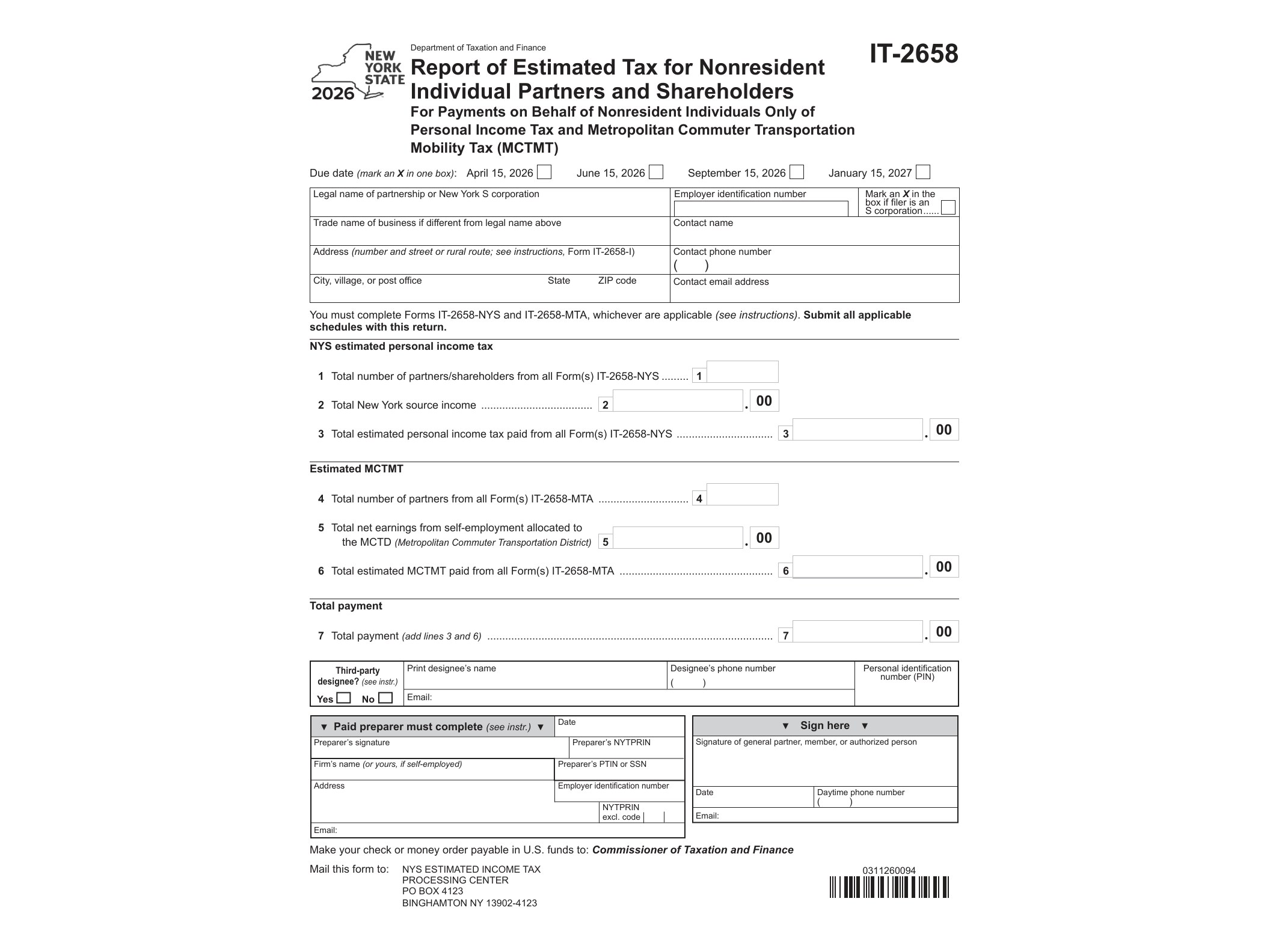
Form IT-2658, Report of Estimated Tax for Nonresident Individual Partners and Shareholders, is how partnerships and New York S corporations pay estimated personal income tax on behalf of their nonresident individual partners, members, or shareholders. Issued by the New York State Department of Taxation and Finance, this version applies to tax year 2026 and reflects the current filing requirements for entities with nonresident owners who have New York source income.
The idea behind this form is straightforward. When a partnership or S corporation has income sourced to New York, nonresident individual partners or shareholders owe New York tax on their share of that income, even if they never set foot in the state. Rather than waiting for each individual to file and pay on their own, the entity itself is required to estimate and remit tax quarterly using Form IT-2658. This keeps the state from losing track of tax owed by out-of-state owners and shifts the compliance burden to the business entity, which usually has better visibility into the income allocation.
Who Needs to File Form IT-2658
Any partnership or New York S corporation with one or more nonresident individual partners or shareholders who have New York source income allocated to them generally must file this form. This includes standard partnerships, limited liability companies treated as partnerships for tax purposes, and S corporations doing business in New York. The requirement applies regardless of whether the nonresident partner actually owes tax at the end of the year — the entity is making estimated payments on the partner’s behalf, and any overpayment gets reconciled when the individual files their own New York nonresident return.
There are exceptions. A nonresident partner or shareholder can be excluded from these estimated payments if they file Form IT-2658-E, certifying that they will file their own New York return and pay any tax due directly. Entities should keep this exemption certificate on file rather than submit it with the return, since the Tax Department may request it later.
Entities that also owe the Metropolitan Commuter Transportation Mobility Tax for partners working within the MCTMT district need to pair this filing with Form IT-2658-MTA, which calculates the additional MCTMT estimated tax owed for nonresident partners working in the metropolitan commuter transportation district. The two forms work together and are typically filed on the same schedule.
When Estimated Payments Are Due
Form IT-2658 follows a quarterly payment schedule similar to individual estimated tax vouchers, with due dates in April, June, September, and January. Entities calculate each nonresident partner’s or shareholder’s share of estimated tax based on projected New York source income for the year and submit payment with the corresponding voucher. Underpayment can trigger penalties, so entities with fluctuating income across partners often recalculate their estimates each quarter rather than relying on a flat projection from January.
How to Get and Complete the Form
The 2026 version of Form IT-2658 is a fillable PDF (AcroForm) available directly from the New York State Department of Taxation and Finance website. Because it’s a digital form, entities can type in partner information, income allocations, and payment amounts directly into the PDF fields before printing or submitting according to the department’s current filing instructions.
Completing it accurately requires having each nonresident partner’s or shareholder’s allocated New York source income figured out ahead of time, along with their identifying information and ownership percentage. Entities managing several nonresident owners with different income levels sometimes need to file supplemental documentation similar to how due diligence forms work in other states — for comparison, California’s Form 3596 due diligence checklist shows how states use structured verification for tax credits, though the New York requirement here is about estimated payment accuracy rather than credit eligibility.
Nonresident partners who end up overpaying through these quarterly filings, or who paid tax in a prior year on income later found to be improperly taxed, may want to look into New York’s Claim of Right Credit under Form IT-257 when reconciling their personal return, since it addresses situations where income was taxed in a year it shouldn’t have been.
Download Official Form IT2658 (PDF)
Opens the official government PDF in a new tab