
Download Official Form IT2658MTA (PDF)
Opens the official government PDF in a new tab
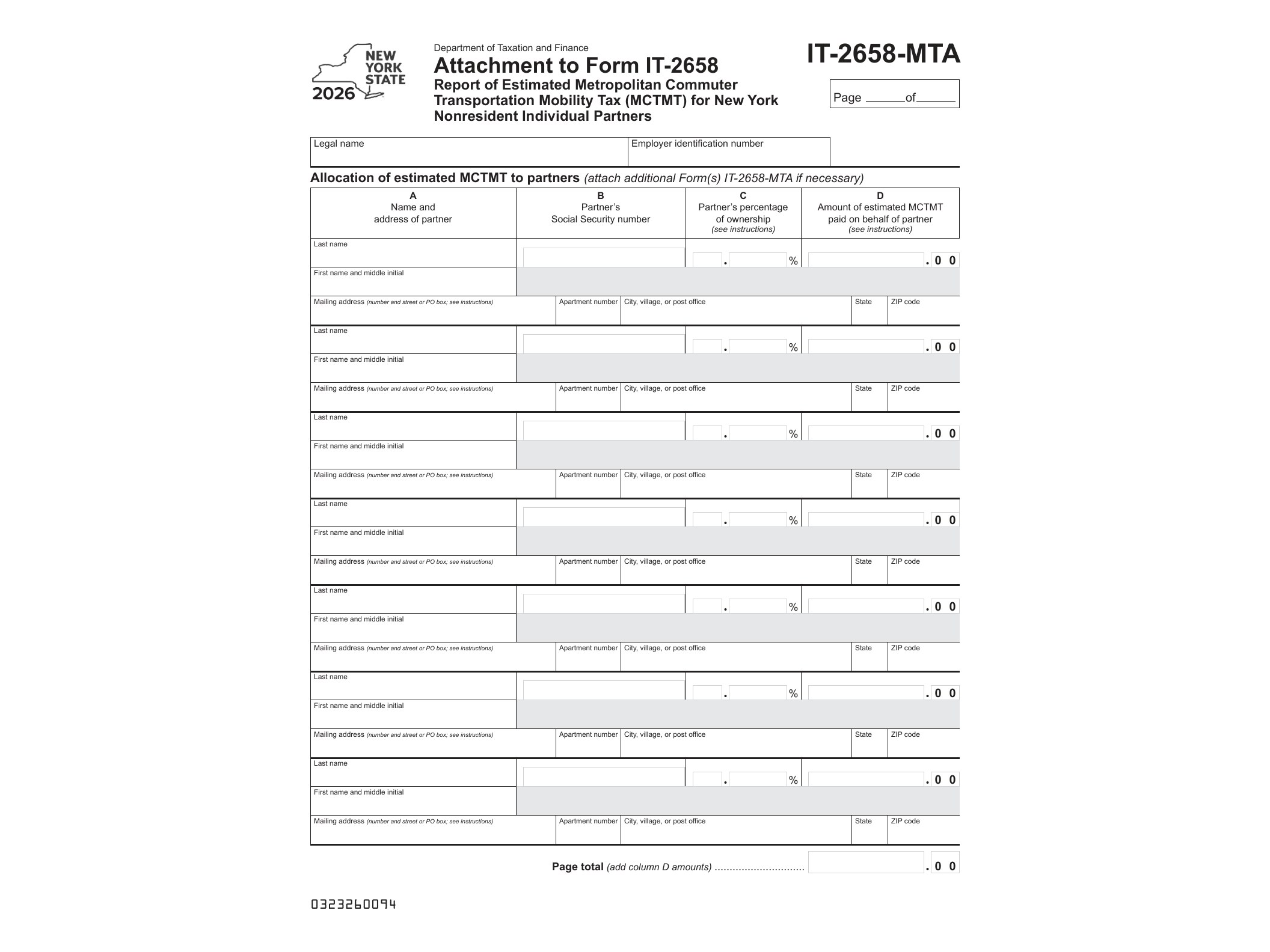
Form IT-2658-MTA is a supplemental attachment that certain partnerships in New York use alongside Form IT-2658 to report and pay estimated Metropolitan Commuter Transportation Mobility Tax (MCTMT) on behalf of their nonresident individual partners. It’s issued by the New York State Department of Taxation and Finance and applies specifically to partners who work or earn income within the Metropolitan Commuter Transportation District (MCTD), which covers New York City and several surrounding counties.
The MCTMT itself is a payroll-style tax tied to self-employment and partnership earnings generated within the MCTD. When a partnership has nonresident partners earning income sourced to that district, the partnership is generally responsible for making estimated tax payments on those partners’ behalf. Form IT-2658 handles the base estimated tax filing, and Form IT-2658-MTA exists to break out and calculate the mobility tax portion separately, since MCTMT has its own rate structure and thresholds distinct from regular personal income tax.
Any partnership with nonresident partners who have net earnings from self-employment attributable to the MCTD needs to determine whether this attachment applies. If the partnership is already filing Form IT-2658 for standard estimated income tax withholding on nonresident partners, and any of those partners meet the MCTMT income threshold, the MTA attachment becomes a required part of the filing package for tax year 2026. It’s not a standalone form — it only makes sense in the context of the main IT-2658 estimated tax return, since it pulls figures from that filing to compute the mobility tax liability per partner.
Timing follows the same quarterly estimated tax schedule as the primary form. Partnerships calculate each nonresident partner’s share of MCTMT liability and remit payments across the year rather than waiting until the annual return. This matters because underpayment penalties can apply if the estimated payments fall short of what’s ultimately owed, similar to how underpayment penalties work with other New York estimated tax obligations. Partnerships that added new nonresident partners mid-year, or that saw a jump in MCTD-sourced earnings, should recalculate their estimates rather than relying on prior-year figures.
Filling out the form requires basic identifying information about the partnership and a partner-by-partner breakdown of MCTD net earnings, the applicable MCTMT rate, and the resulting estimated tax due. Because it’s an AcroForm-enabled PDF, you can type directly into the fields on a computer before printing or saving, which cuts down on transcription errors compared to handwriting figures on a paper copy. Double-check partner allocation percentages against the partnership agreement or K-1 estimates, since misallocated income is one of the more common reasons these filings get flagged for correction.
Partnerships that also handle other New York credit or compliance forms for their partners might find it useful to compare how documentation requirements work elsewhere in the state’s tax system. For example, individuals claiming a Claim of Right Credit on Form IT-257 go through a similarly specific calculation tied to prior-year repayments, and those filing for a Nursing Home Assessment Credit on Form IT-258 deal with their own set of supporting documentation rules. Reviewing how these adjacent forms are structured can help partnership preparers get a feel for how New York expects backup calculations to be presented.
Once completed, Form IT-2658-MTA should be submitted together with Form IT-2658 by the applicable quarterly due date. Keep a copy with the partnership’s estimated tax records, since partners will need consistent figures when they later reconcile their own individual New York nonresident returns. If the partnership’s income sourcing changes significantly during 2026, revisit the estimate calculations promptly rather than waiting for the next quarterly deadline to avoid a larger balance due at year-end.
Download Official Form IT2658MTA (PDF)
Opens the official government PDF in a new tab