
Download Official Form DTF281 (PDF)
Opens the official government PDF in a new tab
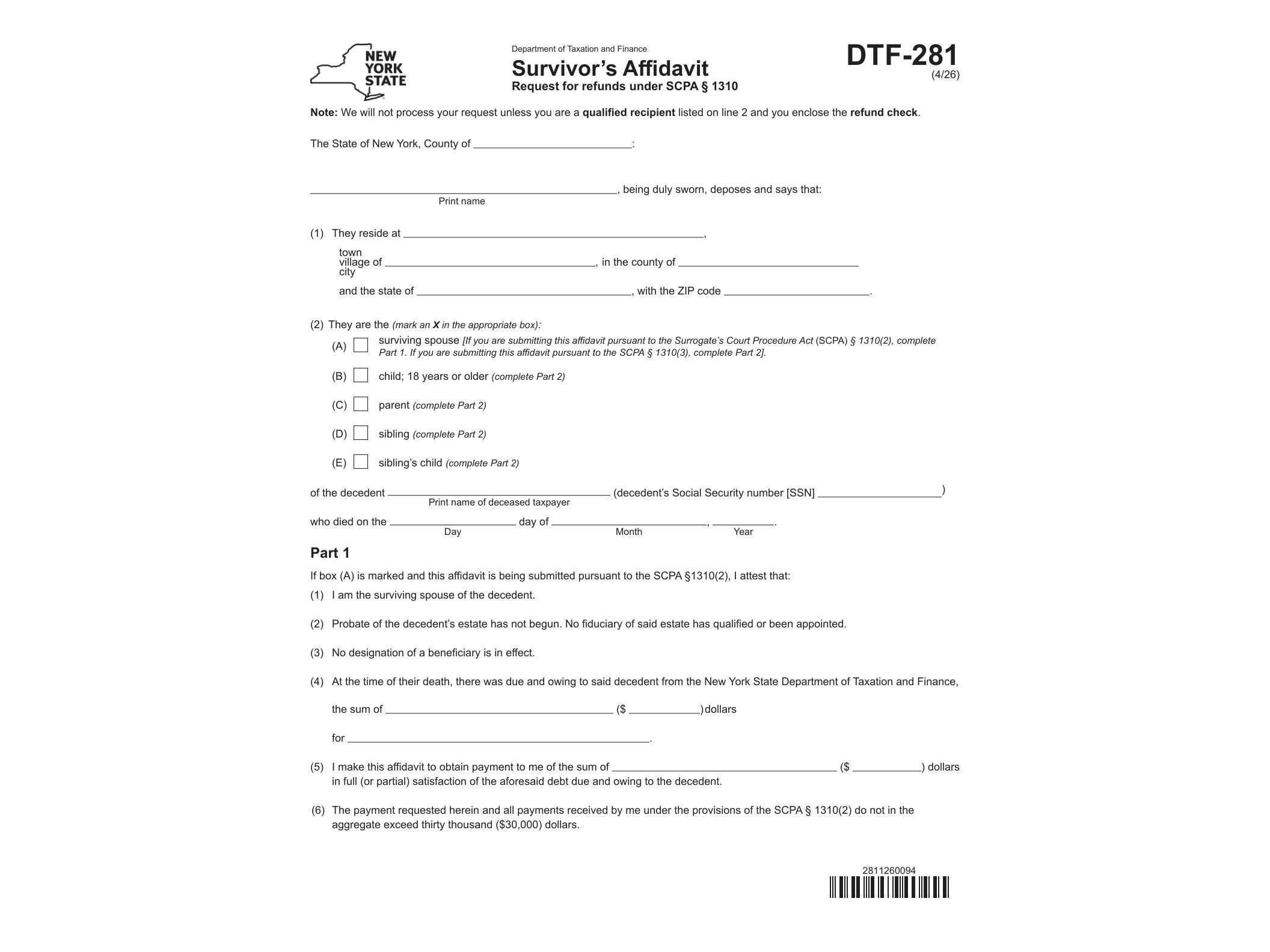
When someone in New York passes away and the state owes them a tax refund, that money doesn’t just disappear — but it also can’t be released to just anyone who asks for it. Form DTF-281, Survivor’s Affidavit Request for Refunds Under SCPA 1310, is the document the New York State Department of Taxation and Finance uses to verify who is legally entitled to claim a deceased taxpayer’s refund without requiring a full estate proceeding in Surrogate’s Court.
SCPA 1310 refers to a specific section of New York’s Surrogate’s Court Procedure Act that allows certain small sums owed to a decedent to be collected by a qualifying survivor or family member, bypassing the more time-consuming and costly process of opening a formal estate administration or probate case. Instead of hiring an attorney and going through the courts, an eligible person can sign this affidavit and submit it directly to the Tax Department to request the refund be released to them.
Who Needs This Form
Form DTF-281 is meant for surviving spouses, children, or other close relatives (or, in some cases, a person who paid funeral expenses) who are trying to collect a tax refund that was owed to someone who has since died. This typically comes up when a taxpayer filed a personal income tax return, was due a refund, and passed away before the check was issued or cashed. Rather than leaving the refund in limbo, the survivor can complete this affidavit to claim it directly.
It’s worth noting this form is specifically tied to small estate refunds falling under the dollar thresholds set by SCPA 1310. If the estate is larger or more complex, or if there’s a dispute among heirs, the Tax Department may require formal letters testamentary or letters of administration from Surrogate’s Court instead of accepting the affidavit alone.
When It’s Used
The most common scenario is a decedent who filed a New York State income tax return (or was owed a refund from an amended return) and died before the refund was processed or deposited. Family members handling the decedent’s affairs discover the outstanding refund and need a way to collect it without opening a full estate case, especially when the amount doesn’t justify the expense of probate.
The Tax Department reviews the affidavit along with supporting documentation — typically a copy of the death certificate and proof of the affiant’s relationship to the decedent — before releasing the refund. If there are multiple potential claimants, the department may require additional consents or documentation to avoid disputes over who should receive the money.
How to Get and Complete the Form
Form DTF-281 is only available as a fillable-by-hand PDF — there’s no digital fill-in version, so you’ll need to print it out and complete it manually with a pen. Once printed, fill in the decedent’s information, the refund details, your relationship to the decedent, and sign the affidavit, ideally in the presence of a notary if the form requires notarization for your specific situation. Attach the required supporting documents, such as a certified copy of the death certificate, before mailing it to the address listed in the form’s instructions.
Because this affidavit deals with tax refunds and legal claims to a decedent’s assets, it’s a good idea to double-check that you’re using the current version of the form and that all fields are filled out completely before submitting. Missing information is one of the most common reasons these requests get delayed or sent back.
If you’re dealing with other New York tax forms tied to specialized situations — for example, wagering or pari-mutuel activity — you might also find it useful to review guides like the Form AU-212 pari-mutuel betting tax return explainer or the Form AU-215 uncashed pari-mutuel tickets guide, both of which cover other niche New York tax filings. And if your situation involves business tax credits rather than personal estate matters, the instructions for Form IT-668 walk through a completely different but equally specific corner of New York tax law.
Download Official Form DTF281 (PDF)
Opens the official government PDF in a new tab