
Download Official Form AU215 (PDF)
Opens the official government PDF in a new tab
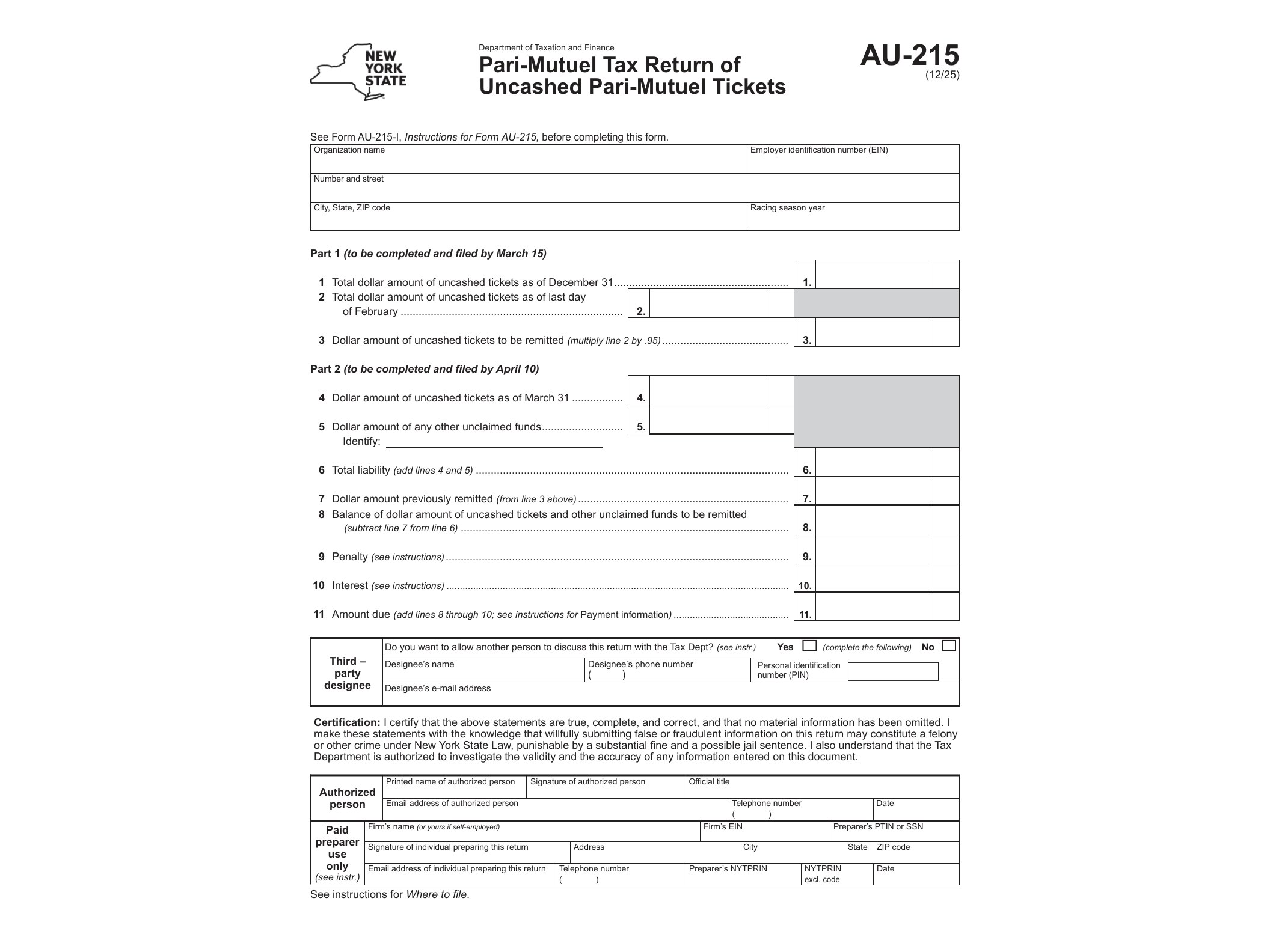
Form AU-215, officially titled “Pari-Mutuel Tax Return of Uncashed Pari-Mutuel Tickets,” is a specialized tax form issued by the New York State Department of Taxation and Finance. It’s used by racetracks, off-track betting corporations, and other licensed pari-mutuel wagering operators to report and remit tax on winning tickets that bettors never redeemed. This isn’t a form most individual taxpayers will ever encounter, but if you’re involved in operating or managing a licensed betting facility in New York, it’s a routine part of your compliance calendar.
When someone places a winning bet at a racetrack or through an authorized OTB operation and never cashes the ticket, that money doesn’t just disappear into the operator’s general revenue. New York State law treats unclaimed pari-mutuel winnings as subject to a specific excise tax, and Form AU-215 is the mechanism operators use to calculate and pay that liability to the state. The form essentially reconciles how much was wagered, how much was won but never claimed, and how much tax is owed on those uncashed amounts.
Who Needs to File Form AU-215
The filing obligation falls on entities licensed to conduct pari-mutuel wagering in New York, including thoroughbred and harness racetracks, simulcast facilities, and off-track betting corporations. If your organization holds winning tickets that bettors failed to redeem within the statutory period, you’re required to report those amounts using this form and pay the corresponding tax. Track operators typically have internal accounting or compliance staff responsible for preparing this return as part of their regular tax filing routine alongside other state and local gaming tax obligations.
When Is It Used
Form AU-215 is tied to the reporting periods established for pari-mutuel tax purposes, generally following the racing or wagering calendar rather than the standard income tax year. Operators typically prepare this return periodically throughout the year as unredeemed ticket amounts accumulate and reach the point where they must be reported and taxed under state pari-mutuel law. Because the underlying revenue stream (unclaimed winnings) is directly tied to wagering activity, the filing schedule often aligns with racing seasons and specific meet dates rather than a single annual deadline.
How to Complete and Submit the Form
This is a paper-only form. The New York State Department of Taxation and Finance has not made Form AU-215 available as a fillable digital document, which means you’ll need to download the PDF, print it, and complete it by hand using black or blue ink. Make sure your entries are legible, since illegible handwriting is one of the more common reasons state tax forms get kicked back for correction or clarification.
The form itself asks for identifying information about the licensed operator, the applicable reporting period, and a breakdown of uncashed ticket amounts subject to tax. You’ll need accurate internal records showing which winning tickets went unredeemed during the period in question, since the tax calculation depends entirely on those figures. Double-check your math before submitting, and keep a copy of the completed form along with your supporting documentation in case the department requests verification later.
Once completed, the form gets mailed to the address specified in the instructions accompanying the PDF, since New York does not currently offer electronic filing for this particular pari-mutuel tax return. If you’re unsure about your specific filing frequency or the tax rate that applies to your operation, contacting the Department of Taxation and Finance directly or consulting with a tax professional familiar with New York gaming law is a reasonable step before you file.
For businesses dealing with other New York State tax credits and specialized filings, it’s worth browsing related guidance such as the Form IT-668 instructions for the Semiconductor Research and Development Credit or the Form IT-663 instructions for the Commercial Security Credit, both of which illustrate how New York structures industry-specific tax filings beyond standard income tax returns. Businesses juggling multiple specialized credits, like the one described in the Form IT-669 instructions for the Semiconductor Manufacturing Workforce Training Program Credit, know how important it is to keep track of form-specific deadlines and documentation requirements, and the same discipline applies to pari-mutuel tax reporting under Form AU-215.
Download Official Form AU215 (PDF)
Opens the official government PDF in a new tab