
Download Official Form ST126 (PDF)
Opens the official government PDF in a new tab
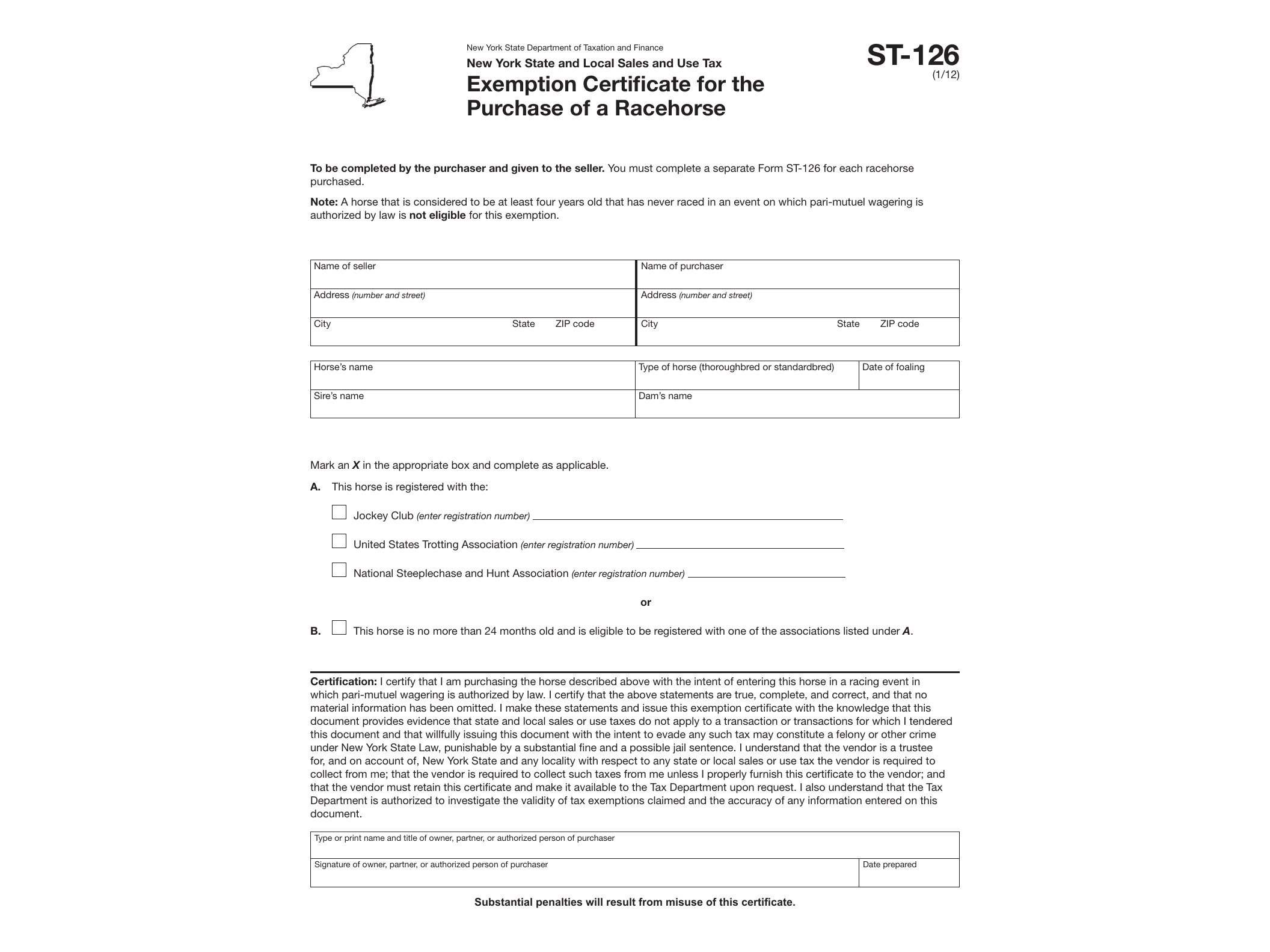
Form ST-126, issued by the New York State Department of Taxation and Finance, is the exemption certificate buyers use when purchasing a racehorse without paying state and local sales tax. New York law allows certain racehorse purchases to skip the sales tax that would normally apply to the transaction, but only when the buyer and seller document the sale correctly with this certificate at the time of purchase.
This form matters to anyone involved in the horse racing industry who is buying a racehorse intended for racing purposes rather than general ownership. If you’re a trainer, owner, breeder, or racing stable acquiring a horse that will compete, Form ST-126 is what lets the seller know not to charge sales tax on the sale. Without it, the seller is generally required to collect tax on the full purchase price, and the buyer would have no straightforward way to recover that cost afterward.
Who Needs to Use This Form
The exemption applies specifically to racehorses, meaning horses that are being purchased to be raced competitively, not pleasure horses, breeding stock unrelated to racing, or horses bought for other purposes. The buyer completes the certificate and gives it directly to the seller at the point of sale. The seller then keeps the completed form on file as proof that the transaction qualified for the exemption, in case the Department of Taxation and Finance ever asks for documentation during an audit.
It’s the buyer’s responsibility to make sure the information on the certificate is accurate and that the horse genuinely qualifies under the exemption rules. Sellers are not expected to investigate the claim beyond accepting a properly completed certificate in good faith, but if the exemption turns out to be invalid, the tax liability can shift back to the buyer.
When the Certificate Should Be Used
Form ST-126 should be completed and handed over at the time of the sale, not after the fact. If a buyer pays sales tax on a racehorse purchase without providing the certificate first, getting a refund later becomes a more complicated process involving direct communication with the state rather than a simple point-of-sale exemption. For that reason, anyone planning to buy a racehorse under this exemption should have the form ready before finalizing the transaction with the seller.
How to Fill Out and Submit the Form
Form ST-126 does not have fillable digital fields, so it needs to be printed and completed by hand. The certificate asks for basic identifying information: the buyer’s name and address, the seller’s name and address, a description of the racehorse being purchased, and a signed certification that the horse is being bought for racing purposes and qualifies for the exemption under New York tax law.
Once completed, the buyer gives the signed original to the seller rather than mailing it to the Department of Taxation and Finance. The seller retains the certificate as part of their sales records. Both parties should keep a copy for their own files, since tax records related to a sale like this may need to be produced years later if the transaction is reviewed.
Because the form must be printed and signed manually, it’s worth downloading a fresh copy directly from the Department of Taxation and Finance rather than relying on an old version, since exemption certificates are occasionally updated with revised instructions or formatting. Always check that the date on the form matches the most current revision before using it in a transaction.
If you work in an industry that deals with other New York tax exemption or refund forms, you may also find it useful to look at related certificates like the Application for Refund of Sales Tax Paid on Petroleum Products or the Refund of Prepaid Sales Tax on Highway Diesel Motor Fuel, both of which follow a similar logic of documenting a transaction upfront to avoid or recover sales tax. Businesses that regularly file state tax paperwork, such as those required to submit the Quarterly Inventory Report for Retail Service Stations and Fixed Base Operators, know that keeping organized records of every exemption or refund claim makes future filings and audits far less stressful.
Form ST-126 is a short, single-purpose document, but getting it right at the time of sale saves both buyer and seller from having to untangle a tax dispute later. Since it must be filled out by hand and exchanged directly between the parties, print a clean copy, double-check every field against the horse’s actual sale details, and keep your copy filed away with your other purchase records.
Download Official Form ST126 (PDF)
Opens the official government PDF in a new tab