
Download Official Form ST101 (PDF)
Opens the official government PDF in a new tab
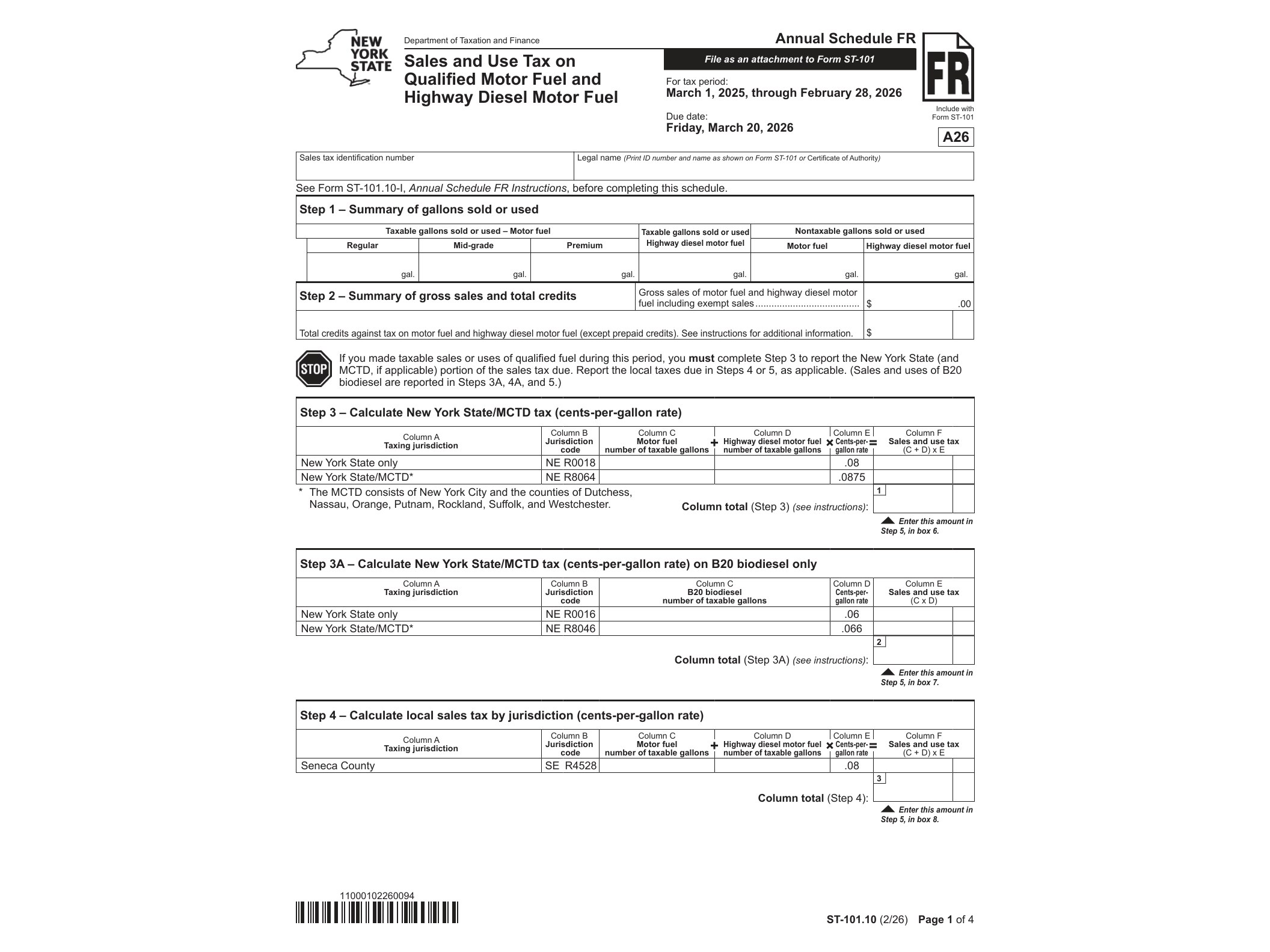
Form ST-101.10 is a schedule used by the New York State Department of Taxation and Finance to report sales and use tax collected on qualified motor fuel and highway diesel motor fuel. It isn’t a standalone filing — it’s attached to Form ST-101, the annual sales tax return, and is used specifically by businesses that sell these types of fuel at retail during the course of their regular sales tax reporting period.
If your business sells gasoline, diesel, or other fuel products that fall under New York’s definitions of “qualified motor fuel” or “highway diesel motor fuel,” the state wants a separate breakdown of those sales rather than having them lumped in with your general merchandise totals. That’s exactly what this schedule does: it isolates fuel-related sales tax so the Tax Department can track fuel tax revenue accurately and verify that the correct rates were applied.
Who Needs to File This Form
This form applies to annual sales tax filers in New York who are registered vendors selling qualified motor fuel or highway diesel motor fuel. That typically includes gas stations, fuel distributors, and fixed base operators who sell directly to consumers or businesses. If your sales tax filing frequency is annual rather than quarterly or monthly, you’ll use the ST-101 series of forms, and ST-101.10 is the specific attachment covering fuel sales.
Businesses that deal heavily in fuel inventory often have overlapping reporting obligations. For example, retail service stations and fixed base operators are also required to track their fuel stock separately using Form FT-943, the Quarterly Inventory Report, which documents how much fuel moved in and out of your tanks each quarter. While FT-943 tracks inventory, ST-101.10 tracks the sales tax collected on what you actually sold, so the two forms serve different but related purposes for fuel sellers.
When This Form Is Used
Form ST-101.10 is filed once a year, alongside your annual ST-101 sales tax return, covering the full 12-month reporting period ending February 28 (as reflected in this version revised for 2/26). You don’t file it separately or on a different schedule — it goes in with your main annual return package. If you didn’t sell any qualified motor fuel or highway diesel motor fuel during the year, you generally won’t need to include this schedule at all.
Keep in mind that fuel-related tax forms in New York often intersect with each other. If your business ever prepaid sales tax on highway diesel motor fuel and later needs to recover some of that amount — say, because the fuel was resold or used in a way that qualifies for a refund — you’d look into Form FT-1007, which handles refund requests for prepaid sales tax on that fuel category. ST-101.10 and FT-1007 aren’t the same filing, but businesses that deal in diesel fuel frequently end up using both over the course of a year.
How to Get and Complete the Form
Form ST-101.10 is only available as a fillable PDF that must be printed and completed by hand — there’s no digital entry option through the state’s online system for this particular schedule. You’ll need to download the PDF directly from the New York State Department of Taxation and Finance, print it, and fill in your gallon totals and tax amounts manually before attaching it to your annual ST-101 return.
When completing it, you’ll break down your total gallons sold and the applicable tax rates for qualified motor fuel versus highway diesel motor fuel separately, since each category can carry different rate structures depending on the period covered. Double-check your totals against your point-of-sale or inventory records before submitting, since errors on fuel tax schedules tend to trigger follow-up requests from the Tax Department more often than general merchandise errors do.
Businesses new to fuel retailing in New York sometimes confuse this schedule with exemption certificates used in specialty sales, such as the one required for purchasing a racehorse under Form ST-126. These are unrelated — ST-101.10 deals strictly with fuel tax reporting — but it’s a good reminder that New York’s sales tax system has many narrow, product-specific forms, and using the correct one for your industry avoids unnecessary processing delays.
Download Official Form ST101 (PDF)
Opens the official government PDF in a new tab