
Download Official Form 3500 (PDF)
Opens the official government PDF in a new tab
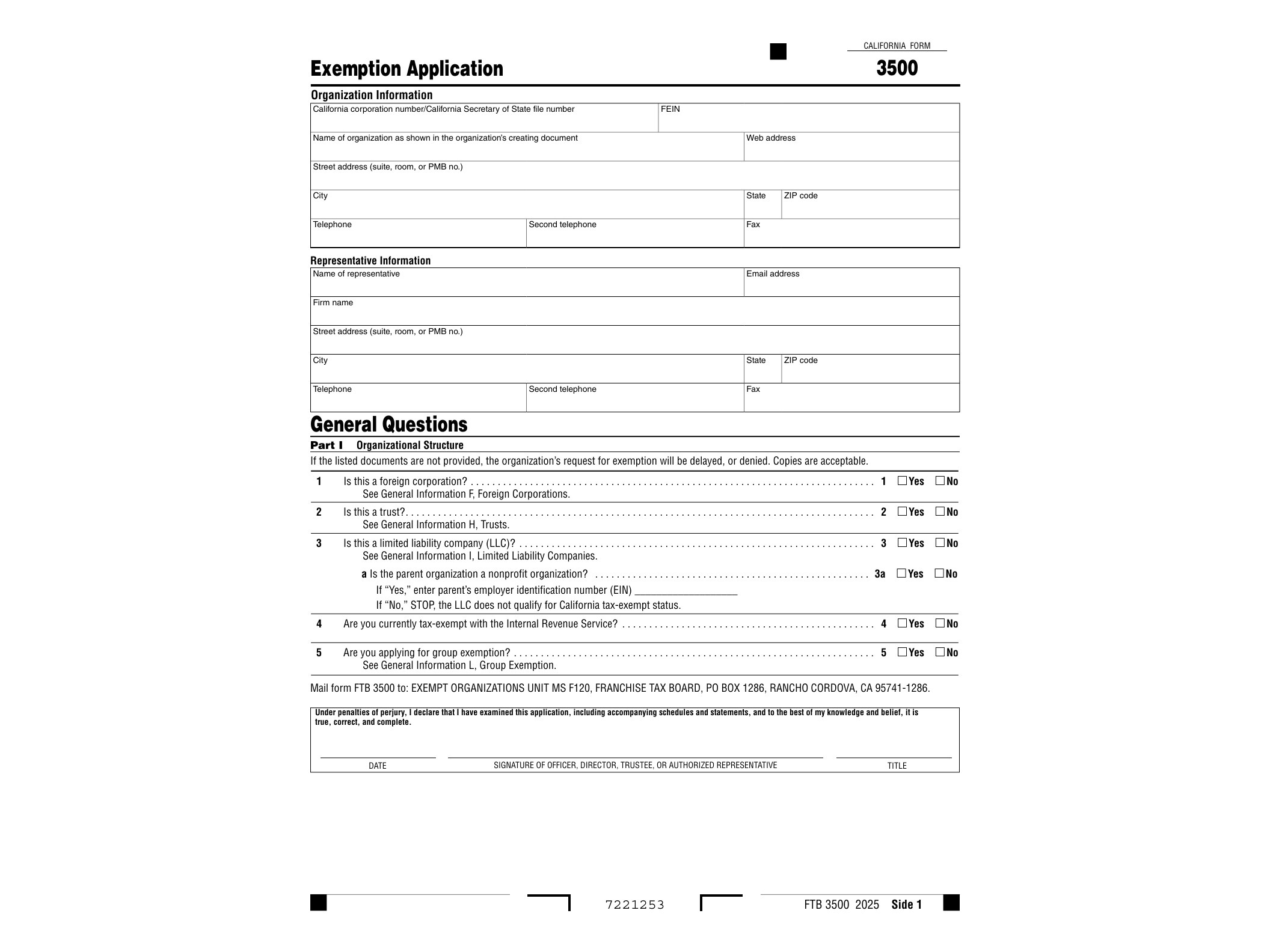
California Form 3500, Exemption Application, is the document nonprofit organizations file with the Franchise Tax Board to request recognition as tax-exempt under California law. Unlike the IRS process for federal tax exemption, California requires its own separate application before an organization can stop paying state corporate income tax or franchise tax on its qualifying activities.
This form is issued by the California Franchise Tax Board (FTB), not the IRS, so it’s specifically about state-level exemption. Getting federal 501(c)(3) status from the IRS does not automatically grant you exemption from California taxes — that requires this separate application, or in some cases the shorter Form 3500A.
Who Needs to File Form 3500
Form 3500 is meant for organizations that have never received California tax-exempt status and need to apply for it directly. This includes nonprofit corporations, unincorporated associations, and certain trusts organized for charitable, religious, educational, scientific, literary, or other qualifying purposes recognized under California Revenue and Taxation Code Section 23701.
Common filers include newly formed nonprofits, churches, charitable foundations, social clubs, labor organizations, and civic leagues seeking recognition under one of the various 23701 subsections (the California equivalent of the IRS’s 501(c) categories). If your organization was formed in California or does business in the state and wants relief from franchise or income tax, this is the form that starts that process.
It’s worth noting that organizations that already hold IRS federal tax-exempt determination letters may qualify for a faster path using Form 3500A instead. That shorter submission simply asks the FTB to recognize the exemption already granted federally, rather than going through the full application process required by Form 3500.
When to Use Form 3500
You should file Form 3500 when your organization has not yet obtained federal tax-exempt recognition from the IRS, or when you want California exemption under a category that doesn’t have a federal equivalent. It’s also used when an organization’s federal exemption was revoked or denied and it still wants to pursue state-level exempt status on its own merits.
There’s no strict annual deadline tied to a tax year for this form since it’s an application, not a periodic return. Organizations typically file it soon after formation, once articles of incorporation or organizing documents are finalized and the entity is ready to demonstrate it meets the requirements for exempt purposes.
What the Form Requires
Form 3500 asks for detailed information about the organization’s structure, governing documents, financial activities, and specific purpose. Expect to attach articles of incorporation or association bylaws, a narrative description of activities, financial statements or budgets, and information about officers and directors. The FTB uses this information to determine whether the organization genuinely operates for an exempt purpose and doesn’t benefit private individuals in ways that would disqualify it.
Because the form has fillable digital fields, applicants can complete it directly on a computer before printing or submitting, which helps avoid the handwriting legibility issues that used to complicate paper submissions. Take time filling in the organizational purpose and activity descriptions accurately, since incomplete or vague answers are a common reason applications get delayed with FTB follow-up requests.
How to Submit It
Once completed, Form 3500 and its required attachments go directly to the Franchise Tax Board, not the IRS. Processing times can vary depending on the complexity of the organization and whether the FTB needs additional documentation. Keep a copy of everything submitted, since you’ll likely need to reference these documents for future state filings once exempt status is granted.
Organizations dealing with multi-state tax questions may also want to check requirements elsewhere, similar to how nonresidents filing in New York rely on supplemental documents like Form IT-203-ATT or residents use Form IT-201-ATT to handle credits and additional taxes beyond the standard return. Each state sets its own separate exemption and credit procedures, and California’s Form 3500 process is a good example of how state requirements can diverge from federal ones even when the underlying nonprofit purpose is identical.
Download Official Form 3500 (PDF)
Opens the official government PDF in a new tab