
Download Official Form IT203A (PDF)
Opens the official government PDF in a new tab
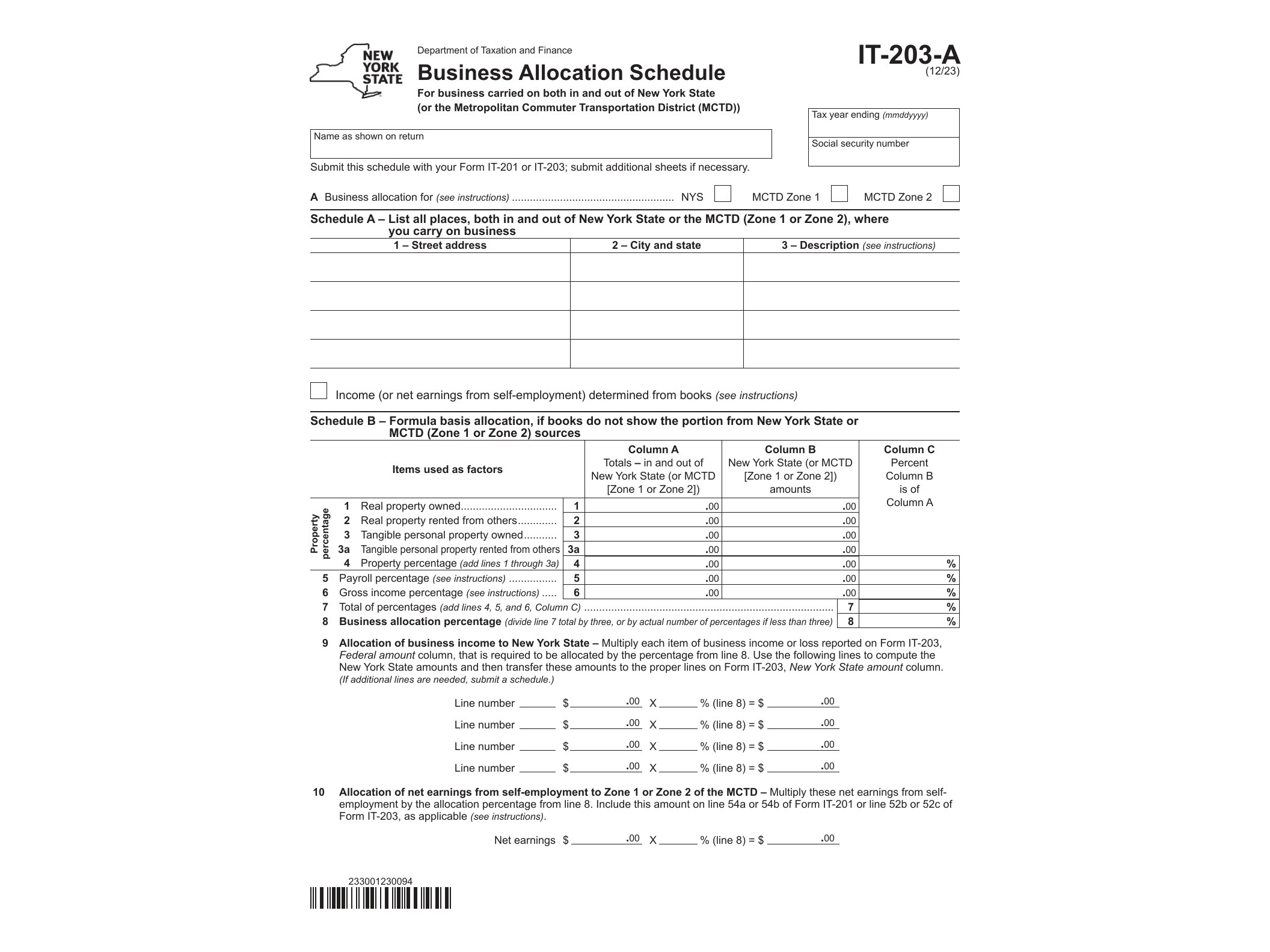
If you run a business, profession, or farm and only part of that activity happens in New York State, Form IT-203-A is the schedule that lets you separate your New York income from everything earned elsewhere. It’s filed alongside Form IT-203, the nonresident and part-year resident income tax return, and it exists specifically because New York can only tax the portion of your business income tied to activity carried on within the state.
Without this schedule, a nonresident who operates a business with locations or clients both inside and outside New York would have no clear method to show the state which slice of income actually belongs to them. Form IT-203-A provides that method through a set of allocation formulas based on business assets, payroll, and gross sales or receipts.
Who Needs to File Form IT-203-A
This form applies to nonresident or part-year resident individuals who are self-employed, own a business, work as independent contractors, or operate a farm, and whose business activity is not conducted entirely within New York State. Typical filers include:
- Sole proprietors with customers or operations in multiple states
- Independent contractors performing services partly in New York and partly elsewhere
- Partners in businesses that require individual-level allocation
- Farmers with land or operations that cross state lines
If your entire business is based and conducted in New York, you generally won’t need this allocation schedule, since all your business income is already New York-source income. The form becomes necessary the moment your business activity spans state borders.
When Is This Form Used
Form IT-203-A is used when you file your New York nonresident or part-year resident return and need to prove that only a fraction of your business income should be taxed by New York. The state relies on a three-factor allocation percentage, comparing your New York property, payroll, and gross sales against your total property, payroll, and gross sales everywhere. That percentage is then applied to your net business income to determine what portion New York can tax.
This is conceptually similar to how other states require businesses to document specific exemptions or allocations rather than assume a default tax treatment. Just as businesses dealing with California often need documentation like the one described in our overview of Form 100X for amended California corporate returns, New York requires its own precise paperwork before granting a reduced tax burden based on out-of-state activity.
How to Fill Out Form IT-203-A
The form is broken into sections covering business property, payroll, and gross sales, both within New York and everywhere. You’ll need:
- Records of business property value located in New York versus total business property value
- Payroll figures for employees working in New York compared to total payroll
- Gross sales or receipts generated from New York customers versus total gross sales
Each category produces a percentage, and the average of those percentages becomes your business allocation percentage. That figure is carried over to Form IT-203 to calculate the New York-source portion of your business income. Because the form has fillable digital fields, you can complete it directly on a computer before printing or attaching it electronically, which reduces transcription errors compared to handwriting entries.
Keep supporting documentation, like payroll records, lease agreements, or sales invoices, in case the New York Department of Taxation and Finance requests verification of your allocation figures. Accurate recordkeeping matters here just as much as it does when businesses claim exemptions using forms like Form CT-2658-E for corporate partners, where documentation determines whether an exemption holds up.
Getting the Current Version
The December 2023 revision is the version currently accepted by New York State. Using an outdated version could delay processing or require you to resubmit with the correct form. Since this is an AcroForm-enabled PDF, you can type your figures directly into the document, which also makes it easier to save a copy for your own records before submission.
If your allocation calculation later needs correction, or if you discover an error after filing, understanding how amended filings work elsewhere, such as the process outlined for reasonable cause claims for business entities, can give you a sense of what documentation tax authorities typically expect when you ask them to revisit a prior calculation.
Download Official Form IT203A (PDF)
Opens the official government PDF in a new tab