
Download Official Form IT203TM (PDF)
Opens the official government PDF in a new tab
Form IT-203-TM-ATT-A Schedule A is a supporting attachment used by professional athletic teams filing a group nonresident income tax return with New York State. It’s tied to Form IT-203-TM, the group return that lets a team file one consolidated return on behalf of its nonresident team members rather than requiring each athlete to file an individual New York return.
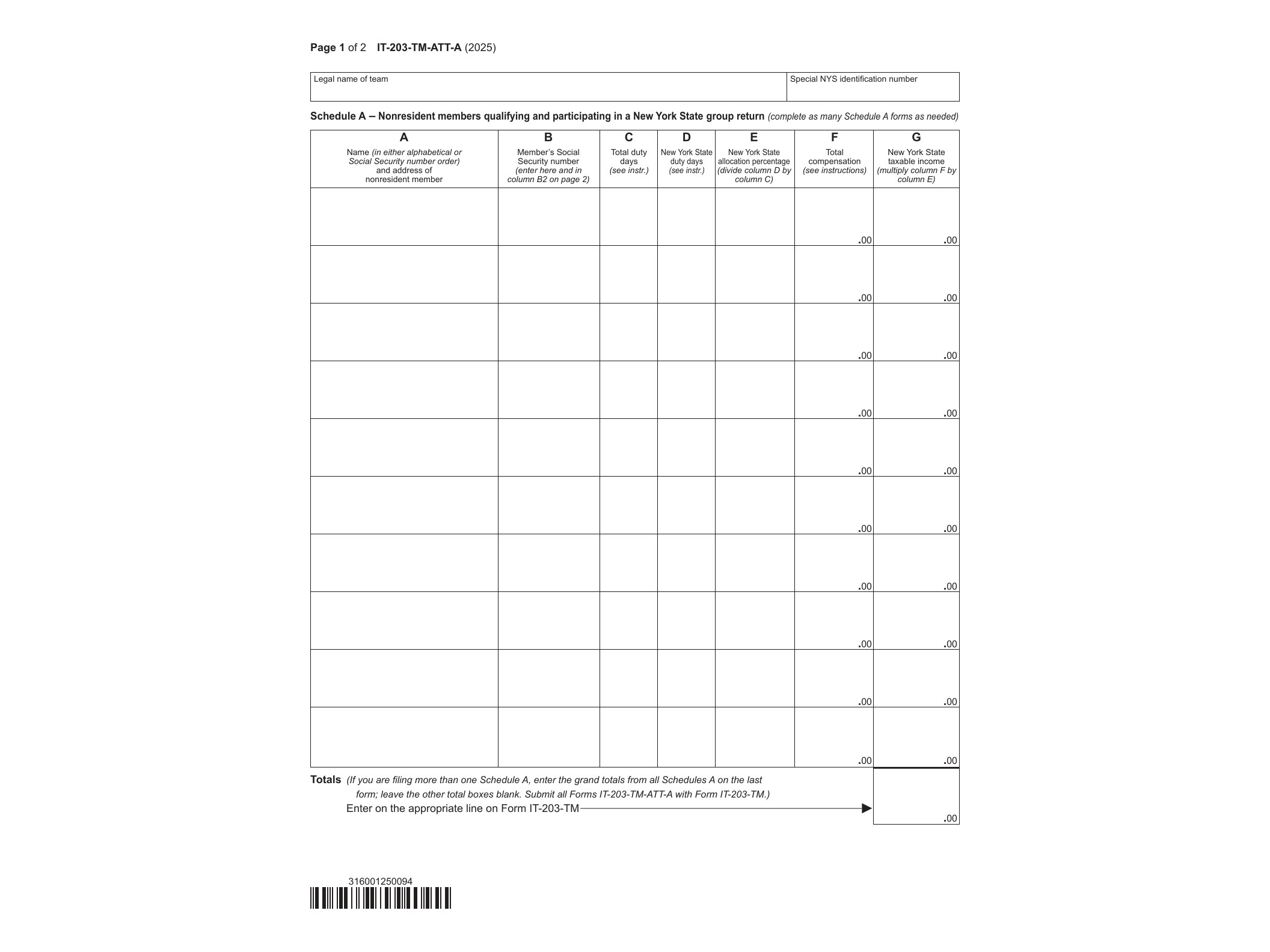
Schedule A specifically lists out the New York source income allocated to each nonresident athlete participating in the group filing. Rather than every player, coach, or eligible team member submitting a separate personal income tax return for income earned during games, practices, or other duty days spent in New York, the team consolidates this information on Schedule A and submits it alongside the main group return.
Who Needs This Form
This form is relevant to professional athletic teams — think baseball, basketball, hockey, football, or soccer organizations — that have nonresident players or team staff earning income connected to activities performed in New York State. If a team elects to file a group return under IT-203-TM instead of having each nonresident member file individually, Schedule A becomes a required attachment to document the income allocation for every member included in that group filing.
Team members themselves generally don’t fill out this schedule. It’s prepared by the team’s tax department or accounting firm on behalf of the entire roster included in the group election. That said, athletes should understand this form exists because it determines how their New York-source income is reported and taxed, and it affects whether they need to file anything separately with the state.
When It’s Used
Schedule A is filed for Tax Year 2025 as part of the team’s annual group nonresident filing obligation. It applies whenever a nonresident athlete or team member has earned income attributable to New York duty days — this typically includes game days, practice sessions, meetings, and other team-related activities physically performed within the state, even if the team isn’t based there.
Teams generally calculate this allocation using a duty-day method, comparing days worked in New York against total duty days for the season. Schedule A is where that calculation gets documented per player, which is why accuracy here matters — errors can lead to incorrect tax liability for individual team members, or trigger correspondence from the Department of Taxation and Finance later on.
How to Get and Complete the Form
The form is available directly from the New York State Department of Taxation and Finance website as a fillable PDF with AcroForm fields, meaning it can be completed digitally before printing or submitting. This makes it easier for team accountants managing multiple players’ data to enter figures directly into the document rather than filling it out by hand.
When preparing Schedule A, the person completing it will need each team member’s name, identifying information, total compensation, New York allocation percentage, and the resulting New York-source income amount. This data must align with what’s reported on the main IT-203-TM group return, since Schedule A functions as the itemized backup supporting the totals claimed there.
Teams unfamiliar with multi-state income allocation rules may find it useful to compare this process with other allocation-based forms, such as Form IT-203-F, which covers multi-year income allocation for nonresidents in different contexts. The underlying logic — dividing income based on days or activity performed in New York versus elsewhere — follows similar principles across these forms.
Organizations that also handle partnership-level nonresident reporting might find it helpful to review Form IT-204.1, which deals with how corporate partners’ income gets scheduled and reported to New York. While it serves a different filer type, the reporting structure shares some conceptual overlap with how Schedule A organizes individual allocations under a group filing.
Because this form deals with income sourced to a specific state based on physical presence and activity, teams managing rosters across multiple states sometimes also need authorization forms for handling tax matters with other state agencies. If your organization operates across state lines, it’s worth understanding equivalent processes like California’s Form 3534, which governs tax information authorization for a different jurisdiction but addresses a similar administrative need.
Once completed, Schedule A should be submitted together with the primary IT-203-TM return by the filing deadline that applies to the team’s tax year. Keeping detailed duty-day logs throughout the season makes completing this schedule considerably easier, since the allocation percentages depend directly on accurate day-count records maintained by the team.
Download Official Form IT203TM (PDF)
Opens the official government PDF in a new tab