
Download Official Form IT230 (PDF)
Opens the official government PDF in a new tab
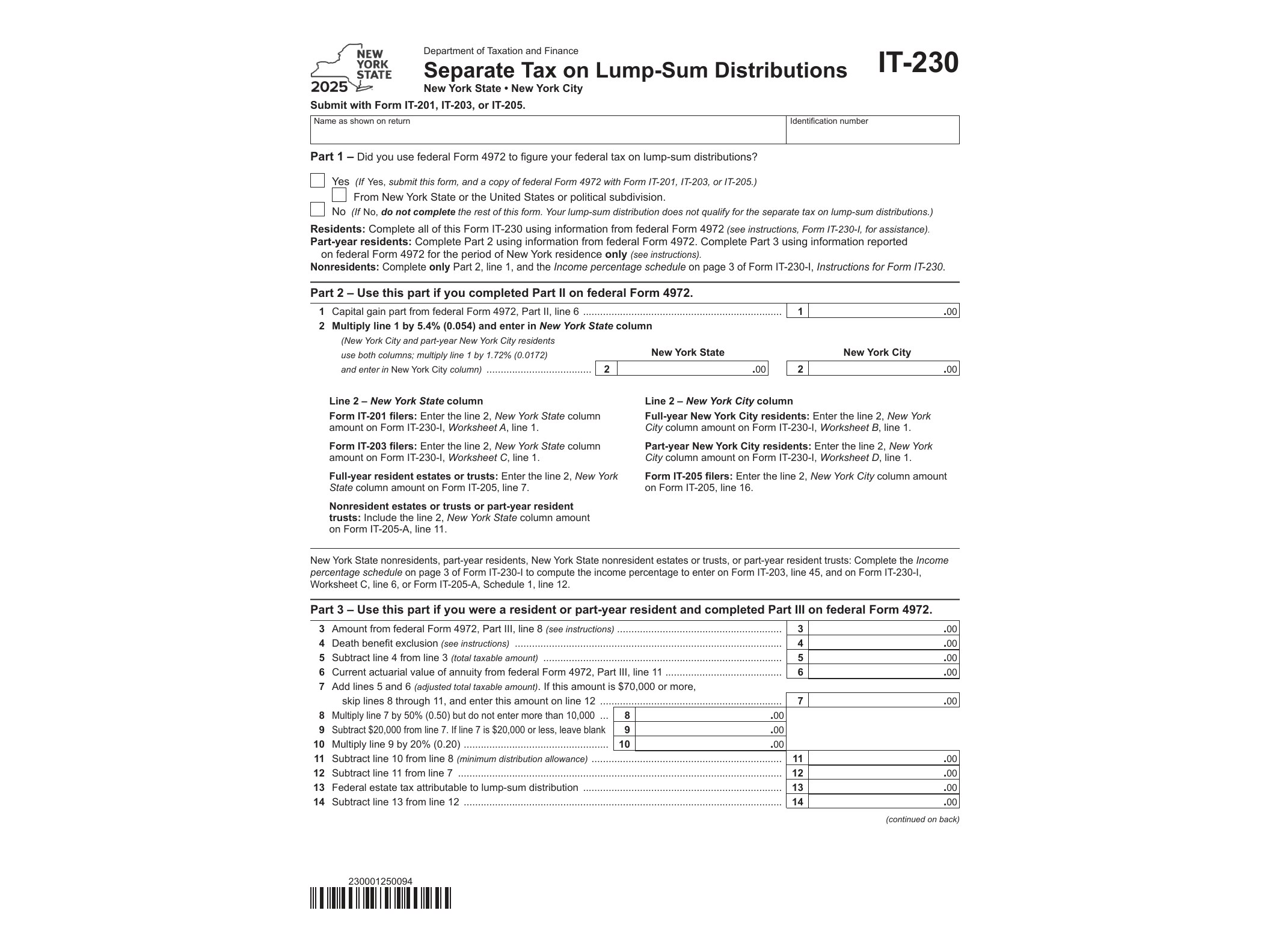
Form IT-230 is a New York State tax form used to calculate a separate tax on lump-sum distributions from qualified retirement plans. It’s issued by the New York State Department of Taxation and Finance and applies to taxpayers who received a lump-sum distribution and chose to use the federal special averaging method (via federal Form 4972) to figure their federal tax on that distribution. Because New York doesn’t automatically follow the federal averaging calculation for state purposes, this form exists to reconcile the difference and determine the correct New York tax liability on that income.
In plain terms, if you cashed out a pension, profit-sharing plan, or similar qualified retirement account in one lump sum rather than spreading it over time, and you used the federal averaging option to reduce your federal tax bill, New York requires you to complete IT-230 to compute a comparable separate state tax on that same distribution. This keeps the state tax treatment aligned with how the distribution was taxed federally, even though New York’s tax rates and rules differ from the IRS.
Who Needs to File Form IT-230
This form is relevant to a fairly specific group of taxpayers: those who received a qualifying lump-sum distribution during the tax year — typically due to retirement, separation from employment, reaching age 59½, or the death of a plan participant — and elected the 10-year averaging method on their federal return. If you didn’t use federal averaging and instead rolled the distribution over or reported it as ordinary income, you generally won’t need this form.
Retirees, individuals who recently left a job with a vested pension payout, and beneficiaries who received a lump-sum distribution from a deceased person’s retirement plan are the most common filers. If you’re unsure whether your distribution qualifies, the eligibility rules mirror those used for federal Form 4972, so reviewing that form’s instructions alongside IT-230 is a reasonable starting point.
When Form IT-230 Is Used
You’ll attach IT-230 to your New York State income tax return for the same year the lump-sum distribution was received and taxed federally under the averaging method. For tax year 2025, that means it accompanies your 2025 New York return. The form calculates the separate state tax owed on the distribution using New York’s own tax computation, which is then added to your regular state tax liability rather than being taxed as ordinary income at your marginal rate.
This distinction matters because lump-sum distributions can be large enough to push a taxpayer into a much higher bracket if taxed as regular income. The separate tax calculation on IT-230, much like the federal averaging method, is designed to soften that impact by taxing the distribution somewhat independently of your other annual income.
How to Get and Complete the Form
Form IT-230 is available directly from the New York State Department of Taxation and Finance as a fillable PDF, meaning you can enter your figures digitally before printing or saving the completed form. You’ll need details from your federal Form 4972, including the total taxable amount of the lump-sum distribution, any capital gain portion, and the federal tax computed under averaging, since New York’s version of the calculation starts from similar inputs.
Work through the form section by section, transferring figures accurately from your federal paperwork, and double-check the final tax amount before adding it to your New York return. If you’re also dealing with other state-specific credits or wage adjustments in the same filing year, it’s worth reviewing related guidance like the Form IT-226 wage credit overview to understand how different New York tax provisions interact on the same return.
Taxpayers who split time between states or deal with multi-state credit allocations sometimes find it helpful to compare how other states handle similar specialized tax situations. For instance, California’s Form 3544 credit assignment process and its dependent care credit form illustrate how state tax authorities frequently create separate forms to handle income or credits that don’t fit neatly into the standard return — a pattern that applies to IT-230 as well.
Once completed, keep a copy of both IT-230 and the corresponding federal Form 4972 with your tax records, since the state may request documentation supporting the lump-sum distribution and the averaging election if your return is reviewed.
Download Official Form IT230 (PDF)
Opens the official government PDF in a new tab