
Download Official Form 3538 (PDF)
Opens the official government PDF in a new tab
What Form 3538 (565) Is For
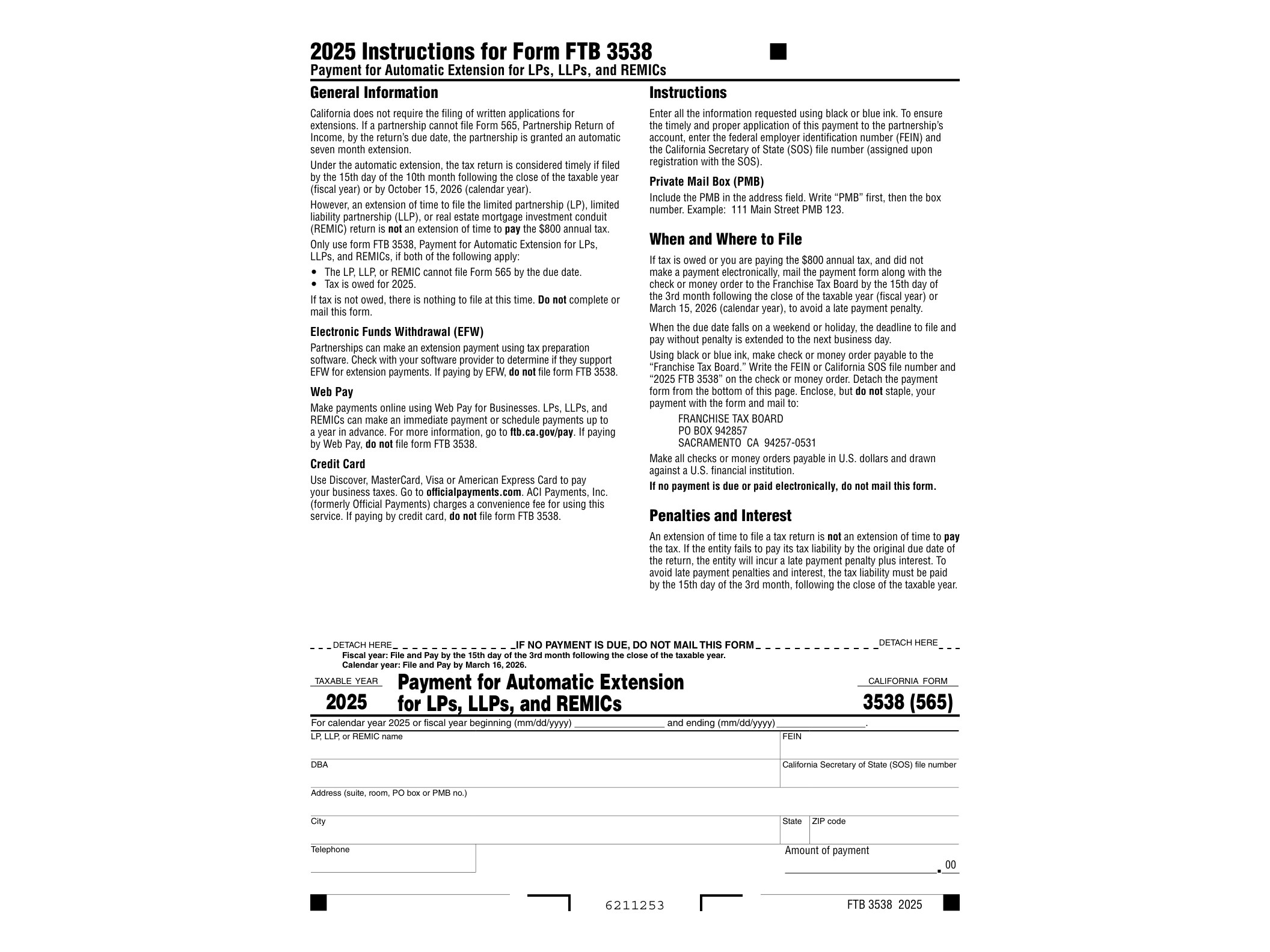
Form 3538 (565) is the payment voucher that limited partnerships (LPs), limited liability partnerships (LLPs), and real estate mortgage investment conduits (REMICs) use to send money to the California Franchise Tax Board (FTB) when they need extra time to file their state partnership return. California grants an automatic six-month extension to file Form 565, but that extension only covers the paperwork — not the tax, fee, or penalty amounts that may be owed. This voucher is how an entity pays what it estimates it owes while the actual return is still being prepared.
The form itself is short: it asks for the entity’s name, California corporation number or FEIN, address, and the payment amount. It’s an AcroForm PDF, meaning you can type your information directly into the fields on a computer before printing, which cuts down on handwriting errors when the FTB processes the check or electronic payment.
Who Needs to File It
You need Form 3538 (565) if your business is registered in California as an LP, LLP, or REMIC and you owe an annual tax, LLC fee equivalent, or nonconsenting nonresident (NCNR) member tax, but you’re not ready to file the full Form 565 by the original due date. If you already know you’ll owe zero additional tax and you’ve paid everything through estimated payments during the year, you generally don’t need to submit this voucher — the automatic extension to file still applies without it. The voucher matters specifically when there’s a balance due that needs to reach the FTB on time.
This is similar in spirit to how other states handle pass-through entities. In New York, for example, partnerships with nonresident partners rely on Form IT-2658 to estimate and remit tax on behalf of those partners, with Form IT-2658-NYS used as a supplemental attachment when multiple partners are involved. California’s system for LPs and LLPs works differently in its mechanics, but the underlying idea is the same: the entity, not just the individual partners, carries responsibility for making sure tax obligations are paid on schedule.
When to Use It and Payment Deadlines
The payment tied to Form 3538 (565) is due by the original filing deadline for Form 565, which for most calendar-year partnerships falls on the 15th day of the third month after the close of the tax year — typically March 15. Even though the return itself gets an automatic extension to file, interest and penalties start accruing on any unpaid tax from that original due date, not from the extended filing date. So the smart move is to calculate your expected liability as accurately as possible and submit the voucher and payment before that March deadline, rather than waiting until the extended filing window.
How to Get and Fill Out the Form
The FTB publishes an updated version of Form 3538 (565) each year, and the current version can be downloaded directly as a fillable PDF. Because it’s an AcroForm, you can complete it on your computer, save a copy for your records, and either mail it with a check or use it as reference when submitting payment electronically through the FTB’s Web Pay system. Keep a copy of the completed voucher and proof of payment with your partnership’s tax records — if the FTB later questions the timing or amount of your extension payment, that documentation is what settles the matter. Entities that also have activity in other states, such as New York-based operations filing under rules like Form IT-261 for industry-specific credits, should treat each state’s extension and payment rules separately, since California’s deadlines and voucher requirements don’t align automatically with other jurisdictions.
Download Official Form 3538 (PDF)
Opens the official government PDF in a new tab