
Download Official Form 3521 (PDF)
Opens the official government PDF in a new tab
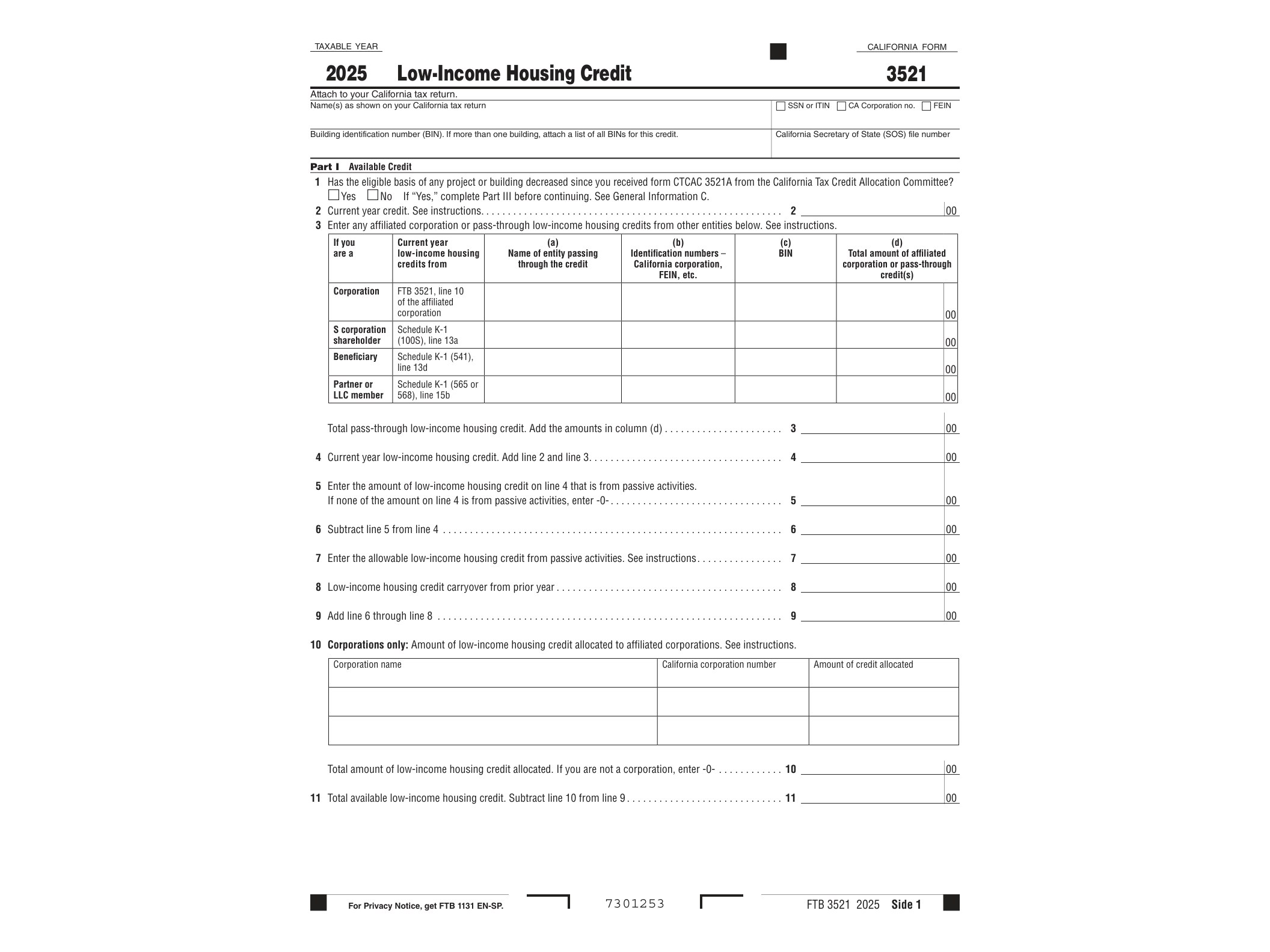
Form 3521 is the California Franchise Tax Board’s Low-Income Housing Credit form, used by taxpayers who have invested in or developed qualified low-income rental housing within the state. It mirrors, in some ways, the federal low-income housing credit but operates under California’s own rules, allocation process, and calculation methods. If you own an interest in a qualified low-income housing project in California, this is the form that lets you calculate and claim your share of the state credit.
The credit exists to encourage private investment in affordable rental housing. California allocates a limited amount of these credits each year through the California Tax Credit Allocation Committee (CTCAC), and property owners or investors who receive an allocation must use Form 3521 to translate that allocation into an actual tax credit claimed on their state return.
Who Needs to File Form 3521
This form applies mainly to:
- Owners of qualified low-income housing projects that received a credit allocation from CTCAC
- Partners, shareholders, or members of pass-through entities (partnerships, S corporations, LLCs) that hold an interest in a low-income housing project and receive a share of the credit
- Taxpayers carrying forward unused low-income housing credit from a prior year
If you’re an individual investor in a syndicated low-income housing partnership, you’ll typically receive a Schedule K-1 showing your allocated share of the credit, and you’ll use that information to complete Form 3521 before transferring the result to your California income tax return.
When This Form Is Used
Form 3521 is filed with your California income tax return for any tax year in which you’re claiming, carrying over, or recapturing a low-income housing credit. Since these credits are often allocated over a 10-year compliance period, many taxpayers end up filing this form repeatedly across multiple tax years for the same project. The 2024 version of Form 3521 corresponds to the 2024 tax year, so it should be filed with your return covering that period, generally due at the same time as your regular California tax filing deadline (with extensions following the same rules as your main return).
It’s worth noting that the low-income housing credit is nonrefundable, meaning it can reduce your tax liability but won’t generate a refund on its own. Any unused portion generally carries forward to future years, which is another reason this form tends to reappear on a taxpayer’s filings year after year.
How to Get and Complete Form 3521
The form is available directly from the California Franchise Tax Board’s website as a fillable PDF, meaning you can type your entries directly into the document before printing or attaching it to your e-filed return. You’ll need information such as:
- The building identification number (BIN) assigned by CTCAC for the project
- Your ownership percentage or allocated credit share
- Prior year carryover amounts, if applicable
- Details on any credit recapture, if the property stopped qualifying during the compliance period
Because the low-income housing credit involves multi-year compliance periods and potential recapture rules, it’s common for taxpayers to work with a tax professional or the entity managing the housing project to get the correct figures. Many investors receive a pre-prepared summary from the project’s general partner or management company specifically for completing this form.
Once completed, Form 3521 is submitted along with your California Form 540, 540NR, or the appropriate return for corporations and pass-through entities. If you’re also dealing with other state credit forms, it may help to review how other California tax credit forms are structured, since many follow a similar layout of current-year credit, carryover, and recapture sections.
Keeping accurate records of your original credit allocation letter from CTCAC, along with any K-1s or partnership statements, will make completing this form each year considerably easier, especially since housing credit compliance periods often stretch a full decade.
Download Official Form 3521 (PDF)
Opens the official government PDF in a new tab