
Download Official Form 3801 (PDF)
Opens the official government PDF in a new tab
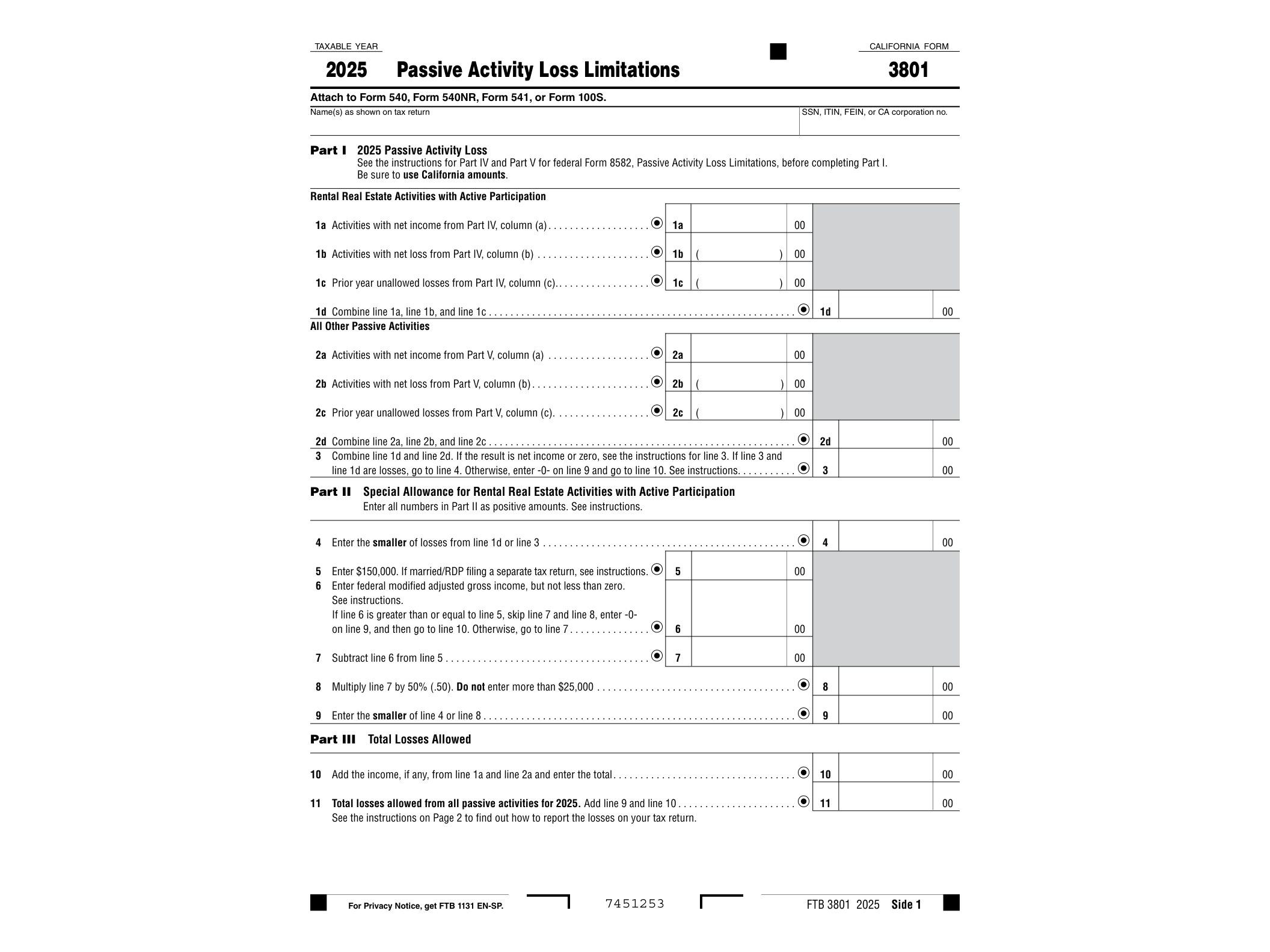
Form FTB 3801, Passive Activity Loss Limitations, is a California Franchise Tax Board form used to figure out how much of your passive activity loss you can actually deduct on your state return. If you’ve ever dealt with the federal version of this issue through IRS Form 8582, this form does something similar but strictly for California purposes, since state rules on passive losses don’t always line up exactly with federal law.
Passive activity losses come from things like rental real estate, limited partnerships, or businesses where you don’t materially participate in day-to-day operations. The IRS and California both generally limit how much of these losses you can use to offset other income in the same year. Instead of letting you deduct everything at once, the rules often require you to carry forward unused losses to future years until you have enough passive income to absorb them, or until you dispose of the activity entirely.
Who Needs to File FTB 3801
You’ll need this form if you have passive activity losses or credits and your California treatment of those amounts differs from what you reported federally. This commonly happens because of differences in depreciation rules, basis calculations, or other state adjustments that don’t match the federal Schedule E or Form 8582 figures.
Individuals, estates, and trusts with rental properties, S corporation interests, or partnership investments where they aren’t actively involved are the most typical filers. If you’re a real estate professional who materially participates in rental activities, you might be exempt from some of these limitations, but you still may need to document that on the form.
Landlords with multiple rental properties often end up here, especially if one property generates income while another generates a loss. The form helps net these activities together and determine what portion of the net loss, if any, you can claim against nonpassive income like wages or interest.
When You’ll Use This Form
You use FTB 3801 for the tax year in which you have passive losses that need to be limited or when you’re releasing previously suspended losses because you sold or disposed of the activity. It’s also relevant if you’re claiming the $25,000 special allowance for active participation in rental real estate, since California has its own income phase-out thresholds that can differ from the federal ones.
If your prior-year suspended losses were tracked separately for state purposes, this form is where those carryovers get reconciled again this year. Keeping accurate records year over year matters a lot here, since a mistake in one year’s carryover amount can throw off your calculations for several years afterward.
How to Get and Fill Out Form 3801
The 2024 version of Form 3801 is available directly from the Franchise Tax Board as a fillable PDF, meaning you can type your figures directly into the form on your computer before printing or attaching it to your e-filed return. This is far less error-prone than filling it out by hand, especially given the multiple worksheets involved in the calculation.
The form itself walks through several worksheets covering different categories of passive activities, including rental real estate with active participation, all other passive activities, and any prior-year unallowed losses. You’ll need your federal Form 8582 handy for comparison, along with California adjustment schedules like Schedule CA (540) if there are basis or depreciation differences to account for.
Similar to how Form FTB 3805P handles additional taxes on retirement accounts with its own set of California-specific rules, Form 3801 exists because state tax law sometimes diverges from federal treatment in ways that require a separate calculation. If you’re also dealing with credits tied to specific investment zones, you might find it useful to review how Form IT-602 approaches capital credits in other states, just to get a sense of how differently each state structures these limitations.
Once completed, attach Form 3801 to your California Form 540, 540NR, or 541, depending on your filing situation. Keep a copy for your records regardless of outcome, since any suspended losses this year will need to be referenced again on next year’s return.
Download Official Form 3801 (PDF)
Opens the official government PDF in a new tab