
Download Official Form 3805P (PDF)
Opens the official government PDF in a new tab
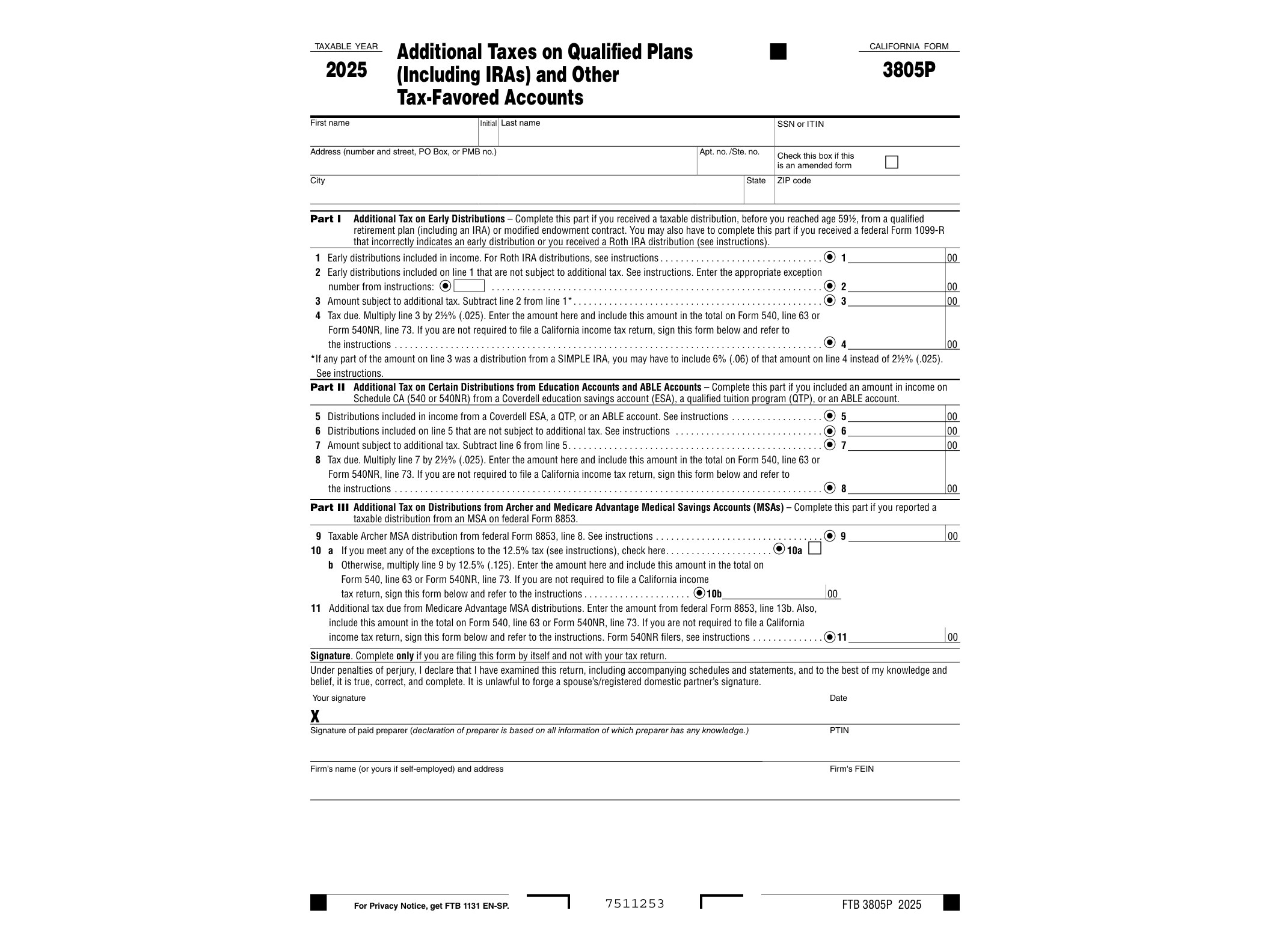
Form FTB 3805P is California’s version of the federal Form 5329. It’s used to calculate additional state taxes owed when someone takes money out of a retirement account, IRA, Archer MSA, Coverdell education savings account, or health savings account in a way that doesn’t follow the rules — usually too early, or in an amount that exceeds contribution limits. If you’ve ever cashed out a 401(k) before age 59½ or over-contributed to a Roth IRA, this is the form that puts a number on the penalty you owe California.
The California Franchise Tax Board issues this form because the state doesn’t automatically mirror the IRS penalty structure. Federally, an early distribution from a qualified plan usually triggers a 10% additional tax. California adds its own layer on top of that — generally 2.5% — and Form 3805P is where that calculation happens. Without it, the FTB has no record of how you arrived at the extra tax figure on your state return.
Who Actually Needs to File This Form
You’ll need FTB 3805P if any of the following applies to your tax year:
- You took an early distribution from a qualified retirement plan, IRA, or annuity before reaching the required age, and no exception applies.
- You contributed more than the allowed limit to a traditional or Roth IRA, Archer MSA, Coverdell ESA, or HSA and didn’t withdraw the excess in time.
- You didn’t take your full required minimum distribution (RMD) from a retirement account once you were required to start.
- You received a distribution that’s subject to additional tax for another reason recognized by California, even if it wasn’t taxed the same way federally.
In most cases, if you had to file the federal Form 5329, you’ll also need the California equivalent — but not always for the exact same reason, since the two states’ rules occasionally diverge on exceptions and thresholds.
When and How It’s Filed
Form 3805P attaches to your California personal income tax return, Form 540, for the same year the distribution or excess contribution occurred. It’s not something you file on its own — it feeds directly into your state tax liability calculation. If you’re working through a return that also involves credits or deferred amounts from other state programs, it helps to understand how supplemental forms interact with your main filing; the process is similar in spirit to how Form IT-602 attaches to a state return to claim a specific credit, or how Form IT-501 handles a deferred payout situation on a New York return.
The 2024 version of Form 3805P is a fillable PDF (AcroForm), meaning you can type your figures directly into the form on your computer before printing it for submission or attaching it to an e-filed return through approved tax software. You’ll need your 1099-R forms, IRA contribution records, and any documentation showing the distribution amount, the account type, and the reason for the withdrawal. The form walks through several parts depending on the type of account and violation — early distributions in Part I, excess contributions in Part III and beyond, and excess accumulation from missed RMDs in a later section.
If your situation involves an exception — disability, certain medical expenses, a first-time home purchase, or a qualified disaster distribution — you’ll still need to file the form, but you’ll note the exception code so the additional tax isn’t applied where it shouldn’t be. Getting the exception code wrong is one of the more common mistakes taxpayers make with this form, so it’s worth double-checking against the FTB instructions before submitting.
Occasionally, taxpayers dealing with unusual or hardship-related tax situations look for relief provisions elsewhere in the tax code, similar to how Form IT-59 provides forgiveness under specific circumstances — but for retirement account penalties, the exceptions built into Form 3805P itself are usually the only path to reducing what you owe.
Download Official Form 3805P (PDF)
Opens the official government PDF in a new tab