
Download Official Form IT607 (PDF)
Opens the official government PDF in a new tab
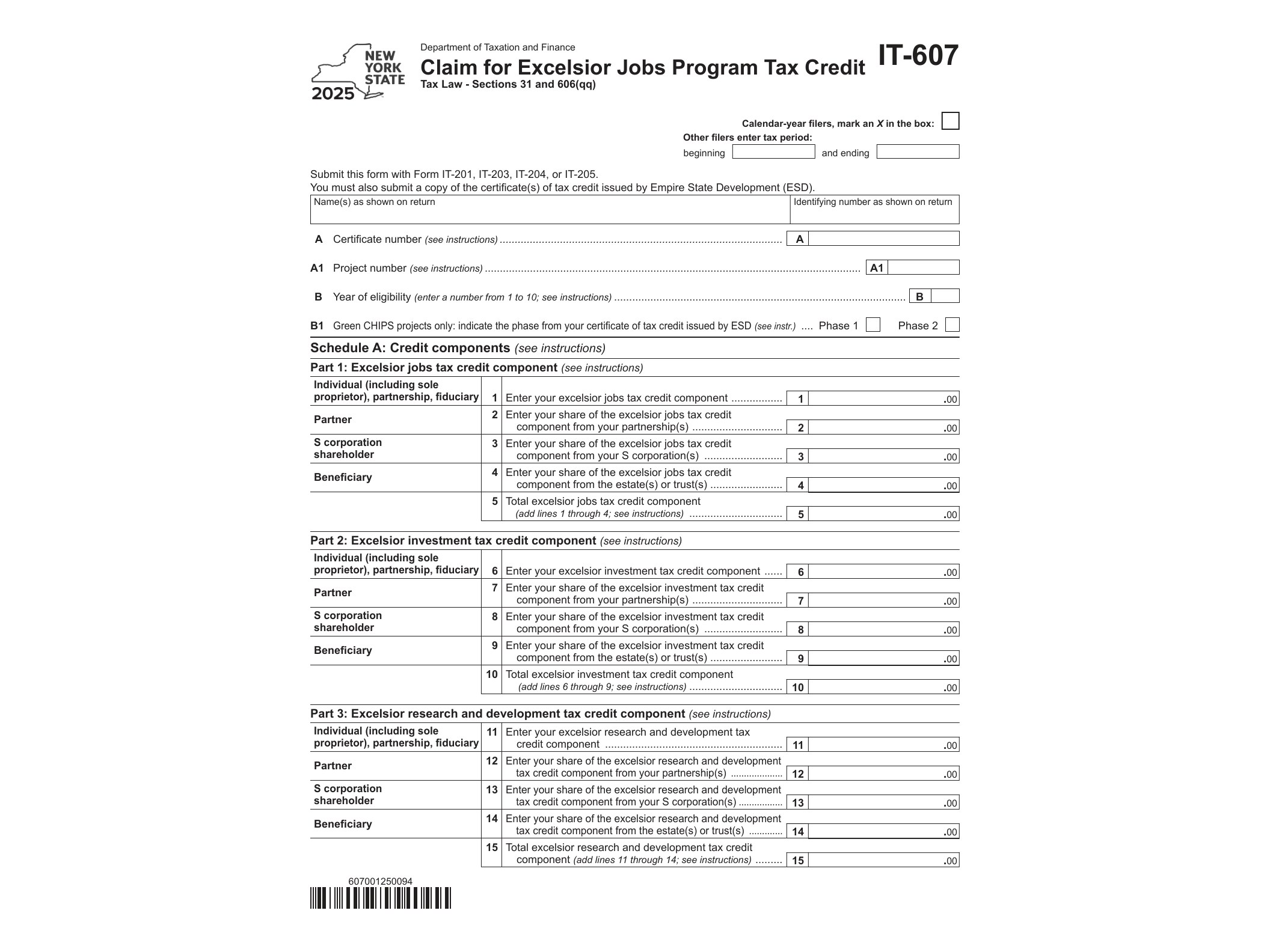
Form IT-607 is the tax form New York State businesses use to claim the Excelsior Jobs Program Tax Credit. It’s issued by the New York State Department of Taxation and Finance and applies to companies that have been admitted into the Excelsior Jobs Program by Empire State Development and have met specific job creation or investment benchmarks during the tax year. If your business participates in this program, IT-607 is how you actually convert that participation into a dollar credit against your New York tax liability.
The Excelsior Jobs Program itself is an economic development initiative designed to encourage businesses in targeted industries — including manufacturing, software development, financial services, agriculture, and back-office operations, among others — to create jobs and invest capital in New York. Being accepted into the program doesn’t automatically generate a tax credit; businesses have to earn it each year by hitting the job and investment thresholds outlined in their agreement with Empire State Development. Form IT-607 is the mechanism for reporting that performance and calculating the resulting credit.
The credit itself is actually a combination of up to four components: the Excelsior Jobs Tax Credit, the Excelsior Investment Tax Credit, the Excelsior Research and Development Tax Credit, and the Excelsior Real Property Tax Credit. Not every business qualifies for all four — it depends on the specific terms of your participation agreement and which benchmarks you met. Form IT-607 walks through each component separately, so you’ll need documentation on employment numbers, qualified investments, R&D expenditures, and property tax payments, depending on which credits apply to your situation.
Who needs this form? Only businesses formally certified under the Excelsior Jobs Program can file it. You can’t claim this credit simply because you created jobs in New York — you need a certificate of eligibility from Empire State Development confirming your participation and the specific benchmarks you agreed to meet. If you’re not sure whether your business is enrolled, that’s a question for your economic development contact or corporate tax advisor before you even start filling out the form.
Form IT-607 is filed alongside your New York State tax return for the year in which you’re claiming the credit — for this version, tax year 2025. Corporations attach it to their corporate franchise tax return, while pass-through entities and individual owners may need to include it with their personal income tax filing, depending on how the business is structured. Because the credit flows through differently for partnerships, S corporations, and sole proprietors, it’s worth reviewing the instructions carefully or working with a preparer familiar with New York’s economic development credits.
The form itself is an AcroForm PDF, meaning it has fillable fields you can complete directly on your computer before printing or attaching it to an e-filed return. You’ll need your Excelsior certificate information, employment and investment data for the tax year, and any supporting schedules Empire State Development has provided as part of your annual compliance reporting. Accuracy matters here — the state cross-checks these credit claims against the benchmarks in your original agreement, so numbers that don’t match your certification paperwork can trigger delays or adjustments.
If your business is exploring other New York State credits, it’s worth knowing there are several similar programs with their own dedicated forms. Security-related businesses training personnel may want to look at Form IT-631, which covers the Security Officer Training Tax Credit. Companies working on contaminated or underused sites might qualify for the credit described in Form IT-611.1, the Brownfield Redevelopment Tax Credit. Both, like the Excelsior credit, require formal program certification before you can claim anything on your return.
Getting the numbers right on IT-607 usually comes down to good recordkeeping throughout the year — tracking new hires, wages, and qualifying investments as they happen rather than trying to reconstruct them at filing time. Keep your Empire State Development correspondence and annual compliance filings on hand, since the state may request them to substantiate the credit amounts you report.
Download Official Form IT607 (PDF)
Opens the official government PDF in a new tab