
Download Official Form Y203 (PDF)
Opens the official government PDF in a new tab
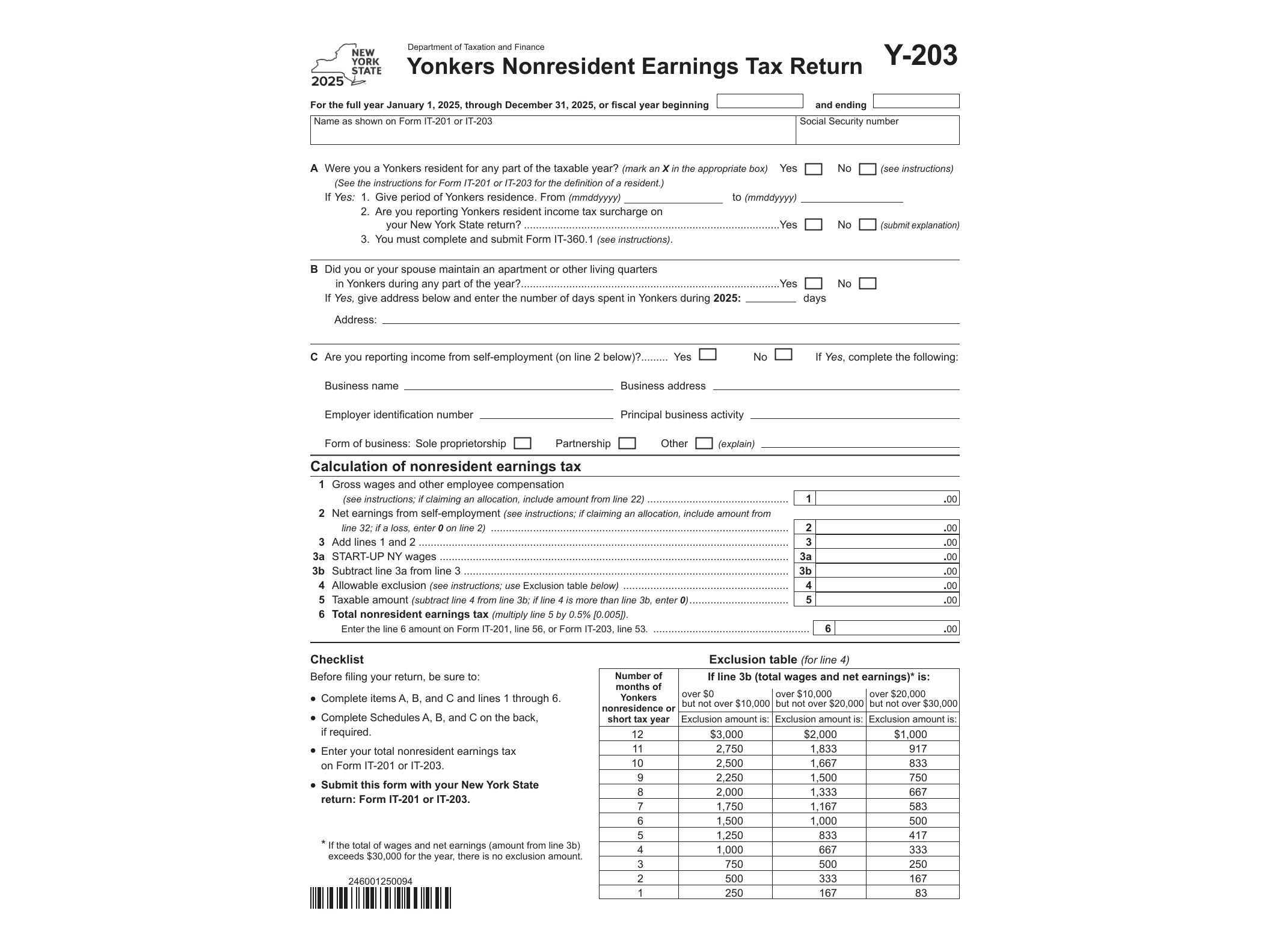
If you don’t live in Yonkers but earn wages or self-employment income there, New York State wants to know about it. That’s where Form Y-203, the Yonkers Nonresident Earnings Tax Return, comes in. It’s a separate filing from your regular New York State income tax return, and it exists specifically to capture income earned within the city limits of Yonkers by people who reside elsewhere.
Yonkers is one of the few municipalities in New York that imposes its own earnings tax on nonresidents who work there, in addition to the city’s resident income tax surcharge. This tax applies whether you commute in from another part of Westchester County, from New York City, or from any other state. If your job duties are performed in Yonkers, or a portion of them are, you likely have a filing obligation.
Who Needs to File Form Y-203
You generally need to file this form if you meet all of the following conditions for the 2025 tax year:
- You are not a resident of Yonkers.
- You earned wages, salary, or net self-employment income from work performed in Yonkers.
- Your employer did not withhold the Yonkers nonresident earnings tax correctly, or you have self-employment income that requires you to calculate and remit the tax yourself.
Partial-year workers and people who split their time between a Yonkers job site and another location also need to file, since the tax is based on income allocated to work actually performed within the city, not just total wages. The form includes worksheets to help you determine what portion of your earnings counts toward the Yonkers tax base.
When and How the Y-203 Is Used
Form Y-203 is filed alongside your New York State personal income tax return (Form IT-201 or IT-203, depending on your residency status), not as a standalone submission to the city. The tax year 2025 version follows the same April filing deadline as your state return, though extensions that apply to your state filing generally carry over to this form as well.
The earnings tax itself is a small percentage of your Yonkers-source wages, and the form walks you through calculating the taxable amount, applying the rate, and reconciling it against any amount already withheld by your employer. If your employer withheld too little, you’ll owe the difference. If too much was withheld, you can claim a refund through this same form.
Self-employed individuals and independent contractors who perform services in Yonkers should pay particular attention to the allocation worksheets, since there’s no employer withholding to fall back on. Getting the allocation percentage wrong is one of the most common mistakes taxpayers make on this return, so it’s worth double-checking the days-worked calculation before submitting.
Getting and Completing the Form
The 2025 version of Form Y-203 is a fillable PDF issued by the New York State Department of Taxation and Finance, meaning you can type your information directly into the form fields before printing or attaching it to your electronic filing software. Because this form is tied directly to your broader state income tax filing, most taxpayers complete it through the same tax preparation software they use for their IT-201 or IT-203, which automatically pulls in the relevant Yonkers allocation figures.
If you’re filing by hand, make sure the numbers on Y-203 match the figures reported on your main state return, since discrepancies between the two are a common trigger for follow-up notices from the Department of Taxation and Finance.
New York publishes a range of specialized tax credit and reporting forms each year beyond the standard resident and nonresident returns. If you’re researching how New York handles other niche filings, it’s worth looking at how the state structures incentive programs like the Empire State Independent Film Production Credit or the Semiconductor Research and Development Credit, both of which follow a similar logic of targeting a specific income source or activity within the broader state tax system. And if your filing situation involves overdue notices or reminders from a tax agency, our breakdown of California FTB Form 856 shows how another state handles similar communication with taxpayers.
Keep a copy of your completed Y-203 with your tax records for at least three years, since it may be requested if the Department of Taxation and Finance has questions about your Yonkers income allocation in a future audit.
Download Official Form Y203 (PDF)
Opens the official government PDF in a new tab