
Download Official Form Y204 (PDF)
Opens the official government PDF in a new tab
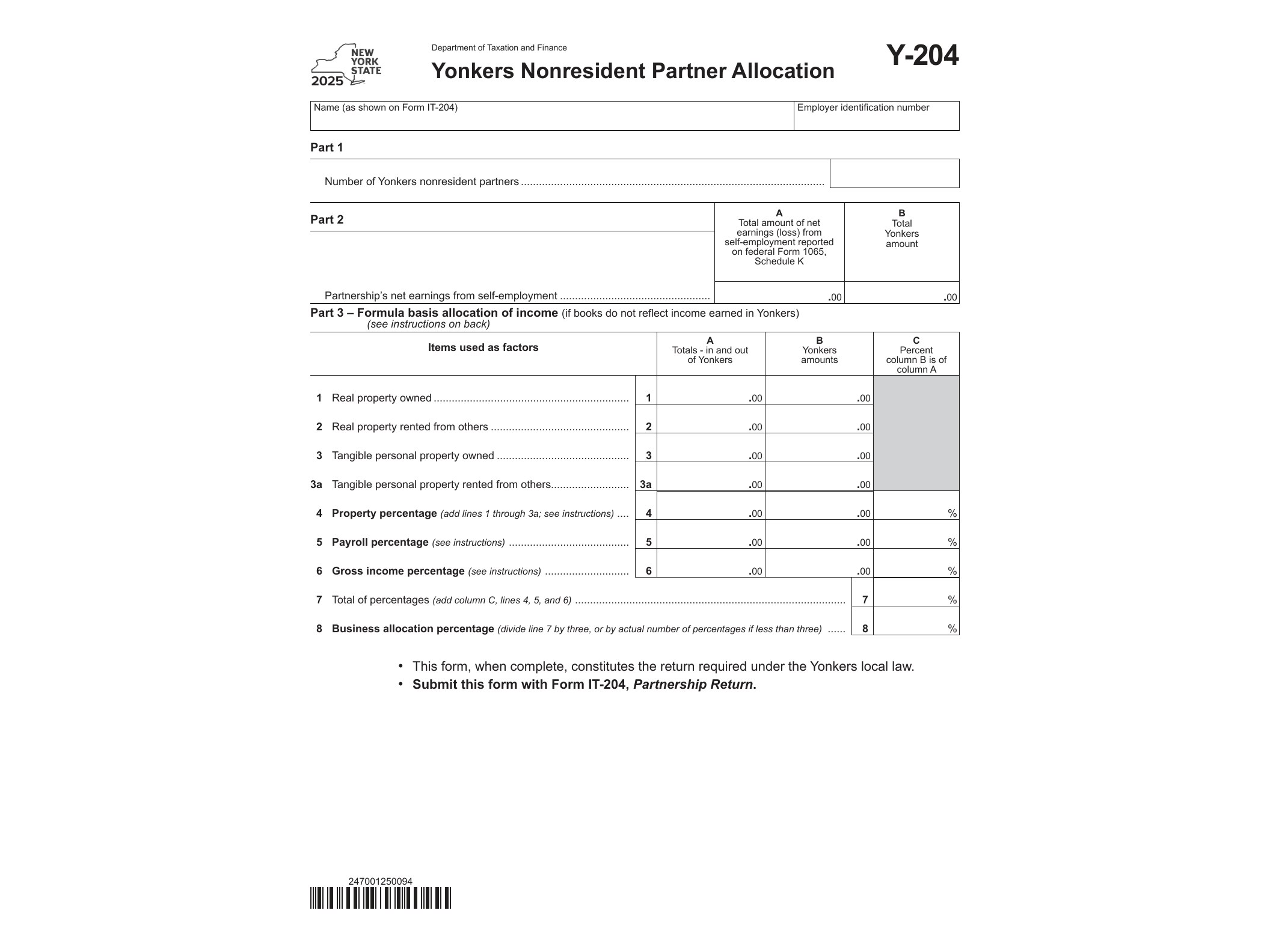
Form Y-204, officially titled Yonkers Nonresident Partner Allocation, is issued by the New York State Department of Taxation and Finance. It’s used to calculate how much of a partnership’s income is allocable to Yonkers when one or more partners are nonresidents of that city. If you’re a partner in a business with operations touching Yonkers, but you don’t actually live there, this form determines your share of the Yonkers nonresident earnings tax liability.
Yonkers imposes its own local income tax obligations separate from New York State and New York City. When a partnership has income connected to Yonkers, and some partners are nonresidents of the city, the partnership can’t just report the total income and call it done. Each nonresident partner’s allocable share needs to be broken out using a formula based on business activity, payroll, property, and receipts tied to Yonkers versus everywhere else. Form Y-204 walks through that allocation process line by line.
Who Needs to File Form Y-204
This form applies to partnerships (including LLCs treated as partnerships for tax purposes) that have at least one partner who is a nonresident of Yonkers but who has income allocable to the city through the partnership’s business activity. The partnership typically prepares this allocation on behalf of its nonresident partners, and the resulting figures flow into each partner’s individual New York State return, specifically supporting the Yonkers nonresident earnings tax calculation.
If every partner in the business is a Yonkers resident, this form generally isn’t necessary — resident partners are taxed differently and don’t need the same allocation exercise. It’s specifically the nonresident partner situation that triggers the requirement.
When You’d Use This Form
Form Y-204 is filed alongside your New York State partnership return for the tax year in which the partnership had Yonkers-source business activity and nonresident partners. For tax year 2025, that means the form covers income, payroll, and property apportionment for that specific filing period. Partnerships with multi-state or multi-city operations — say, a firm with offices in both Yonkers and elsewhere in New York or out of state — are the most common filers, since their income naturally needs to be split by location.
This kind of nonresident allocation exercise isn’t unique to New York. Other states have similar residency-based apportionment rules, and if you’re trying to understand the broader logic behind resident versus nonresident tax treatment, the FTB Publication 1031 guidelines on residency status from California offer a useful comparison point, even though the specific mechanics differ from New York’s approach.
How the Allocation Works
The form uses a standard three-factor apportionment method common in state and local tax law: property, payroll, and receipts. Each factor compares the amount located in or attributable to Yonkers against the partnership’s total amount everywhere. The three percentages are averaged to produce an overall allocation percentage, which is then applied to the nonresident partner’s distributive share of partnership income to determine what’s taxable by Yonkers.
Because the form is a fillable AcroForm PDF, you can complete it directly on your computer using Adobe Acrobat Reader or a similar PDF program before printing or attaching it to your filing. This saves time compared to filling it out by hand and reduces the chance of illegible entries or calculation errors carried over from messy handwriting.
Getting and Completing Form Y-204
The form is available directly from the New York State Department of Taxation and Finance website as a fillable PDF. Before starting, gather the partnership’s financial statements showing property, payroll, and receipts broken out by location, plus a list of partners with their residency status. Nonresident partners should confirm their percentage allocation with the partnership’s tax preparer, since errors here directly affect individual tax liability.
If your business also claims other New York State credits alongside filing partnership-related paperwork, it’s worth reviewing related forms such as the DTF-621 Claim for QETC Employment Credit, since many partnerships juggle multiple state filings in the same tax year. Similarly, if credits carried over from prior years are part of your tax picture, comparing how other states track carryovers — like California’s Form 3540 Credit Carryover and Recapture Summary — can help partnerships operating across state lines keep their recordkeeping consistent.
Once completed, Form Y-204 should be submitted with the partnership’s New York State tax return for the applicable year, and copies of the allocation should be provided to each nonresident partner so they can accurately report their Yonkers-sourced income on their individual returns.
Download Official Form Y204 (PDF)
Opens the official government PDF in a new tab