
Download Official Form 3540 (PDF)
Opens the official government PDF in a new tab
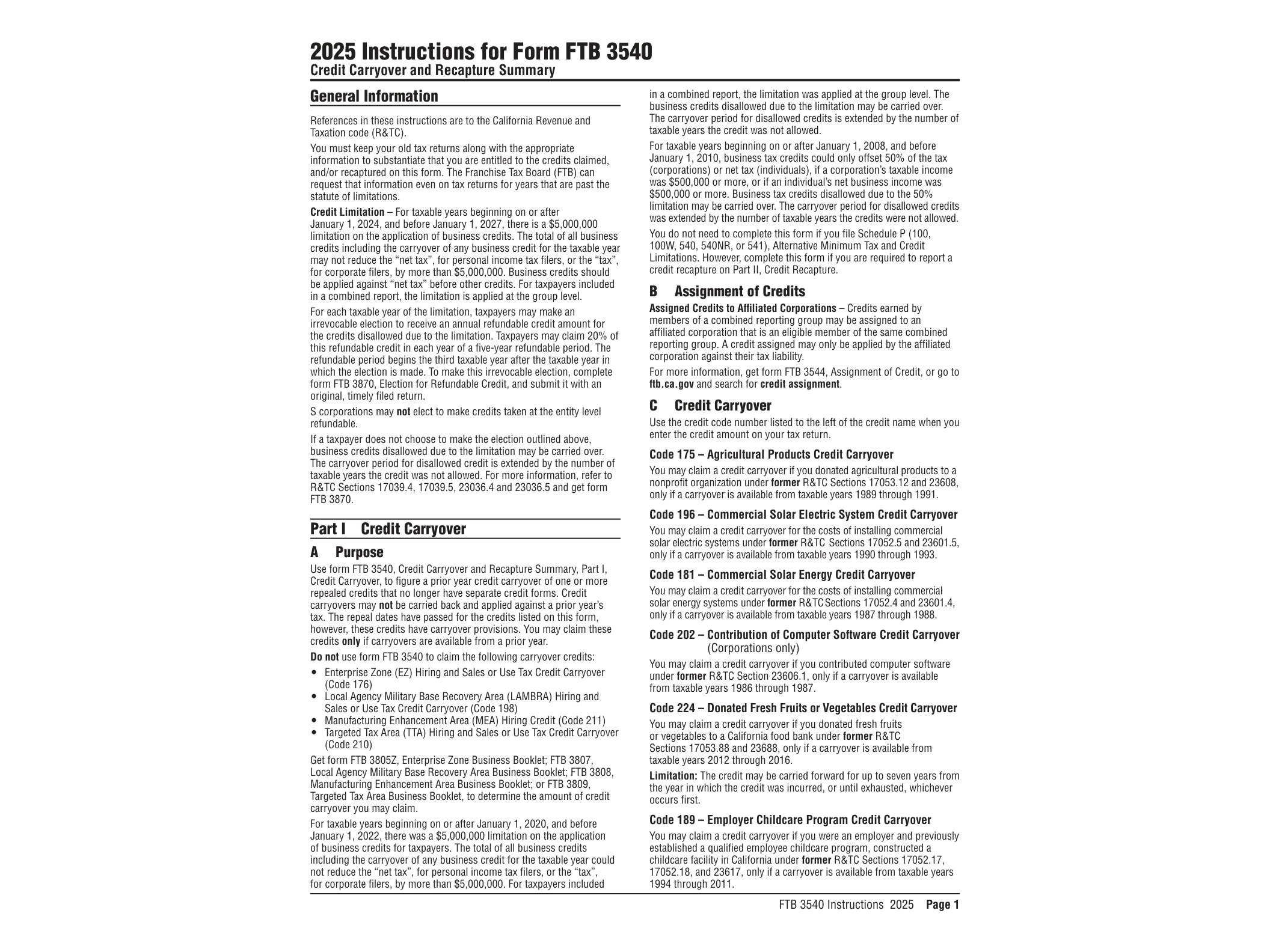
Form 3540, Credit Carryover and Recapture Summary, is a California Franchise Tax Board form used to track tax credits that a taxpayer earned in a prior year but couldn’t fully use, or credits that must be recaptured because the taxpayer no longer qualifies for them. It applies to individuals, estates, trusts, and business entities filing California returns who have leftover credit amounts sitting on their books from previous tax years.
California allows many tax credits to be carried forward when the credit exceeds the tax liability for the year it was generated. Rather than losing that unused portion, taxpayers can apply it against tax owed in future years, sometimes for a set number of years, sometimes indefinitely depending on the specific credit. Form 3540 is where all of that carryover activity gets summarized in one place instead of being scattered across multiple credit-specific forms.
Who Needs to File Form 3540
You need this form if you’re carrying forward an unused credit from a prior tax year into the current one, or if a credit you previously claimed is subject to recapture. Recapture happens when the conditions that originally qualified you for a credit no longer apply — for example, if a business disposes of property tied to a credit before the required holding period ends, or if eligibility requirements change and you no longer meet them.
This form is commonly relevant for businesses that claimed credits like the California Competes Tax Credit, research credits, or various targeted incentive credits tied to specific industries or activities. If you’ve worked with credits like the one described in the California Competes Tax Credit Review Information, you may eventually need Form 3540 to track how much of that credit carries forward or whether any portion needs to be recaptured.
When Form 3540 Gets Used
You’ll typically attach Form 3540 to your California income tax return in any year where you have an active carryover balance or a recapture obligation. It’s not a one-time filing — if a credit carries forward over several years, you may need to file this form annually until the carryover is fully used or expires under the applicable statute of limitations for that specific credit.
The form asks for details on each credit type, the year it originated, the amount already used, the remaining balance, and any recapture amounts that apply to the current tax year. Because California credit rules don’t always mirror federal rules, it helps to cross-reference guidance like the FTB Publication 1006 on California tax forms and related federal forms to confirm you’re tracking the credit under the correct state-specific framework rather than assuming federal carryover rules apply directly.
How to Get and Complete Form 3540
This particular version, the 2016 Form 3540, is not digitally fillable. That means you’ll need to print it and complete it by hand rather than typing directly into a PDF. Once filled out, it gets attached to your California tax return when you file, whether that’s a personal, corporate, or fiduciary return.
Before filling it in, gather your prior-year tax records showing the original credit calculation and any amounts already applied. If you’re unsure how a specific carryover interacts with other California adjustments, the FTB Publication 1001 on supplemental guidelines to California adjustments is a useful companion resource for understanding how state-specific rules might differ from what you’d expect on a federal return.
Since the form covers multiple credit types in one document, take care to match each entry to the correct credit code and tax year. Errors here can delay processing or cause the FTB to request clarification, so double-check totals against your prior filings before submitting.
Download Official Form 3540 (PDF)
Opens the official government PDF in a new tab