
Download Official Form DTF626 (PDF)
Opens the official government PDF in a new tab
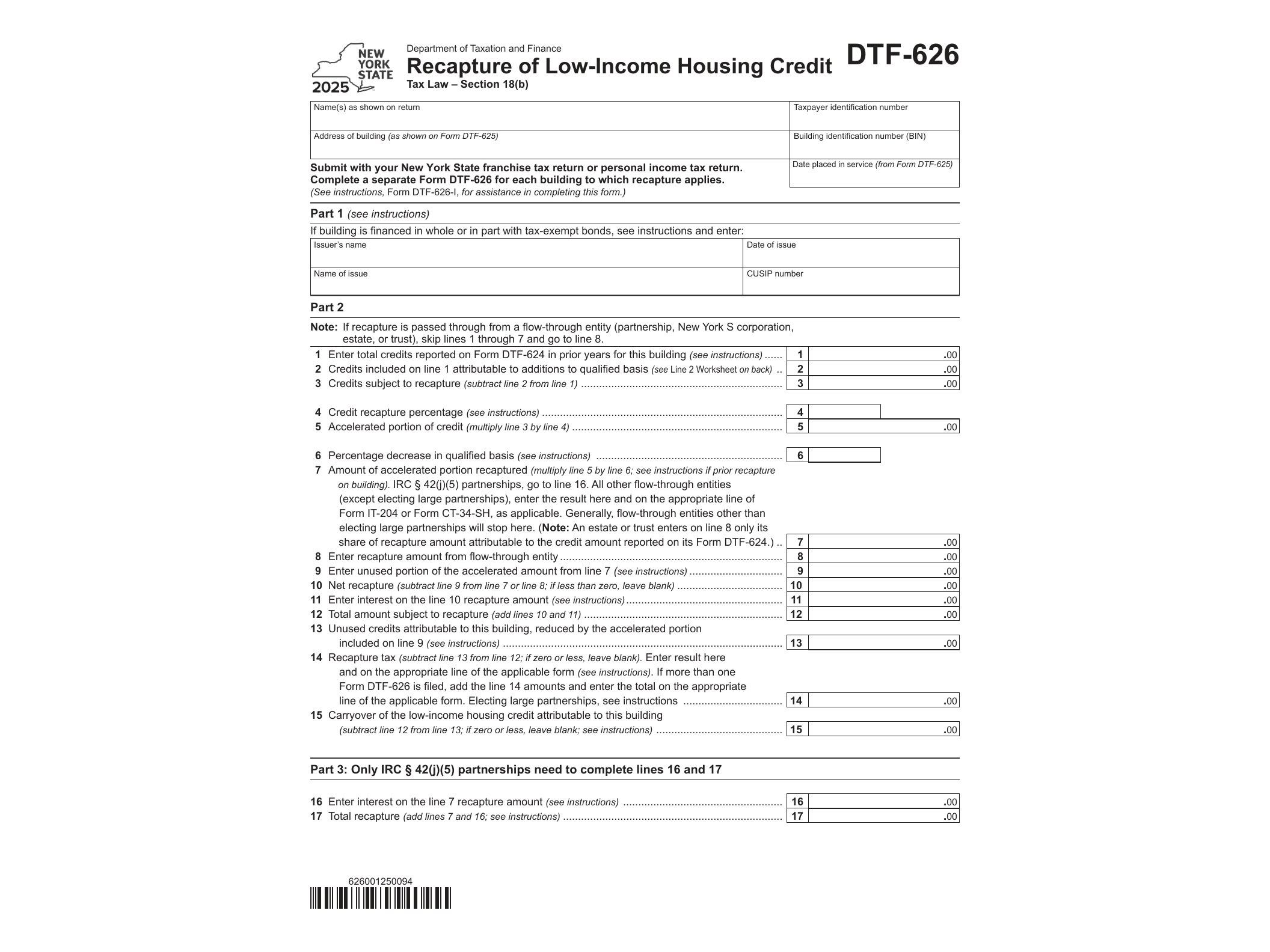
Form DTF-626 is issued by the New York State Department of Taxation and Finance for taxpayers who need to recapture a portion of a low-income housing credit they previously claimed. If a building or unit that generated the credit stopped qualifying under the compliance rules, the state requires you to pay back some of the tax benefit through this form, filed along with your regular income tax return.
The low-income housing credit rewards owners and investors who develop or maintain rental housing set aside for lower-income tenants. That benefit comes with strings attached: the property has to stay compliant with occupancy and rent restrictions for a set compliance period, usually 15 years. When that compliance breaks down, whether through a change in ownership, a drop in the number of qualifying low-income units, or a disposition of the building before the period ends, part of the credit already claimed has to be recaptured and added back to tax liability.
Who needs to file Form DTF-626
This form applies to individuals, partnerships, corporations, and other entities that claimed a New York State low-income housing credit in a prior year and later experienced a recapture event. Common triggers include:
- Selling or transferring the building before the end of the compliance period without arranging a bond as allowed under IRC Section 42(j)(6)
- A reduction in the qualified basis of the building, meaning fewer units still meet the low-income set-aside requirements
- Failure to meet the minimum set-aside test after having previously met it
- Other events that cause the federal credit to be recaptured, since New York generally follows the federal recapture rules
If you’re not sure whether a specific change in ownership or occupancy counts as a recapture event, it usually mirrors whatever triggered a federal recapture under Section 42. Since New York’s credit rides alongside the federal program, most taxpayers filing DTF-626 will have already dealt with the federal recapture calculation on their federal return.
When the form is used
DTF-626 is filed for the tax year in which the recapture event occurs, not the year the original credit was claimed. So if a building disposed of its low-income status in 2025, the recapture gets reported on the 2025 New York return, even though the credit might have been claimed years earlier. The form calculates the accelerated portion of the credit that needs to be added back based on how much of the compliance period remains.
This isn’t a form most landlords will ever touch, but for those managing affordable housing projects with financing tied to housing credits, it’s worth understanding early. Developers who also work with other state credit programs, like the one described in our overview of Form IT-650 for the Empire State Apprenticeship Tax Credit, know that New York ties a lot of its incentive programs to strict compliance tracking, and recapture provisions are a standard part of that structure.
How to get and complete Form DTF-626
The form is available directly from the New York State Department of Taxation and Finance as a fillable PDF, so you can type your entries directly into the form fields before printing or attaching it to your electronic filing. You’ll need documentation from the original credit claim, including the building’s identification number and the credit amount originally allocated, plus details on the recapture event itself: the date it occurred and the percentage of qualified basis affected.
Most filers start with the federal recapture calculation from Form 8611, then translate the relevant figures onto DTF-626 using New York’s specific formulas, since the state credit percentage may differ slightly from the federal one. If your project also involved a low-income housing credit in another state at some point, comparing structures like the one covered in California’s Form 3521 for the Low-Income Housing Credit can help clarify how different states each set up their own compliance and recapture mechanics, even though the actual filing only applies to New York income here.
Once completed, DTF-626 gets attached to your applicable New York State income tax return for the year of the recapture event. Because the calculations depend heavily on how much of the compliance period has passed and how the qualified basis changed, it’s worth double-checking your math against the original credit certificate before submitting.
Download Official Form DTF626 (PDF)
Opens the official government PDF in a new tab