
Download Official Form TP584NYC (PDF)
Opens the official government PDF in a new tab
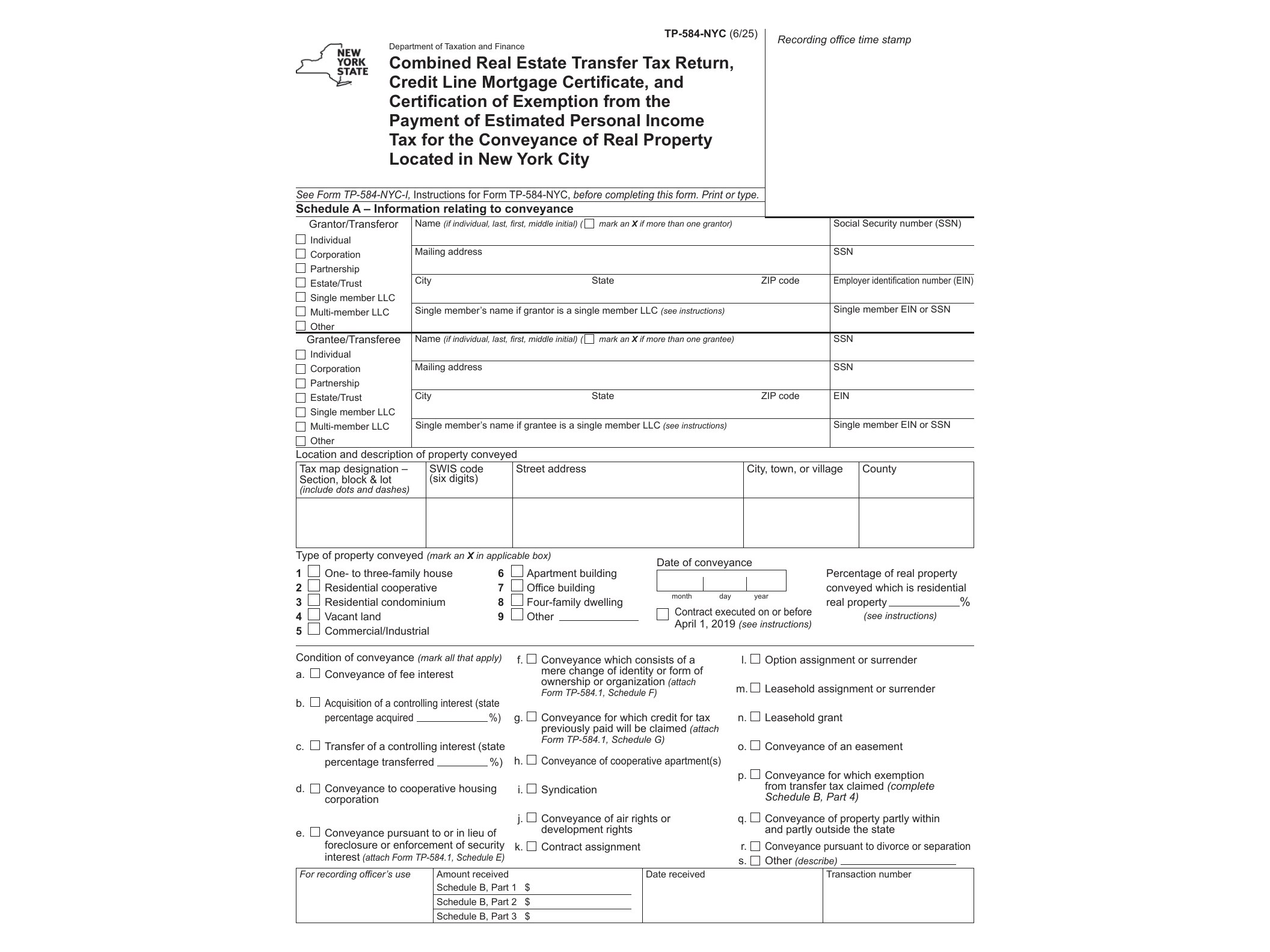
Form TP-584-NYC is the document New York State requires for most real property transfers that take place within the five boroughs of New York City. Issued by the New York State Department of Taxation and Finance, it combines three separate obligations into a single filing: the Real Estate Transfer Tax Return, the Credit Line Mortgage Certificate, and the Certification of Exemption from the Payment of Estimated Personal Income Tax. Because New York City has its own transfer tax rules layered on top of the state’s requirements, this NYC-specific version replaces the standard TP-584 form used in the rest of the state.
Anyone involved in selling, transferring, or conveying real property located in New York City needs to be familiar with this form. In practice, that usually means the grantor (seller), though attorneys, title companies, and closing agents typically prepare and file it on the seller’s behalf as part of the closing package. The form applies to residential sales, commercial transactions, transfers of cooperative units, and conveyances involving certain business entities such as partnerships or corporations that hold title to NYC real estate.
When Is TP-584-NYC Required?
The form must be filed whenever a deed or other instrument transferring real property in New York City is recorded. This includes traditional sales, but also less obvious transactions like transfers between related parties, foreclosure conveyances, and certain lease assignments that are treated as transfers for tax purposes. Filing is mandatory even in cases where no transfer tax is ultimately owed, because the certification of exemption from estimated personal income tax withholding still needs to be documented.
One section of the form addresses credit line mortgages, which are common in New York because they allow a borrower to draw additional funds under an existing mortgage without recording a new one. If the property being transferred is subject to a credit line mortgage, the seller must certify the outstanding balance and related details so the correct transfer tax can be calculated.
What Information You’ll Need
Filers should gather the property address and tax map information, the names and addresses of both grantor and grantee, the type of property being conveyed, the sale price, and details of any existing mortgages assumed by the buyer. The form also requires identifying whether the transaction qualifies for any of the standard exemptions, such as transfers to government entities or certain nonprofit organizations. Entities that already hold state exemption status, similar to organizations that use Form ST-119.2 to apply for exempt organization status, will still need to reference that status correctly on TP-584-NYC when claiming a related exemption.
Because the form has fillable AcroForm fields, it can be completed directly on a computer before printing for signature. This reduces transcription errors at closing, though the finished document still requires wet or electronic signatures where applicable, along with any required notarization, before it’s submitted to the city register or county clerk’s office alongside the deed.
Filing and Payment Details
TP-584-NYC is typically filed at the same time the deed is recorded, and any transfer tax due is paid concurrently. Payment amounts depend on the consideration paid for the property and whether it’s a residential or commercial conveyance, since New York City applies different rate tiers based on property type and sale price. Errors in the tax calculation or missing certifications can delay recording, so many closing professionals double-check figures against the instructions published with the form.
Keeping accurate records of transfer tax filings matters beyond the closing itself. Just as businesses track credits like the one described in our overview of the Green Building Credit for tax year 2025, property owners and sellers should retain a copy of the filed TP-584-NYC for their own tax records, since it documents the basis for state and city transfer tax obligations tied to the property.
Given the interaction between state transfer tax rules, city-specific surcharges, and personal income tax withholding certifications, many filers rely on real estate attorneys or title companies to complete this form correctly. Getting the details right the first time avoids delays at the recording office and prevents complications down the line when the property’s tax history is reviewed.
Download Official Form TP584NYC (PDF)
Opens the official government PDF in a new tab