
Download Official Form RP467 (PDF)
Opens the official government PDF in a new tab
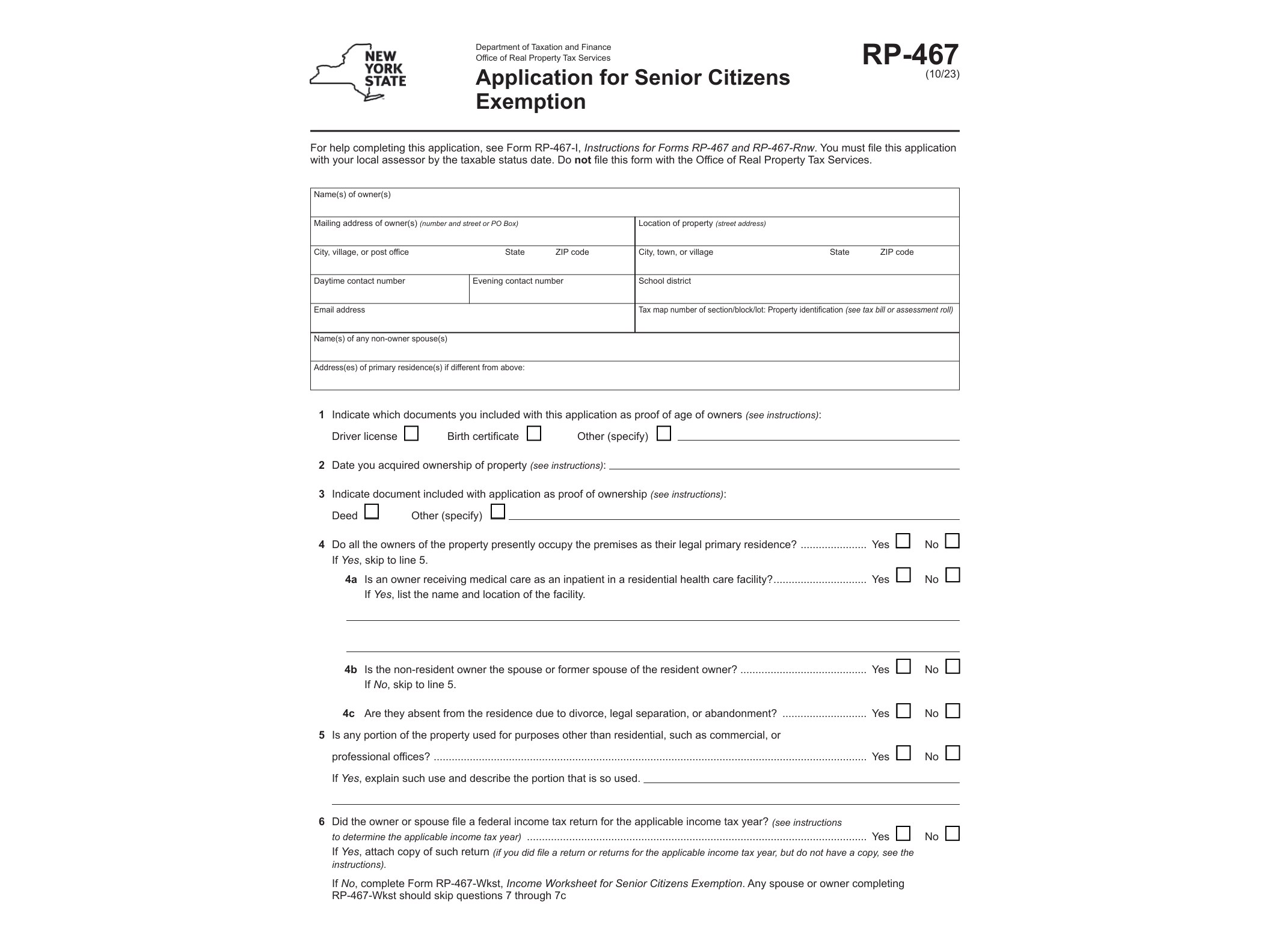
Form RP-467 is the application New York homeowners use to request a partial property tax exemption based on age and income under Real Property Tax Law Section 467. It’s issued by the New York State Department of Taxation and Finance, but it’s actually filed with your local assessor’s office, not with the state directly. The exemption can reduce the taxable assessed value of a senior’s primary residence, which lowers the school, county, city, town, or village taxes owed depending on which taxing jurisdictions have adopted the exemption locally.
This form matters because the senior citizens exemption is optional for each municipality and school district. Some local governments offer it at the maximum allowed percentage, others at a reduced rate, and some don’t offer it at all. Before filling out RP-467, it’s worth checking with your town or city assessor to confirm the exemption is available where you live and what income limits apply, since those limits can differ from one jurisdiction to another.
Who Needs This Form
You need Form RP-467 if you’re 65 or older (or if you own the property jointly with a spouse or sibling and at least one of you is 65+), you own and occupy the property as your primary residence, and your income falls within the limits set by the local taxing jurisdiction. Income for this purpose generally includes Social Security, pensions, interest, dividends, and net rental income, minus certain deductible medical and prescription drug expenses.
Property owners who don’t meet the age or income thresholds for this exemption but still want relief on residential property in specific counties should look at Form RP-467-J, which applies to a different partial exemption program limited to certain counties. Homeowners in Syracuse dealing with flood insurance-related property adjustments may instead need Form RP-467-K1, which addresses a separate, narrower exemption tied to flood insurance costs.
When to File
Form RP-467 must be filed with your local assessor’s office on or before the taxable status date for your municipality, which is typically March 1 in most of New York State, though it can vary by county (May 1 in some, July 1 in Nassau County, and different dates in New York City). Filing late usually means missing the exemption for that tax year entirely, so it’s worth marking the deadline on your calendar rather than waiting until the last week.
Once granted, the exemption isn’t necessarily permanent. Most assessors require proof of continued eligibility, and many jurisdictions ask seniors to file a renewal or an affidavit periodically instead of a full new application. If your assessor sends you a renewal notice, you may be asked to complete Form RP-467-aff/ctv, the affidavit confirming your income and residency status haven’t changed in a way that would disqualify you.
How to Complete and Submit It
The version linked here for tax year 2023 is a fillable PDF, meaning you can type your information directly into the form fields on a computer before printing it for signature. You’ll need to provide ownership information, the property’s tax map number or address, proof of age (such as a birth certificate or driver’s license), and documentation of income for the applicable base year, which is usually the calendar year prior to the application.
Supporting documents commonly requested alongside the form include Social Security benefit statements, pension statements, bank interest records, and tax returns. Because assessors review these applications individually, it helps to submit complete documentation the first time rather than leaving gaps that could delay processing or result in a denial you’d need to appeal through the local Board of Assessment Review.
If you’re unsure whether your municipality participates in this exemption or what the local income ceiling is, contacting the assessor’s office before submitting the paperwork saves time and avoids a rejected application over eligibility issues that could have been clarified upfront.
Download Official Form RP467 (PDF)
Opens the official government PDF in a new tab