
Download Official Form RP483D (PDF)
Opens the official government PDF in a new tab
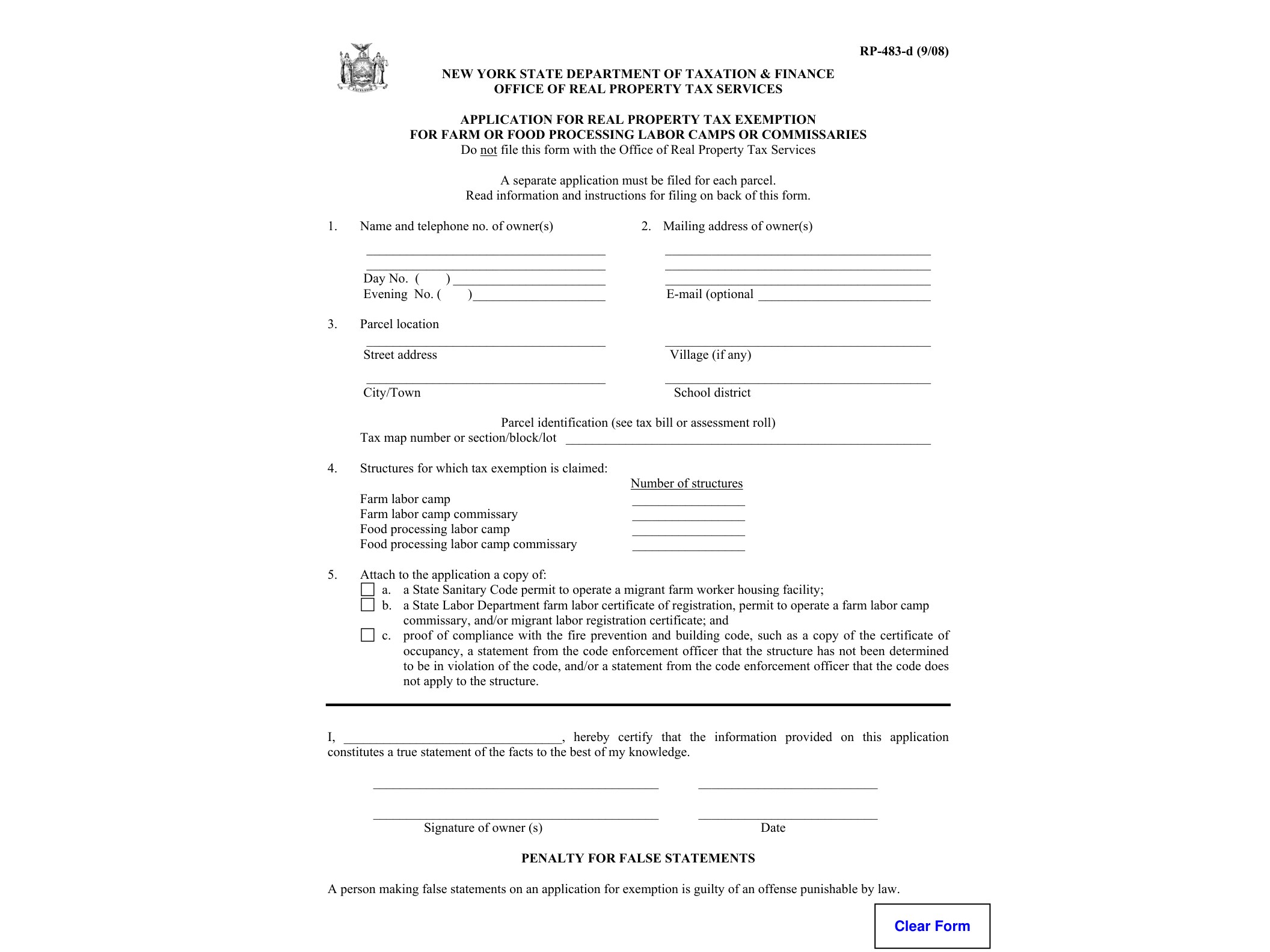
Form RP-483-D, officially titled “Application for Real Property Tax Exemption for Farm or Food Processing Labor Camps or Commissaries,” is issued by the New York State Department of Taxation and Finance. It allows owners of agricultural or food processing operations to request a property tax exemption on structures built or improved specifically to house or feed seasonal farm labor.
The exemption covers buildings used as labor camps — housing for migrant or seasonal workers employed on a farm or in a food processing facility — as well as commissaries, meaning on-site facilities where workers can purchase food, personal items, or other necessities. New York created this exemption to encourage farm owners and food processors to maintain decent, code-compliant housing and support services for agricultural workers without facing a heavier property tax burden for doing so.
Who Needs This Form
This application is intended for owners of farm operations or food processing businesses in New York State who have constructed, reconstructed, or improved a labor camp or commissary building on their property. If you’re a farmer who built new dormitory-style housing for seasonal crews, or a food processing company that added a commissary structure for workers, this is the form your local assessor will require to grant the exemption.
It’s not intended for general agricultural exemptions or for residential property owned by non-farm entities. The exemption specifically targets the value added by qualifying construction related to farm or food processing labor housing and support facilities, not the entire assessed value of the farm itself.
When Is It Used
RP-483-D is typically filed after new construction or a significant improvement to a labor camp or commissary is completed. Property owners generally need to submit the application to their local assessor within the timeframe set by the taxable status date in their municipality, which is often March 1 in many parts of the state, though this can vary by locality. Missing that window usually means waiting until the next assessment cycle.
Because the exemption is tied to a specific construction or improvement project, owners should keep documentation such as building permits, cost records, and construction dates on hand, since assessors may request proof that the improvement qualifies under the statute before approving the exemption.
How to Get and Fill Out RP-483-D
The form is available as a fillable PDF directly from the New York State Department of Taxation and Finance. It can be completed on a computer using the built-in AcroForm fields, then printed and signed before submission, since most local assessors still require a physical or scanned signed copy.
When filling it out, you’ll need to provide basic identifying information about the property, a description of the labor camp or commissary improvement, the date construction was completed, and the associated costs. The form also asks for details confirming that the housing or commissary is used specifically for farm or food processing workers, which is central to qualifying for the exemption.
Once completed, the form is filed with the assessor of the city, town, or village where the property is located — not with the state tax department directly. Local assessors review the application and supporting documentation to determine eligibility and the amount of the exemption.
Property owners dealing with agricultural or industrial property tax exemptions in New York often find themselves navigating several related forms. For instance, businesses with waste treatment infrastructure on similar properties may also need to look into Form RP-477 for industrial waste treatment facility exemptions. Homeowners on the same property who qualify for age-based relief should check out the RP-467-Rnw renewal application for the Senior Citizens Exemption, and those managing notifications for that exemption may need Form RP-467-TPN for third-party notice requests.
Because exemption rules and renewal requirements can change from one assessment cycle to the next, it’s worth confirming current deadlines and documentation requirements with your local assessor’s office before submitting RP-483-D.
Download Official Form RP483D (PDF)
Opens the official government PDF in a new tab