
Download Official Form RP485G (PDF)
Opens the official government PDF in a new tab
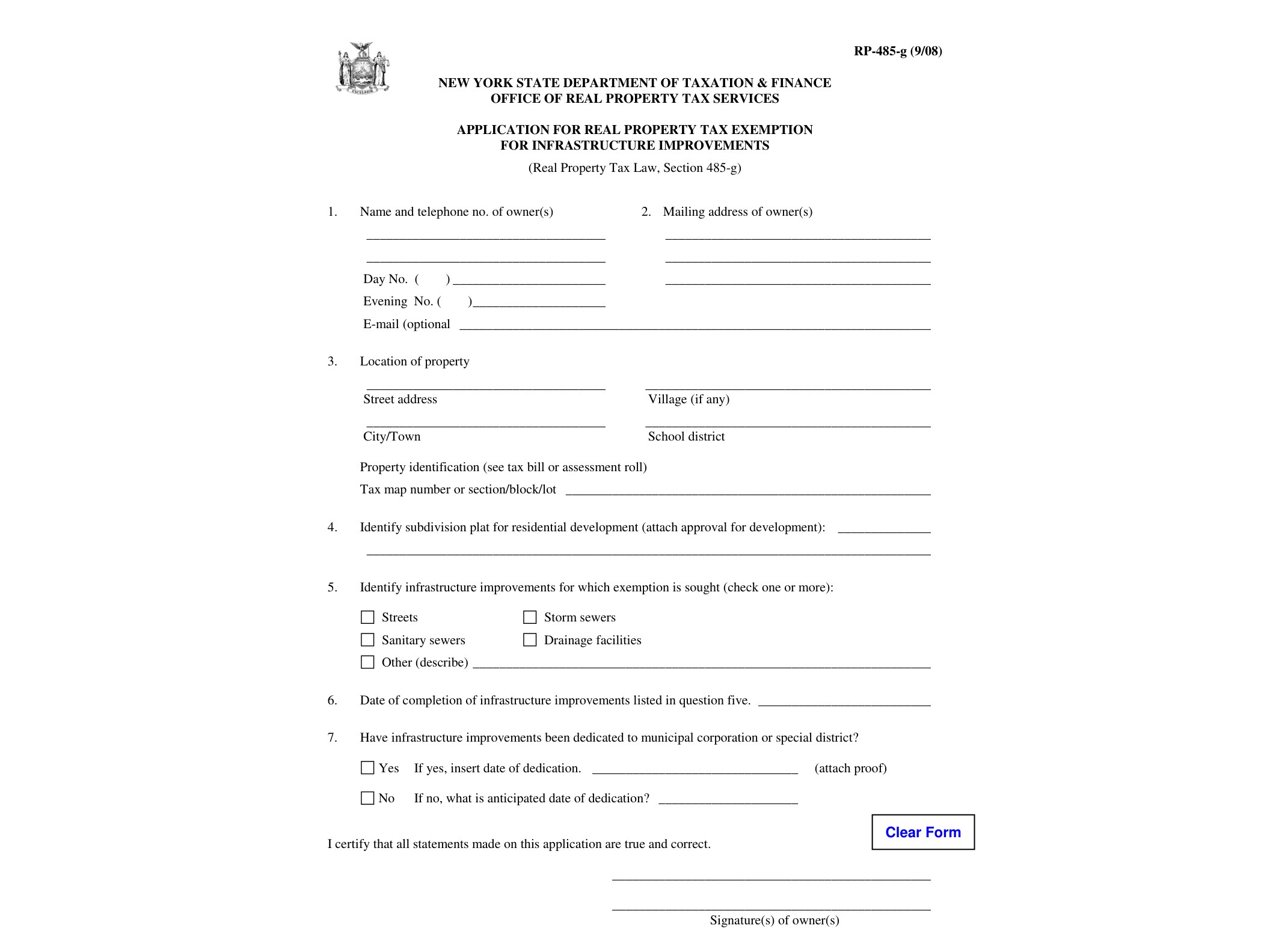
Form RP-485-G is issued by the New York State Department of Taxation and Finance to let property owners apply for a real property tax exemption tied specifically to infrastructure improvements. This exemption exists to encourage property owners to invest in upgrades like water lines, sewer connections, roads, drainage systems, and other physical infrastructure that support development on a parcel, without immediately triggering a higher tax assessment based on that added value.
The form dates back to a September 2008 revision (9/08) and remains in active use in municipalities across New York that have adopted the local law authorizing this exemption under the relevant section of the Real Property Tax Law. Not every town or city offers this exemption automatically — it depends on whether the local taxing jurisdiction has opted into the program. Property owners should check with their local assessor’s office before filling out the paperwork to confirm the exemption is actually available where the property sits.
Who Needs Form RP-485-G
This form is meant for owners of real property who have made, or plan to make, qualifying infrastructure improvements to their land. That typically includes developers, business owners, and in some cases residential property owners who are extending utility service, building access roads, or installing drainage and stormwater systems as part of a larger construction or renovation project.
It’s worth noting that this exemption is narrower than some of the other property tax exemption programs New York offers. For example, property owners working on residential rehabilitation projects may find more relevant options in forms like Form RP-485-L for residential property improvements in Amherst, which covers a different category of upgrades under its own local exemption rules. Form RP-485-G, by contrast, is focused specifically on infrastructure — not general renovations or livability improvements.
When to File This Form
Property owners should submit Form RP-485-G to their local assessor after completing the infrastructure work, though timing requirements can vary by jurisdiction. Most municipalities that adopt this exemption set a filing deadline tied to the taxable status date, which is usually March 1 in most of New York State outside New York City. Missing that window generally means waiting until the following assessment cycle to apply, so it pays to file as soon as the work is finished and documented rather than waiting.
The exemption itself is not permanent. Like most of New York’s property tax exemption programs tied to specific improvements, it phases in gradually and then phases out over a set number of years, meaning the taxable value gradually reflects the full assessed value of the improvements over time rather than jumping immediately.
How to Complete and Submit the Form
Form RP-485-G is available as a fillable PDF, which means you can complete it digitally on your computer before printing it for signature and submission — most local assessors still require a physical signed copy rather than a digital submission. The form asks for standard identifying information: the property owner’s name and address, the parcel’s tax map number, a description of the infrastructure improvements made, the date the work was completed, and supporting cost documentation.
Assessors may also request additional proof, such as contractor invoices, permits, or engineering plans, to verify that the improvements qualify under the local law. It’s a good idea to call the assessor’s office ahead of time to ask what documentation they expect alongside the form, since requirements can differ from one town to the next.
Property owners exploring other real property exemption categories in New York — particularly those involved in urban redevelopment or multi-unit residential conversions — may also want to review Form RP-485-a-C for the residential-commercial urban exemption program or Form RP-485-K for residential investment properties in the Utica school district, since these programs sometimes overlap with infrastructure-related projects depending on the scope of the development.
Because eligibility and exemption schedules are set locally, the assessor’s office is the best source for confirming whether a specific project qualifies and what percentage of the assessed value will be exempted each year during the phase-in period.
Download Official Form RP485G (PDF)
Opens the official government PDF in a new tab