
Download Official Form RP485L (PDF)
Opens the official government PDF in a new tab
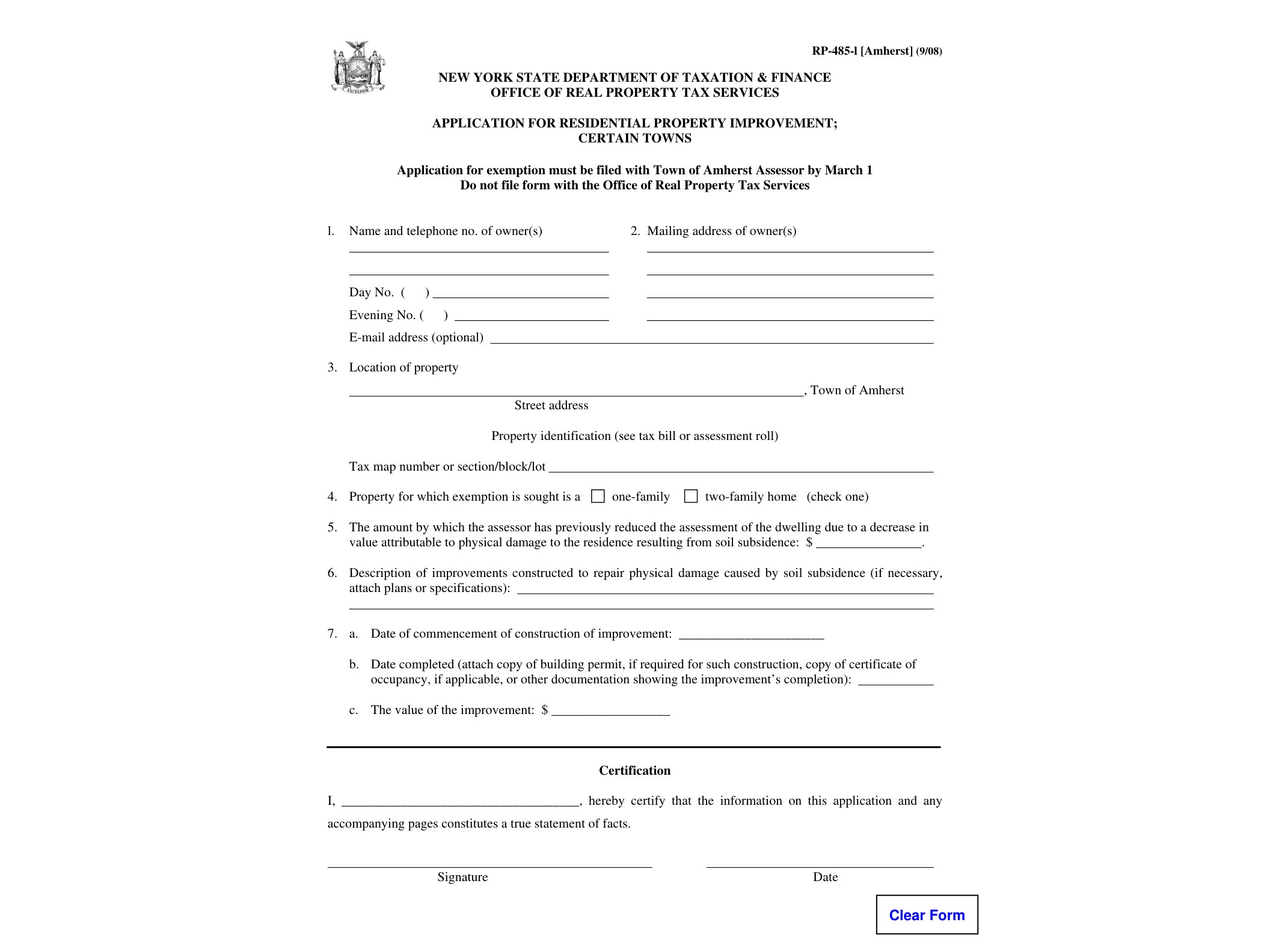
Form RP-485-L is a property tax exemption application specific to the Town of Amherst, New York, designed for homeowners who make qualifying improvements to their residential property. Issued by the New York State Department of Taxation and Finance, this form lets eligible property owners apply for a temporary exemption on the increase in assessed value that results from residential construction, reconstruction, or major alterations. Instead of paying full property taxes on the added value right away, homeowners can phase in that increase over several years.
This exemption exists because local governments recognize that home improvements — additions, renovations, structural upgrades — often raise a property’s assessed value significantly. Without some form of relief, homeowners could face a sudden jump in their tax bill the year after finishing a project. Amherst adopted this local option under New York’s Real Property Tax Law, which is why the form is tied specifically to that town rather than being a statewide document.
Who Needs This Form
Form RP-485-L is meant for owners of one, two, or three-family residential properties located within the Town of Amherst who have completed or are planning improvements that increase the home’s assessed value. Typical qualifying work includes room additions, garage construction, major renovations, or other structural changes that go beyond routine repairs or maintenance. Cosmetic updates like repainting or replacing fixtures generally don’t count — the exemption targets improvements that meaningfully increase market value and, by extension, the assessment.
If you own residential property outside Amherst, this particular form won’t apply to you, since the exemption is a local option adopted at the town level. Other municipalities in New York have their own versions of similar exemptions, sometimes under different form numbers, so it’s worth checking with your local assessor if you live elsewhere and want to know whether a comparable program exists.
When to Use It
The application should be filed after the qualifying improvement is completed, but there are strict deadlines tied to the local assessment calendar. Property owners typically need to submit the form before the taxable status date for the assessment year in which they want the exemption to begin. Missing that window usually means waiting until the following assessment cycle, so it pays to file as soon as construction wraps up rather than putting it off.
Because the exemption phases in the increased assessment gradually — often over a set number of years with a declining percentage of exemption each year — homeowners should also keep records of their renewal obligations, since some versions of this exemption require continued documentation to keep the benefit active for the full term.
How to Get and Complete the Form
Form RP-485-L for Amherst is available as a fillable PDF directly from the New York State Department of Taxation and Finance website. Since it includes AcroForm fields, you can type your information directly into the document on a computer before printing it for signature and submission — no need to fill it out by hand unless you prefer to.
When completing the form, you’ll need to provide identifying information about the property, a description of the improvement work performed, the date construction was completed, and supporting documentation such as building permits or contractor invoices. The local assessor’s office reviews the application to confirm the work qualifies and calculates the exempt portion of the assessment increase.
Once completed, the form goes to the Amherst town assessor’s office rather than to the state tax department, since exemption determinations are handled locally even though the form itself is a state-issued document. If you’re unsure whether your renovation qualifies, contacting the assessor’s office before filing can save time and prevent an incomplete submission.
Homeowners exploring other residential or commercial property tax exemptions in New York might also find it useful to compare this form with Form RP-485-I for Jamestown, which covers residential investment property exemptions in a different municipality, or review Form RP-485-F, which applies to a very different category of property — branch banks in banking development districts. Property owners dealing with other types of specialized exemptions may also want to look at Form RP-477-A, covering air pollution control facility exemptions, just to get a sense of how varied these local property tax programs can be across New York State.
Because exemption rules and deadlines can shift from year to year, it’s worth confirming current requirements with the Amherst assessor before submitting your application, particularly if your improvement project spanned multiple tax years or involved phased construction.
Download Official Form RP485L (PDF)
Opens the official government PDF in a new tab