
Download Official Form RP485W (PDF)
Opens the official government PDF in a new tab
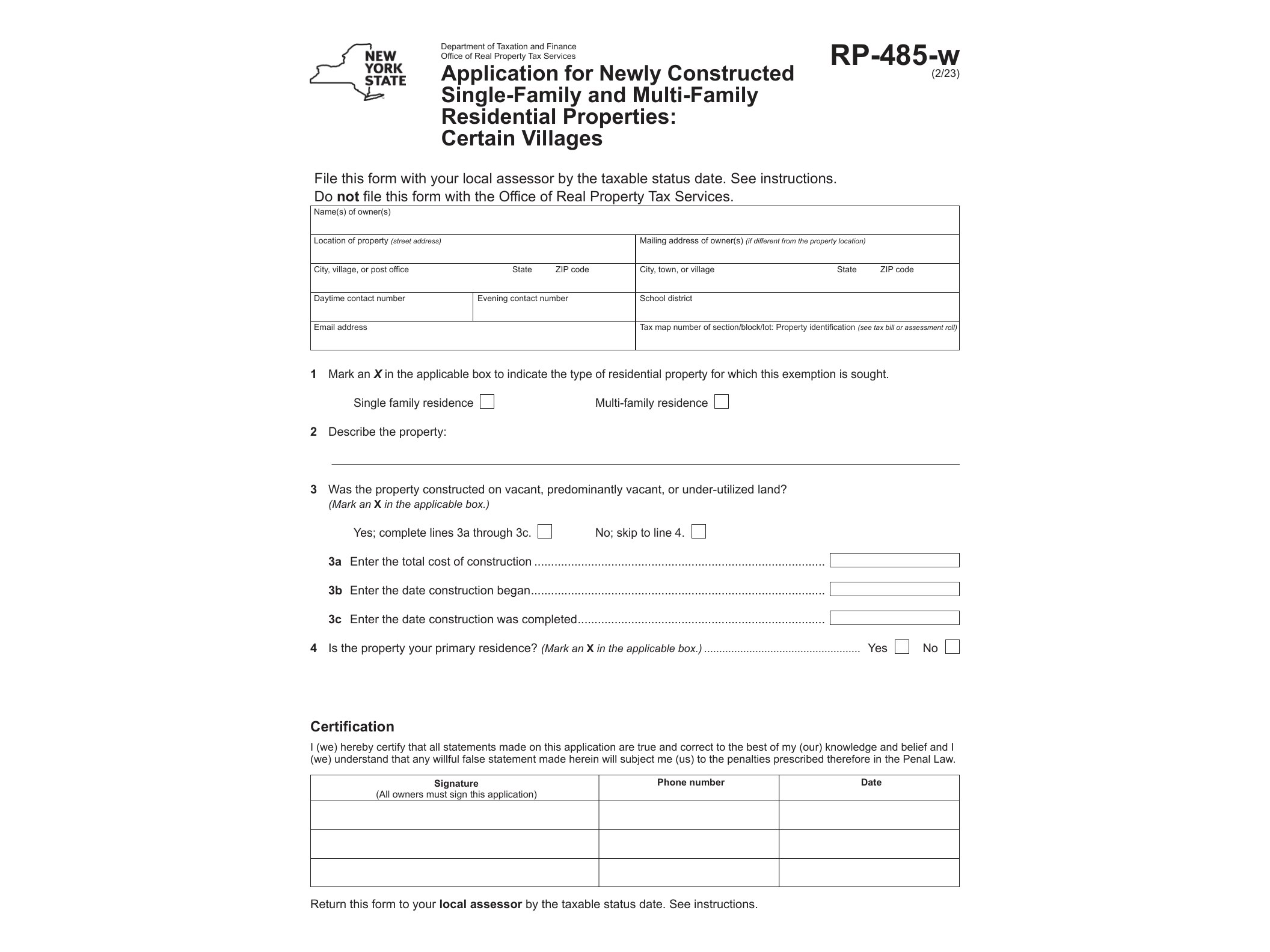
Form RP-485-W is issued by the New York State Department of Taxation and Finance (Office of Real Property Tax Services) and gives owners of newly built residential properties in certain villages a partial exemption from real property taxes. If you’ve recently built a single-family home or a multi-family residential building within an eligible village, this is the form that lets you apply for that tax break rather than paying the full assessed value from day one.
What This Form Does
The exemption under RP-485-W isn’t automatic. A village has to have adopted a local law allowing this exemption before property owners in that jurisdiction can apply. Once that’s in place, newly constructed single-family and multi-family residential properties can qualify for a reduced assessment for a set number of years, phasing in the full taxable value gradually instead of hitting the owner with the entire increase at once.
This matters because new construction often triggers a large jump in assessed value compared to vacant land or an older structure that previously sat on the lot. Without an exemption program like this, homeowners and developers could face a steep tax increase the year after construction is completed. The phased exemption smooths that transition.
Who Should File Form RP-485-W
This form is meant for:
- Owners of newly constructed single-family residential properties located in a village that has adopted the local exemption law
- Owners or developers of newly constructed multi-family residential properties within an eligible village
- Property owners who completed construction recently and haven’t yet had the increased assessment reflected in a prior tax roll
Before filling anything out, check with your village clerk or local assessor to confirm the village has actually opted into this exemption. Not every village offers it, and the terms (exemption percentage, number of years, phase-out schedule) can vary depending on the local law adopted.
When to Submit the Application
Applications for property tax exemptions in New York generally need to be filed with the local assessor before the taxable status date for the assessment roll on which the exemption is first sought. Because this date differs by municipality, it’s worth confirming the exact deadline with your assessor’s office rather than assuming a statewide date applies. Missing the deadline typically means waiting until the following assessment year to apply.
How to Fill Out the Form
Form RP-485-W is a fillable PDF (AcroForm), so you can complete it directly on your computer before printing it for signature and submission. The form asks for standard identifying details such as the property’s location, tax map number, and owner information, along with specifics about the construction project itself — completion date, type of residence (single-family or multi-family), and construction costs. You’ll also need to indicate which local law is being cited, since the exemption depends on the village’s specific adopted ordinance.
Supporting documentation is usually required, including proof of construction costs and the certificate of occupancy or similar evidence showing when the building was completed. Assessors may request additional paperwork depending on local practice, so it helps to call ahead and ask what they expect to see alongside the application.
Once completed, the form goes to the assessor of the village (or the appropriate assessing unit) where the property sits — not to the state tax department directly. The Department of Taxation and Finance publishes the form, but local assessors administer the actual exemption.
Related Village and Municipal Exemptions
RP-485-W is one of several similar forms covering different property types and municipalities. If your project involves mixed residential and commercial use, take a look at Form RP-485-S for mixed-use property exemptions. Property owners dealing with vacant residential buildings that have since been improved may want to review Form RP-485-Y for vacant residential improvement exemptions, which applies in certain cities rather than villages. And for residential investment property specifically tied to a school district exemption program, Form RP-485-M covers the Rome School District exemption.
Because these exemptions are tied to local laws rather than a single statewide rule, the right form — and whether you qualify at all — depends heavily on where the property is located. Confirming eligibility with your village assessor before submitting paperwork will save time and avoid a rejected application.
Download Official Form RP485W (PDF)
Opens the official government PDF in a new tab