
Download Official Form RP485M (PDF)
Opens the official government PDF in a new tab
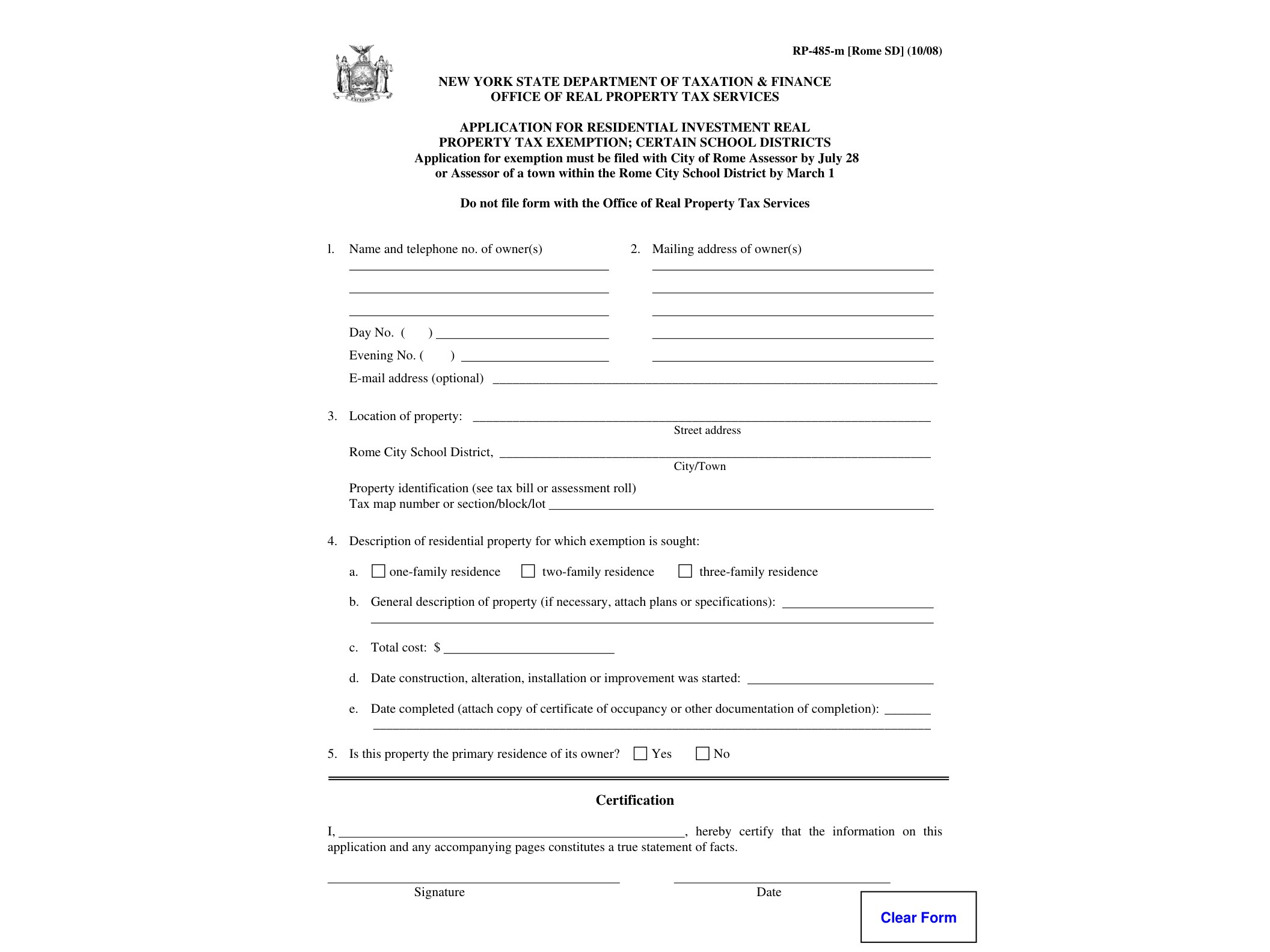
Form RP-485-M is issued by the New York State Department of Taxation and Finance for property owners seeking a tax exemption tied to residential investment property located within the boundaries of a specific school district, in this case the Rome school district. The full title, “Application for Residential Investment Real Property Tax Exemption; Certain School Districts,” reflects the fact that this exemption isn’t available statewide — it applies only where the local school district has opted into the program authorized under Real Property Tax Law Section 485-m.
This form exists because some school districts, working with their municipalities, allow property owners to receive a phased tax exemption on the increased value that comes from investing in residential rental or investment property. The idea is to encourage owners to renovate, improve, or newly construct residential investment properties without facing an immediate spike in their property tax bill based on the full improved assessed value. Instead, the exemption reduces the taxable increase gradually over a set number of years, giving owners time to recoup their investment before the property is taxed at its full improved value.
Who needs this form? Primarily landlords, investors, and developers who own or are constructing residential investment property — meaning property intended for rental income or investment purposes rather than owner-occupied use — within a school district that has adopted the 485-m exemption, such as Rome. If your property doesn’t fall inside a participating school district, this specific version of the form (rp485mrosesd) won’t apply to you, and you’d need to check whether your local school district has its own version of the exemption or look into a different program entirely.
The form is used at the time an owner completes qualifying construction, alteration, installation, or improvement of residential investment property. You typically file it with your local assessor after the work is finished and before the applicable filing deadline in your jurisdiction, since exemption applications are generally tied to the assessment roll and taxable status dates set by the municipality. Missing the local deadline can mean waiting an entire additional assessment cycle before the exemption kicks in, so timing matters as much as accuracy when completing this application.
Because this is an AcroForm, you can fill it out digitally using standard PDF software before printing it for signature and submission, or in some cases submitting according to your assessor’s accepted method. The form asks for details such as the property’s location, a description of the improvements made, the cost of construction, and a certification signed by the owner attesting to the accuracy of the information provided. Assessors use this information to verify eligibility and calculate the exempt portion of the assessed value under the applicable schedule.
It’s worth comparing this exemption to similar but distinct programs available in other parts of the state. For example, property owners in certain villages dealing with mixed residential and commercial use may instead need Form RP-485-S for mixed use property exemptions, while owners of vacant residential property undergoing improvements in specific cities would look at Form RP-485-Y for vacant residential improvement exemptions. Owners of residential-commercial properties in certain counties have their own separate application as well, detailed in Form RP-485-N. These programs overlap in purpose but differ in eligibility based on property type, location, and the specific local law or school district resolution authorizing them.
Before filling out Form RP-485-M, it’s a good idea to confirm directly with your local assessor’s office that the Rome school district version applies to your parcel, since the exemption terms, benefit percentages, and duration can vary based on the local option adopted. Assessors can also confirm what supporting documentation, such as building permits or cost breakdowns, they expect alongside the completed application.
Download Official Form RP485M (PDF)
Opens the official government PDF in a new tab