
Download Official Form RP485Q (PDF)
Opens the official government PDF in a new tab
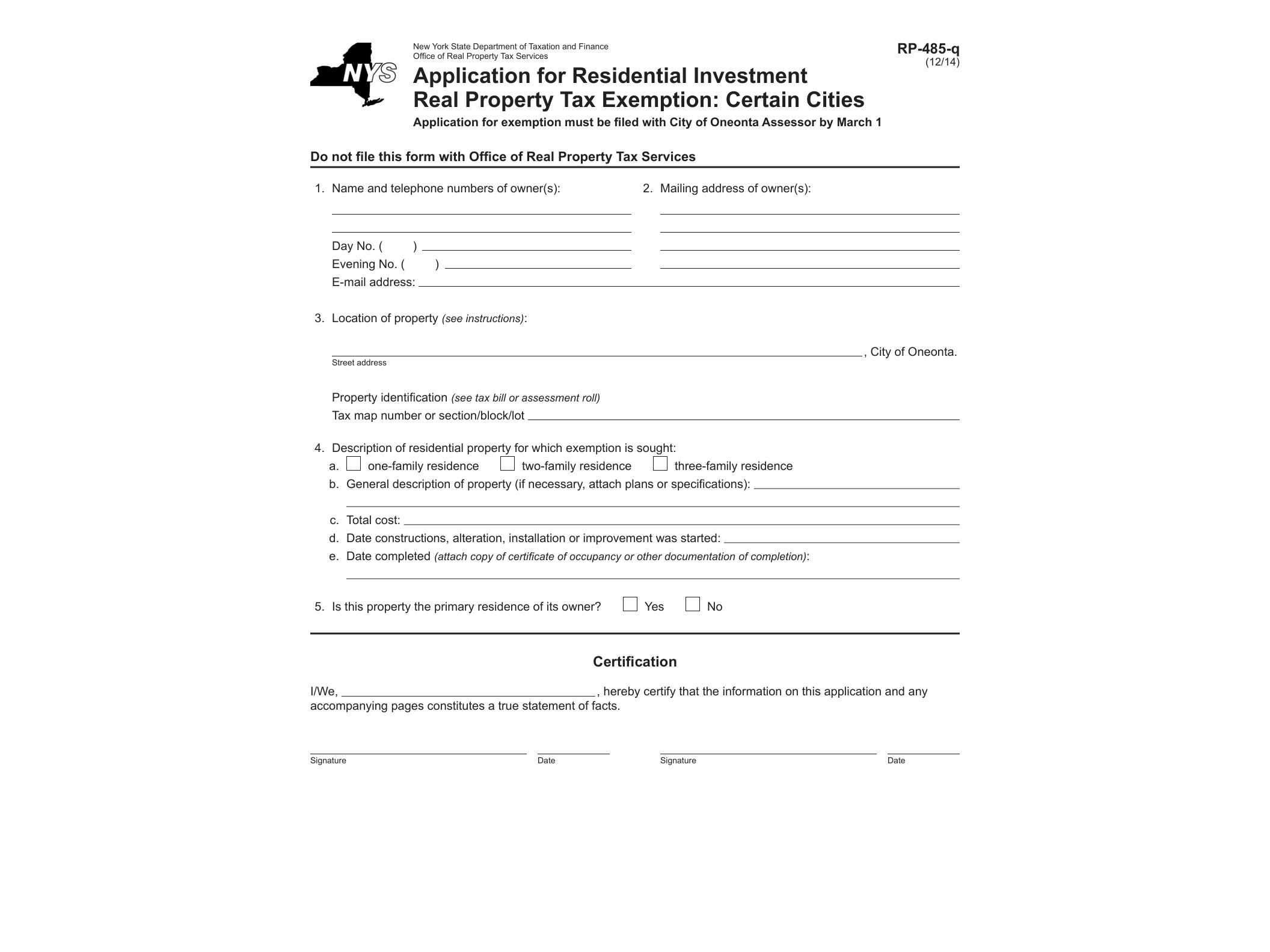
Form RP-485-Q is issued by the New York State Department of Taxation and Finance, specifically through the Office of Real Property Tax Services (ORPTS). Its full title is “Application for Residential Investment Real Property Tax Exemption: Certain Cities,” and it’s designed for property owners in designated New York cities who are investing in the construction or improvement of residential rental property. If your city has adopted a local law authorizing this exemption under Real Property Tax Law Section 485-q, this form is how you apply for the reduced assessment that follows.
This exemption isn’t automatic and it isn’t available everywhere. It only applies in cities that have specifically opted into the 485-q program through local legislation. Before you spend time filling out the form, check with your city or municipal assessor’s office to confirm whether your city participates and what local percentages, terms, or additional conditions apply. Each municipality can set its own exemption schedule within the limits allowed by state law, so the benefit amount and duration can vary depending on where the property is located.
Who Should File Form RP-485-Q
This form is meant for owners of residential investment property — generally multi-family rental buildings — who are constructing new units or making substantial improvements to existing residential rental structures. The exemption is meant to encourage investment in housing stock within cities that have identified a need for more rental units or improved existing ones. If you’re a landlord or developer planning renovations or new residential construction in a qualifying city, this is the exemption program to look into.
It’s worth noting that RP-485-Q is distinct from similar-sounding programs that apply to different property types or municipalities. For example, property owners dealing with newly constructed single-family or multi-family residences in villages should instead look at Form RP-485-W, which covers a separate exemption track. Similarly, if your investment property falls within the Rome School District, Form RP-485-M is the applicable form rather than RP-485-Q. Confirming the right form for your municipality and property type before filing will save you from processing delays.
When to Submit the Application
Timing matters with property tax exemption applications. You generally need to file Form RP-485-Q with your local assessor before the taxable status date for the assessment roll on which you want the exemption to first apply. Local assessors can confirm the exact deadline in your city, since taxable status dates can differ slightly depending on the municipality. Filing after construction or improvements are substantially complete, but before this deadline, is the typical approach.
Because the exemption phases in over a period of years and eventually phases out, the timing of your initial filing affects the entire schedule of reduced assessments you’ll receive. Missing the deadline in a given year usually means waiting until the following assessment cycle to apply, so it pays to plan ahead if you know a project will be completed soon.
How to Complete and File the Form
Form RP-485-Q is available as a fillable PDF, meaning you can type your information directly into the form fields on a computer before printing it for signature and submission. You’ll need to provide details about the property, including its location, a description of the construction or improvements made, cost figures, and ownership information. The form also requires you to certify that the property meets the residential investment criteria set out under the local law adopted by your city.
Once completed, the form is filed with the assessor in the city where the property is located — not with the state Department of Taxation and Finance directly. The assessor’s office reviews the application, verifies eligibility against local requirements, and determines the exemption amount based on the schedule your city has established. Keep copies of construction records, permits, and cost documentation, since assessors may request supporting evidence to substantiate the improvements described in your application.
If your property also includes a mixed-use component, such as ground-floor commercial space combined with residential units above, check whether Form RP-485-S might be a better fit for your situation, since that exemption specifically addresses mixed-use properties in certain villages rather than purely residential investment properties in cities.
Download Official Form RP485Q (PDF)
Opens the official government PDF in a new tab