
Download Official Form RP489DRP (PDF)
Opens the official government PDF in a new tab
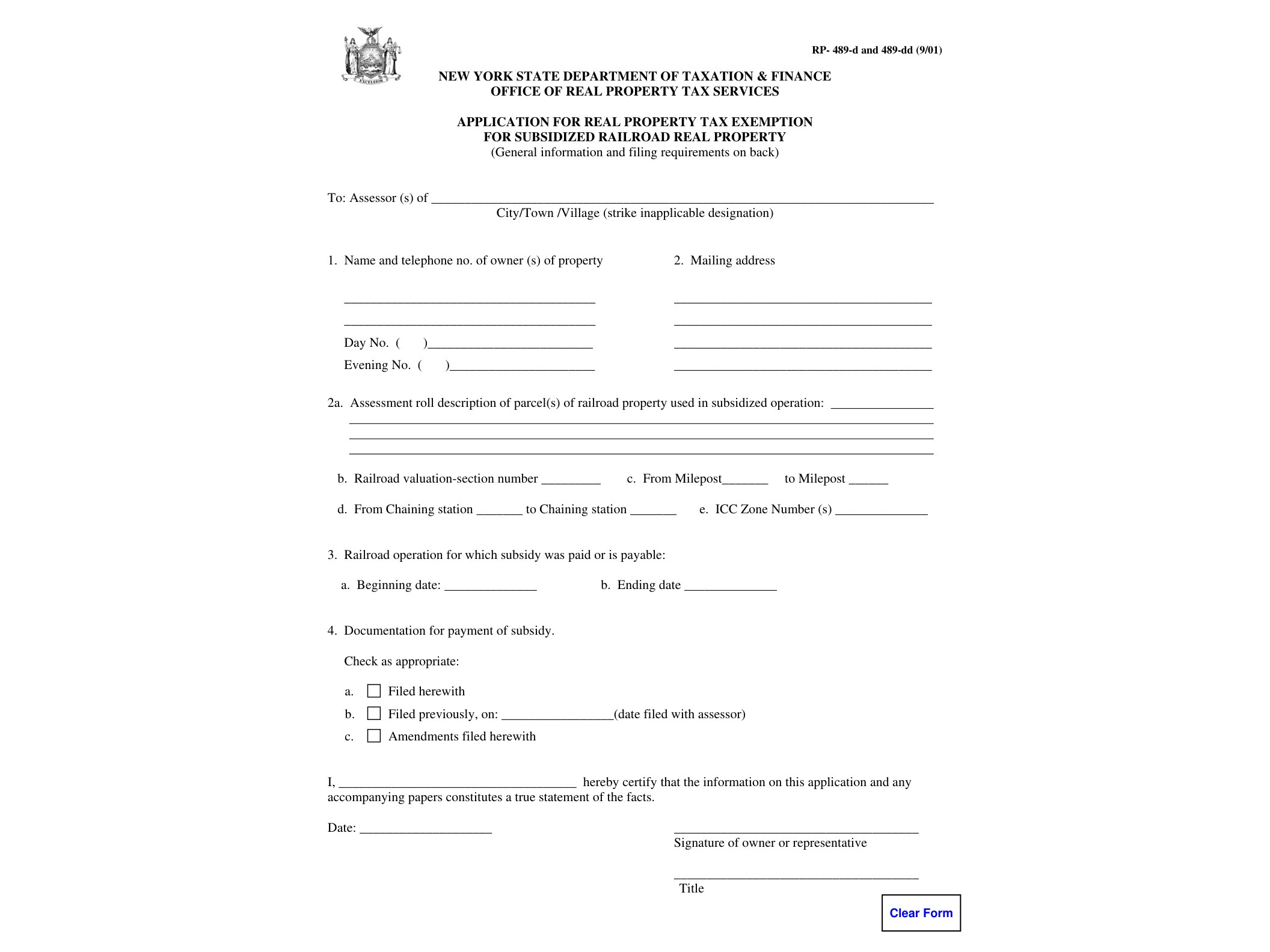
Form RP-489-d and its companion form RP-489-dd make up the application New York railroad companies file to claim a real property tax exemption for subsidized railroad real property. This exemption exists under New York’s Real Property Tax Law to help offset the tax burden on railroad property that receives public subsidies, recognizing that these lines often serve a broader public transportation purpose rather than operating as purely private commercial assets.
The form is issued by the New York State Department of Taxation and Finance through its Office of Real Property Tax Services (ORPTS), and it’s used at the local level — the completed application goes to the assessor of the city, town, or village where the railroad property is located, not to the state tax department directly.
Who Needs This Form
This exemption application is meant for railroad corporations, or entities that own or operate railroad real property that qualifies as “subsidized” under state law. In practice, this typically covers rail lines, rail beds, structures, and related real property that receive government subsidies to keep service running, often because the line wouldn’t be financially viable on its own but serves an important transportation function for the region.
If you’re a property owner outside the railroad industry, this specific form won’t apply to you — it’s a narrow, industry-specific exemption. Homeowners and residential property owners looking for tax relief programs should instead look at exemptions like the ones covered in Form RP-485-W for newly constructed homes or Form RP-485-Q for residential investment property, both of which serve very different property categories.
When to File
Railroad entities need to file this application within the statutory deadline set for exemption applications in their local jurisdiction, which generally aligns with the taxable status date for the municipality where the property sits. Since taxable status dates vary by county and municipality in New York, it’s worth confirming the exact deadline with your local assessor’s office well before you plan to submit. Filing late can mean losing the exemption for that tax year, so this isn’t something to leave until the last minute.
Because this exemption is tied to a specific tax year, the application (or a renewal, depending on local rules) may need to be resubmitted periodically. Some jurisdictions require annual filings while others allow the exemption to continue as long as the underlying subsidy and eligibility conditions remain unchanged — this is another detail to verify locally rather than assume.
How to Fill It Out
Form RP-489-d and RP-489-dd are available as a fillable PDF directly from the New York State Department of Taxation and Finance website. Because the form has AcroForm fields built in, you can complete it on your computer using Adobe Acrobat Reader or similar PDF software before printing it for signature and submission — no need to handwrite the entire application.
You’ll need documentation supporting your claim that the railroad property in question is subsidized, along with identifying details about the property itself: location, parcel information, and the nature of the subsidy arrangement. Since local assessors review these applications, it’s a good idea to reach out to the assessor’s office beforehand to confirm exactly what supporting documents they expect alongside the form.
If your organization has previously received an exemption on this or related property and circumstances have changed, you may also need to look into Form RP-496, which is used to formally renounce a previously granted exemption when it no longer applies. Keeping your exemption filings current and accurate with the assessor helps avoid disputes or unexpected tax bills down the road.
Once submitted, the local assessor’s office reviews the application and supporting materials, and determines whether the property qualifies under the applicable statute. If you have questions specific to your situation, the assessor’s office or ORPTS can clarify eligibility requirements before you file, which can save time compared to submitting an incomplete or ineligible application.
Download Official Form RP489DRP (PDF)
Opens the official government PDF in a new tab