
Download Official Form RP5023 (PDF)
Opens the official government PDF in a new tab
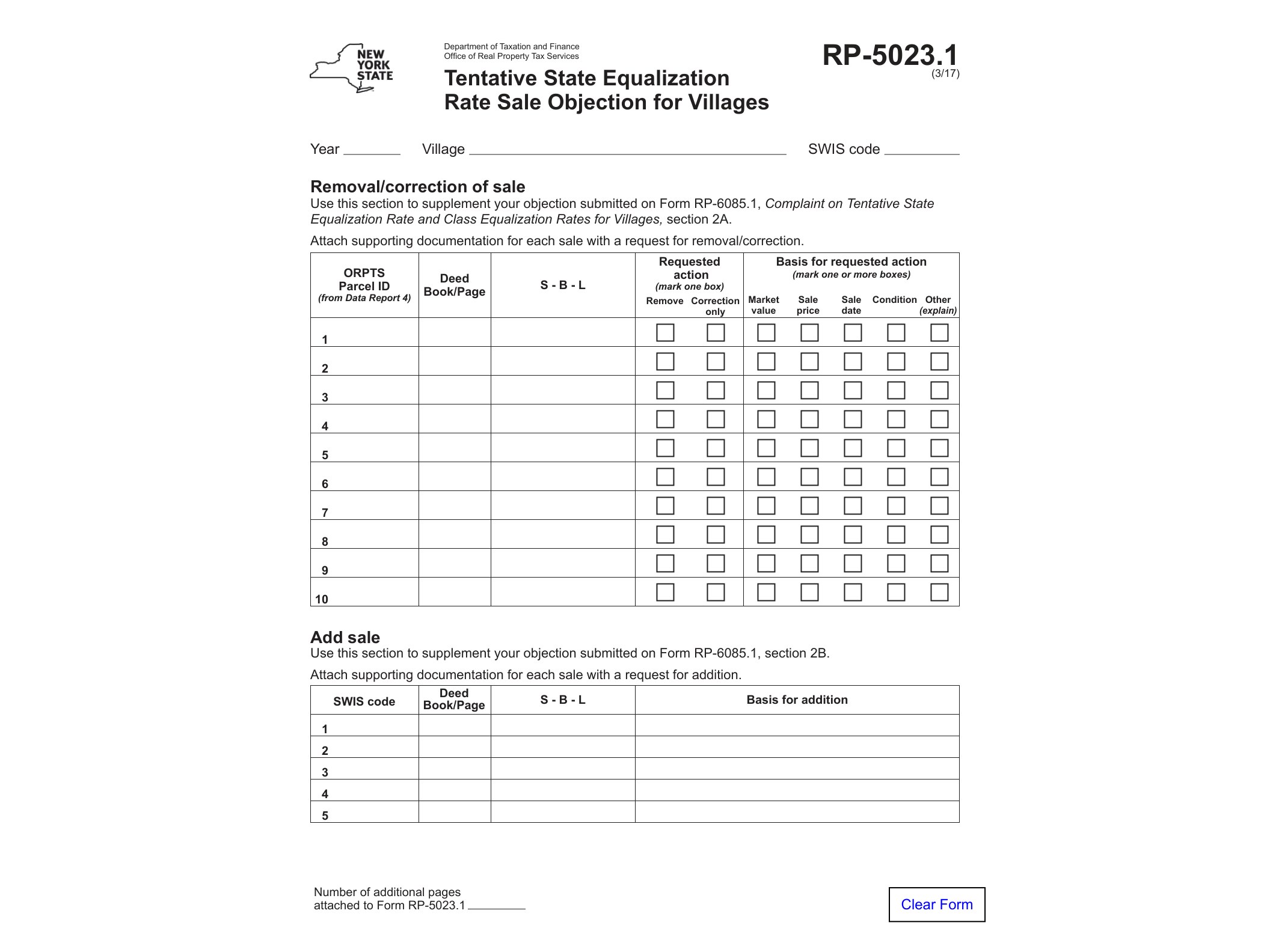
Form RP-5023.1, officially titled “Tentative Equalization Rate Sale Objection for Villages,” is issued by the New York State Department of Taxation and Finance through its Office of Real Property Tax Services (ORPTS). It gives village officials a formal way to challenge a tentative equalization rate before it becomes final. This is a niche but important form for anyone involved in village-level tax administration, particularly assessors and village clerks who track how state-determined rates affect local tax apportionment.
An equalization rate is the state’s estimate of the relationship between a municipality’s total assessed value and its full (market) value. These rates matter because they’re used to distribute tax levies fairly across overlapping jurisdictions like counties, school districts, and villages, especially when property within those jurisdictions isn’t assessed at a uniform percentage of value. Each year, ORPTS calculates tentative rates based on sales data and appraisal studies. Before those rates are finalized, municipalities have a window to review the underlying sales used in the calculation and raise objections if they believe specific sales were misclassified, mispriced, or otherwise shouldn’t factor into the rate.
Who Needs to File This Form
Form RP-5023.1 is specifically for villages, not counties, towns, or school districts, which have their own separate objection procedures and forms. It’s typically completed by a village assessor or an authorized representative of the village government who has reviewed the sales sample ORPTS used to compute the tentative equalization rate. If the village disagrees with how a particular sale was treated, whether it was included when it shouldn’t have been, excluded incorrectly, or assigned an inaccurate sale price, this form is the mechanism to flag that disagreement for state review.
This isn’t a form the general public or individual property owners would ever need. It’s strictly an intergovernmental document used in the technical back-and-forth between village tax officials and the state agency responsible for setting equalization rates. That said, understanding how equalization rates work can be useful context for residents curious about why their village’s share of a county or school tax levy might shift from year to year even when local assessments haven’t changed.
When and How It’s Used
Villages receive their tentative equalization rate along with supporting sales data on a set schedule each year. There’s a limited window, defined by state regulations, during which a village can file objections. Missing that window generally means accepting the tentative rate as final, so timing matters. The form asks for specifics: the property involved in the disputed sale, the reason for the objection, and any supporting documentation that justifies removing or adjusting that sale in the state’s calculation.
Once submitted, ORPTS reviews the objection and may adjust the tentative rate before establishing the final equalization rate for that assessment roll year. Villages that skip this step lose the chance to correct errors that could otherwise affect their share of tax burdens for the year.
Getting and Completing the Form
Form RP-5023.1 is available as a fillable PDF directly from the New York State Department of Taxation and Finance website. Since it includes AcroForm fields, it can be completed digitally in a PDF reader before printing or submitting according to ORPTS instructions, rather than requiring everything to be filled out by hand. Village officials should have the original tentative rate notice and sales listing on hand while completing it, since the form references specific sales by identifying details that need to match ORPTS records exactly.
Like other property tax forms issued by the same office, such as Form RP-489-d and RP-489-dd for railroad property exemptions or Form RP-496 for renouncing exemptions, RP-5023.1 follows a fairly rigid administrative process with firm deadlines. Village assessors who regularly deal with ORPTS filings will also want to be familiar with related property assessment forms, including those covering residential exemptions like Form RP-485-Q, since equalization rates and exemption programs often intersect when calculating a village’s overall tax base.
Download Official Form RP5023 (PDF)
Opens the official government PDF in a new tab