
Download Official Form CG11 (PDF)
Opens the official government PDF in a new tab
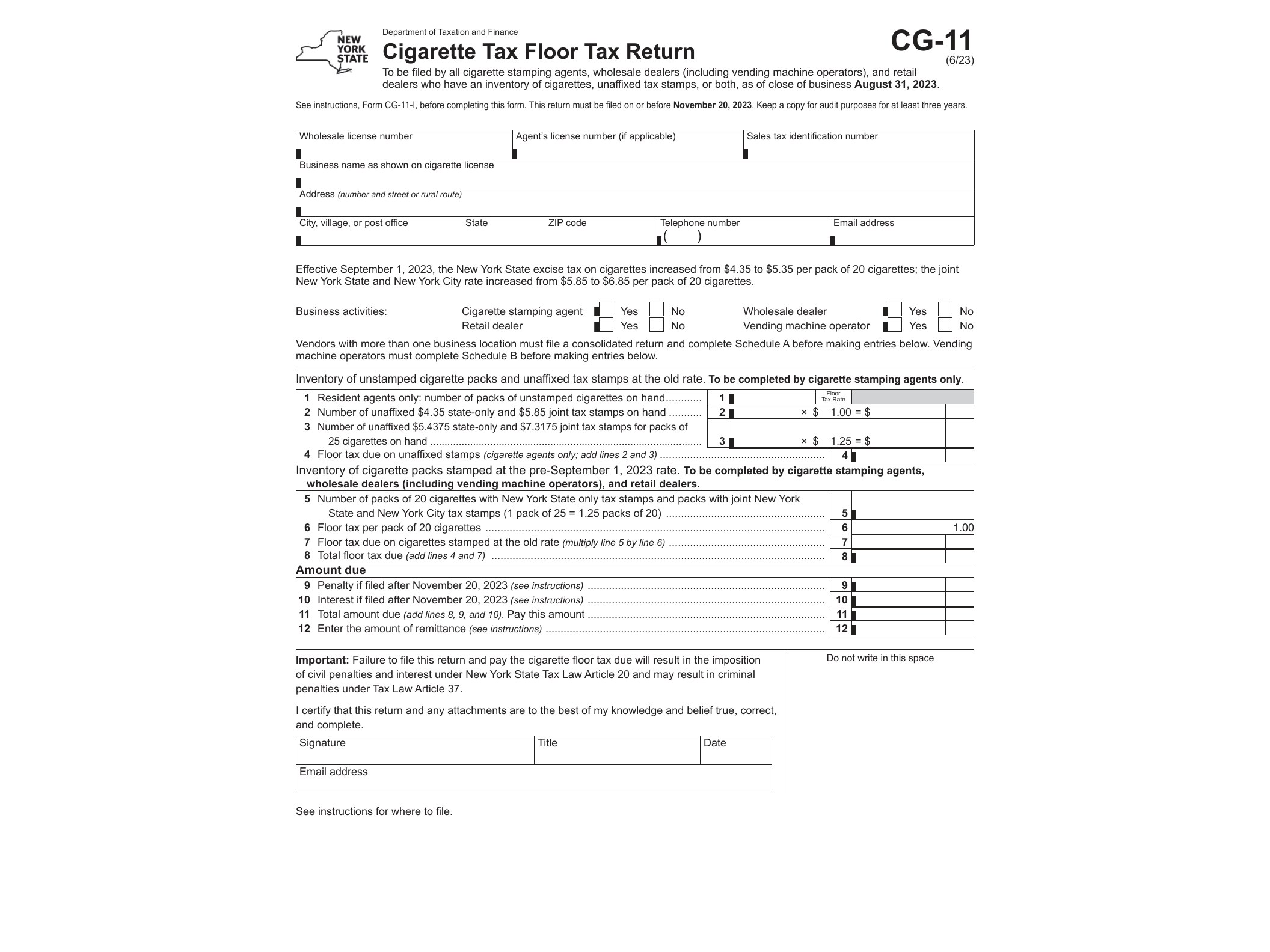
Form CG-11 is the Cigarette Tax Floor Tax Return issued by the New York State Department of Taxation and Finance. It’s used whenever the state raises its excise tax rate on cigarettes, requiring anyone holding cigarette inventory on the effective date of the increase to pay the difference between the old tax rate and the new one on those existing stamped or unstamped stocks. This is commonly referred to as a “floor tax” because it applies to inventory already sitting on the floor of a warehouse, store, or vending business at the moment the new rate kicks in.
The version referenced here was revised 6/23, meaning it reflects the most recent formatting and instructions from the Tax Department tied to the latest cigarette tax adjustment. Anyone in possession of untaxed or partially taxed cigarette inventory on the specified floor tax date is legally required to file this return and remit the additional tax owed, regardless of whether they’re a wholesaler, retailer, distributor, or vending machine operator.
Who Needs to File Form CG-11
This form applies to a fairly specific group of businesses tied to the tobacco supply chain in New York State:
- Licensed cigarette agents and wholesale dealers holding cigarette stock
- Retail dealers with cigarette inventory on hand at the time of the rate change
- Vending machine operators who stock cigarettes
- Chain store distributors and warehouse operators storing cigarette products
If your business had zero cigarette inventory on the floor tax date, you generally still need to confirm your filing obligation with the Tax Department, since reporting requirements can apply even to businesses reporting no additional tax due.
When This Return Is Used
Form CG-11 isn’t an annual or recurring filing like income tax returns. It only becomes relevant when New York State legislatively increases the cigarette excise tax rate. Once that happens, the Tax Department sets a specific floor tax date and a corresponding due date for the return, typically giving businesses a short window (often 30 days or less) to inventory their stock, calculate the tax differential, and submit payment. Missing this deadline can trigger penalties and interest, so businesses in the tobacco retail and distribution space need to stay alert to legislative announcements affecting cigarette tax rates.
How to Complete and Submit the Form
The CG-11 is an AcroForm, meaning it has fillable fields you can complete directly on your computer before printing or submitting. To fill it out accurately, you’ll need:
- A physical count of all cigarette packs on hand as of the floor tax date, broken down by pack size
- Your business’s tax identification and license information as a registered cigarette dealer
- The prior and new tax rates per pack, which the Tax Department publishes alongside the floor tax announcement
- Calculation of the tax differential owed based on your counted inventory
Once completed, the form is submitted along with payment to the Department following the instructions printed on the return, which specify mailing address and any electronic payment options available at the time.
Businesses that handle multiple state tax obligations, including corporate estimated payments or withholding reporting, often find it useful to keep a broader calendar of state and federal deadlines. For context on other types of periodic state filings, our guide on Form CT-2658 estimated tax reporting for corporate partners walks through a similar structure of scheduled state filings tied to specific triggering events.
Retailers and distributors juggling both state excise obligations and withholding responsibilities for out-of-state transactions may also want to review how Form 592-B handles resident and nonresident withholding statements, since businesses operating across state lines often deal with several overlapping compliance calendars.
Because floor tax filings are tied to legislative rate changes rather than a fixed annual schedule, the safest approach is to register for updates directly from the New York State Department of Taxation and Finance and confirm the current floor tax date and filing deadline before completing Form CG-11. Keeping accurate, dated inventory records throughout the year makes this process considerably faster whenever a new rate increase is announced.
Download Official Form CG11 (PDF)
Opens the official government PDF in a new tab