
Download Official Form 588 (PDF)
Opens the official government PDF in a new tab
California generally requires businesses to withhold 7% on payments made to nonresident vendors, contractors, and payees for services performed in the state. Form 588, issued by the California Franchise Tax Board (FTB), gives certain payees a way to avoid that withholding altogether by requesting a waiver rather than dealing with reduced withholding after the fact.
Instead of having tax withheld and then claiming it back when filing a California return, a qualifying payee can submit Form 588 to the withholding agent (the business making the payment) or directly to the FTB for approval. Once granted, the waiver tells the payer not to withhold on future payments, which keeps cash flow intact for the nonresident individual or entity receiving income from California sources.
Who Needs to File Form 588
This form is meant for nonresident payees—individuals, corporations, partnerships, LLCs, estates, or trusts—who receive California-source income such as payments for services, royalties, rents, or other similar income subject to withholding under California Revenue and Taxation Code Section 18662. Common filers include:
- Out-of-state contractors or consultants performing work for California clients
- Nonresident business entities with a consistent filing history in California
- Payees who can demonstrate a track record of timely tax compliance, making withholding unnecessary
To qualify, the payee typically needs to show they’ve filed California returns in prior years, have no outstanding tax liabilities, and are current with any required estimated tax payments. The FTB reviews these factors before approving a waiver, since the goal is to protect state revenue while reducing unnecessary withholding on payees who are already compliant.
When Form 588 Is Used
The form should be submitted before the withholding agent makes the first reportable payment. Waivers are typically requested at the start of a business relationship—when a California company sets up a contract with an out-of-state vendor, for example—so the payer knows from day one whether withholding applies. If approved, the waiver generally remains valid for the calendar year specified, and it may need to be renewed for subsequent tax years depending on the payee’s continued eligibility.
It’s worth noting that Form 588 is different from Form 589, which is used for reduced withholding rather than a full waiver, and from Form 592-B, which reports withholding that was actually taken and remitted. If withholding has already occurred, 592-B is the document payees use to claim credit for those amounts on their California tax return—Form 588 is strictly for preventing withholding in the first place.
How to Fill Out and Submit the Form
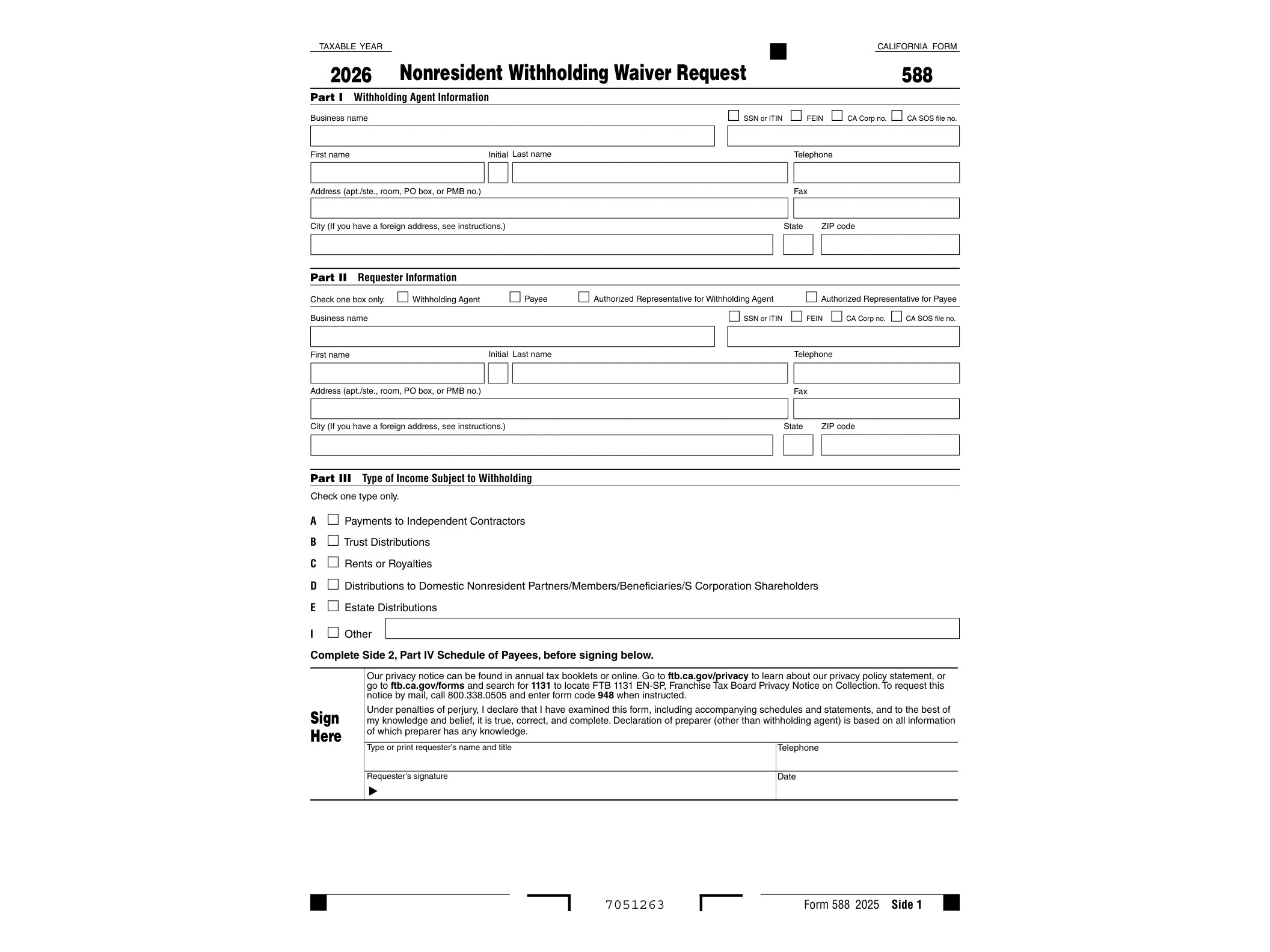
Form 588 is a fillable PDF, so it can be completed digitally before printing or submitting electronically where accepted. The basic sections require:
- Payee information, including name, address, and taxpayer identification number (SSN, ITIN, or FEIN)
- Entity type (individual, corporation, partnership, LLC, estate, or trust)
- A description of the income type and the withholding agent’s details
- Certification statements confirming California filing history and compliance
Once completed, the form is sent to the FTB for review. Processing isn’t instant, so it’s smart to submit well before the first payment is due rather than waiting until a contract is already underway. If the waiver is approved, the FTB issues a determination letter that the payee should keep on file and share with the withholding agent as proof that no withholding is required.
Businesses juggling multi-state withholding obligations often deal with several related forms depending on where their vendors or partners are based. For comparison, corporate partners working across state lines might also encounter something like Form CT-2658 in New York, which handles estimated tax for corporate partners in a similar but distinct way. And for businesses managing entirely separate state tax obligations, such as excise filings, resources like the Form CG-11 guide show how state-specific compliance requirements can vary widely even outside the withholding context.
Keeping Form 588 on file, along with any approval correspondence from the FTB, helps avoid confusion during tax season and gives both the payer and payee a clear paper trail if California ever questions why withholding wasn’t applied to a particular payment.
Download Official Form 588 (PDF)
Opens the official government PDF in a new tab