
Download Official Form RP6085 (PDF)
Opens the official government PDF in a new tab
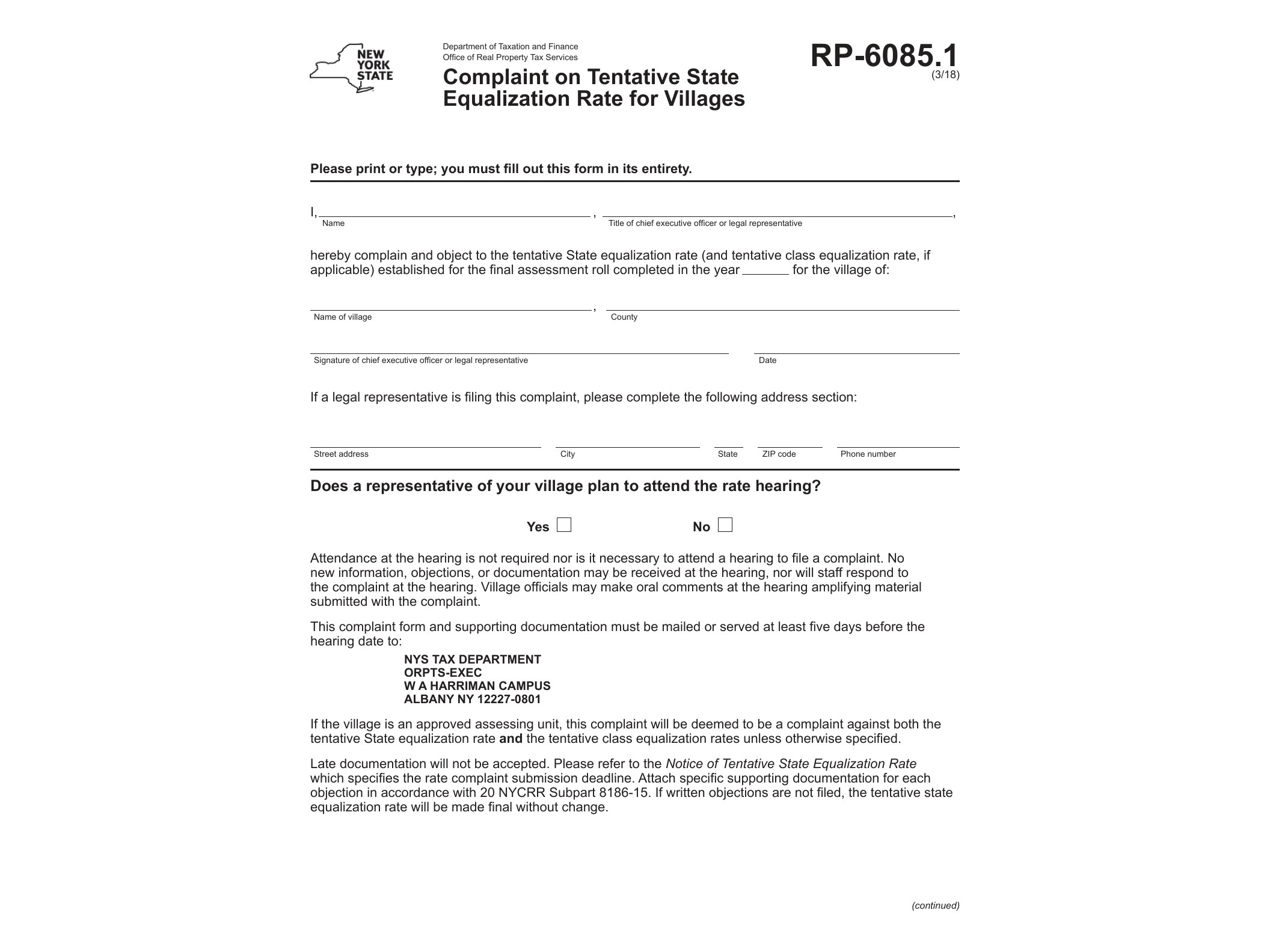
Form RP-6085.1, officially titled Complaint on Tentative State Equalization Rate for Villages, is issued by the New York State Department of Taxation and Finance through its Office of Real Property Tax Services (ORPTS). It gives village officials a formal way to dispute a tentative equalization rate before it becomes final for the assessment roll year.
Equalization rates are used across New York to compare a municipality’s assessed property values against actual full market value. Since assessing practices and cycles differ from one village or town to the next, the state calculates these rates to keep tax burdens, school aid distribution, and other formulas fair when they span multiple assessing units. When ORPTS sets a tentative rate for a village, that number can directly affect how much a village’s taxpayers contribute relative to residents of other jurisdictions sharing the same tax base, such as a school district or county.
Who Uses Form RP-6085.1
This form is filed by village officials, not by individual property owners. Typically, it’s the village board, village assessor, or an attorney representing the village who submits the complaint on the municipality’s behalf. If a village believes the tentative rate calculated by the state doesn’t accurately reflect its assessment-to-market-value ratio, this form is the official channel to raise that objection and request a review.
A village might have grounds to complain if, for example, the sales data or valuation methodology ORPTS used to compute the rate seems outdated, incomplete, or inconsistent with more recent local market conditions. Because equalization rates influence apportionment of shared tax levies, an inaccurate rate can shift more of the tax burden onto village residents than it should.
When the Form Is Used
ORPTS releases tentative equalization rates on a set schedule each year. Once a village receives its tentative rate, there’s a limited window to file a complaint before the rate becomes final. Villages need to act quickly, gather supporting documentation, and submit Form RP-6085.1 within that complaint period. Missing the deadline generally means the tentative rate stands as final for that assessment cycle, with no further administrative appeal available through this process.
This process is distinct from other property tax relief or valuation forms homeowners might encounter. For instance, individual property owners dealing with assessment reductions due to property damage would look at something like the Notice of Assessor’s Determination of Loss of Property Value, while those seeking a refund on taxes already paid would use the Application for Refund or Credit of Real Property Taxes. Form RP-6085.1, by contrast, deals strictly with municipal-level equalization rate disputes rather than individual parcel assessments.
How to Get and Complete the Form
Form RP-6085.1 is a fillable PDF (AcroForm), meaning it can be completed directly on a computer before printing or submitting, rather than requiring the form to be filled out by hand. It’s available directly from the New York State Department of Taxation and Finance’s website under current ORPTS forms.
When completing it, village representatives should be prepared to include the village name, county, the tentative rate being challenged, and a clear statement of the grounds for the complaint, along with any supporting data such as recent sales ratios or appraisal information. Because this is a formal administrative filing, it’s worth having the village attorney or assessor review the complaint before submission to make sure it meets ORPTS requirements and deadlines.
Villages weighing whether to file should also keep related waterway or environmental assessment relief programs in mind, such as those covered by the Lake Ontario and Connected Waterways Assessment Relief Application, since these programs can also affect local assessment rolls and, indirectly, equalization calculations.
Download Official Form RP6085 (PDF)
Opens the official government PDF in a new tab