
Download Official Form RP7019 (PDF)
Opens the official government PDF in a new tab
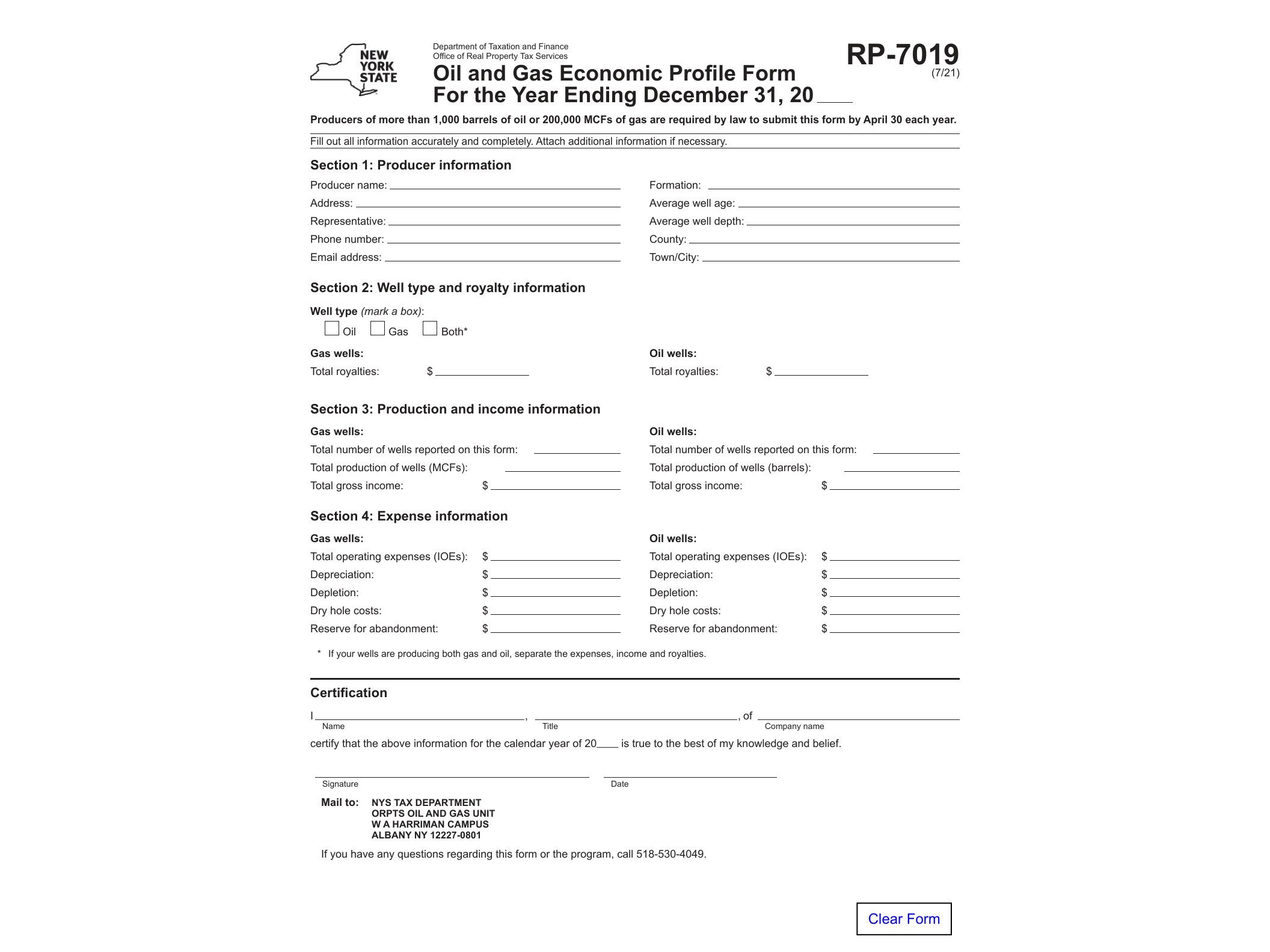
Form RP-7019, officially titled the Oil and Gas Economic Profile Form, is issued by the New York State Department of Taxation and Finance through its Office of Real Property Tax Services (ORPTS). It’s a specialized reporting document used to collect financial and operational data from companies that own or operate oil and gas wells within New York State. The information gathered on this form feeds directly into the state’s unit-of-production valuation system, which local assessors rely on to determine the assessed value of oil and gas economic units for property tax purposes.
Unlike standard property assessment forms, RP-7019 focuses specifically on the economics of extraction: production volumes, pricing, operating costs, and other financial metrics tied to a well or group of wells for the year ending December 31. Because energy markets shift from year to year, the form is revised periodically — the current version reflects a 7/21 revision — to keep the reporting fields aligned with actual industry practices and state valuation formulas.
Who Needs to File Form RP-7019
This form applies to owners and operators of oil and gas wells located in New York State, particularly those in counties where oil and gas extraction is an active part of the local economy, such as parts of Western New York and the Southern Tier. If your business holds an economic interest in a well — whether as an operator, working interest owner, or royalty interest holder in some cases — you may be required to submit this profile annually.
Local assessors use the data submitted on RP-7019 to apply New York’s standardized unit-of-production valuation tables, which convert reported production and pricing figures into an assessed value for each well. Without accurate and timely filings, assessors may have to estimate values using default assumptions, which can lead to disputes or inflated assessments that don’t reflect actual well performance.
When and Why the Form Is Used
RP-7019 is filed annually, corresponding to the calendar year of production ending December 31. It’s typically submitted early in the following year so that assessors can incorporate the data into the assessment roll for that tax cycle. Filing deadlines and specific submission instructions are usually set by the local assessor’s office, so well owners should confirm exact dates with their county or town assessment office rather than relying solely on the state-level guidance.
The form matters because oil and gas properties are valued differently than typical real estate. Instead of relying on comparable sales, New York uses production-based economic modeling. That means the numbers reported here — barrels produced, cubic feet of gas extracted, wellhead prices, and associated costs — directly shape the tax bill for that property. Errors or omissions can result in valuations that don’t match the well’s actual economic performance for the year.
How to Get and Complete the Form
Form RP-7019 is available as a fillable PDF (AcroForm) directly from the New York State Department of Taxation and Finance website. Because it supports digital data entry, filers can complete the fields on a computer before printing or submitting electronically where accepted, which reduces transcription errors compared to handwritten submissions.
When filling it out, gather your production records, sales data, and cost documentation for the full reporting year before starting. The form will ask for well identification details, operator information, and the specific economic figures used in the state’s valuation formulas. If you’re unsure how a particular field applies to your operation — for example, how to report shared interests in a well — it’s worth contacting your local assessor or a property tax professional familiar with oil and gas assessments before submitting.
Well owners who also deal with other specialized property tax filings in New York may find it useful to compare related reporting requirements, such as the Municipal Report of Special Franchise Activity or the Complaint on Tentative Telecommunications Ceiling form, both of which follow similar assessment-driven logic for specialized property types. Businesses managing bulk data submissions for property records might also want to review the Transmittal Tape and Diskette Information Report, which covers a different but related aspect of property data filing in New York.
Keeping accurate records throughout the production year makes completing RP-7019 far less time-consuming when filing season arrives. Since this data directly influences your property’s assessed value, double-checking figures against internal production and sales reports before submission is a reasonable safeguard against assessment disputes later in the year.
Download Official Form RP7019 (PDF)
Opens the official government PDF in a new tab