
Download Official Form RP7143 (PDF)
Opens the official government PDF in a new tab
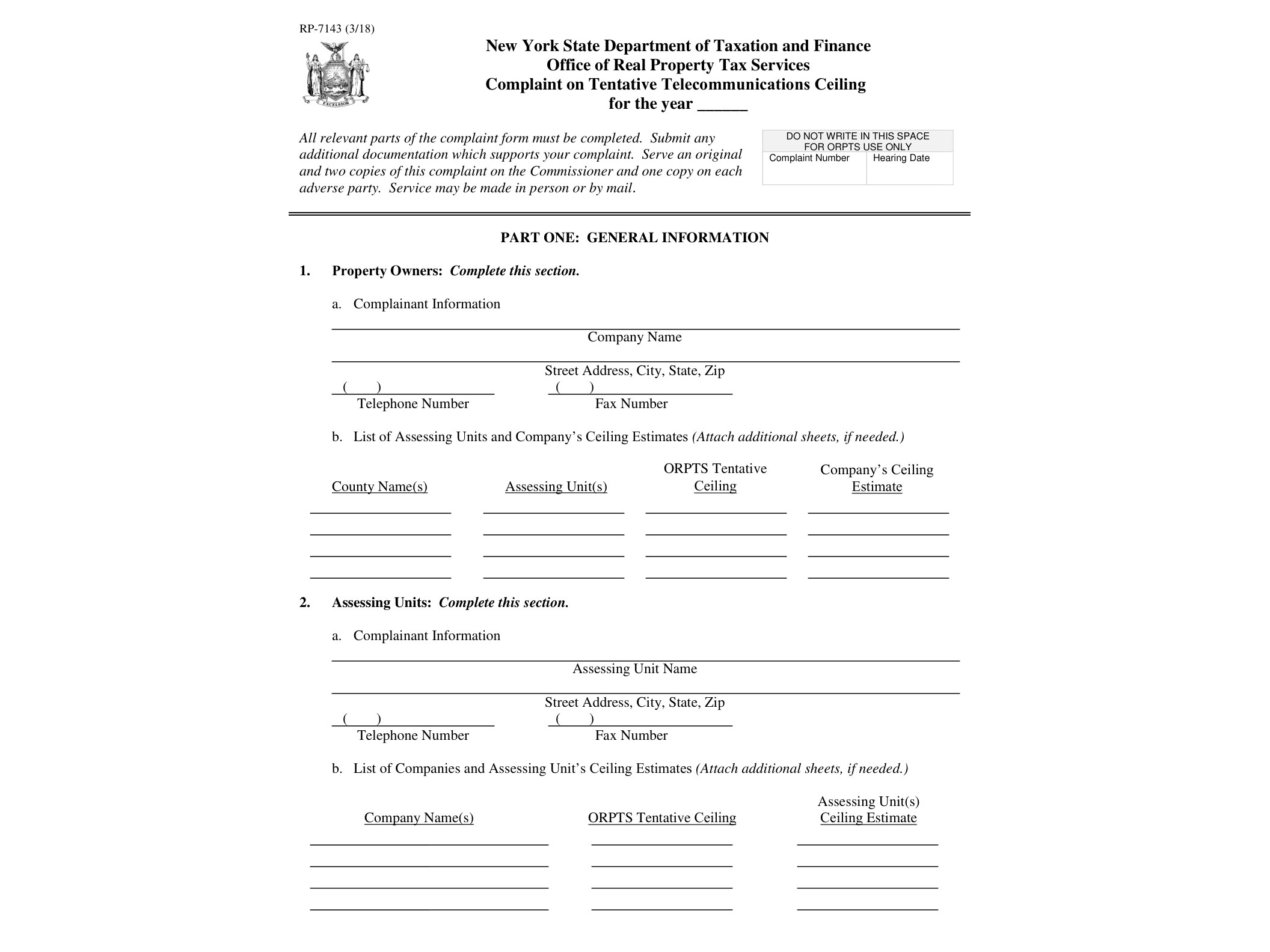
Form RP-7143, officially titled “Complaint on Tentative Telecommunications Ceiling,” is issued by the New York State Department of Taxation and Finance through the Office of Real Property Tax Services (ORPTS). It gives telecommunications companies a formal way to challenge the tentative ceiling value that a local assessing unit has placed on their taxable outside plant property, such as poles, wires, cables, and related equipment used to provide telecommunications service.
Under New York’s real property tax law, certain telecommunications property is centrally assessed, meaning the state sets a ceiling value that limits how much a municipality can assess that property for local tax purposes. Each year, ORPTS releases tentative ceiling values for these companies. If a company disagrees with the tentative figure — because it believes the valuation is too high, based on incorrect data, or doesn’t reflect the actual condition or use of the property — Form RP-7143 is the mechanism for disputing it before the ceiling becomes final.
Who Needs to File This Form
This form is specifically for telecommunications companies whose outside plant property is subject to state-set ceiling valuations. This typically includes telephone companies and other carriers that own physical infrastructure like utility poles, buried or aerial cable, and switching equipment located outside of buildings. If your company received a tentative ceiling notice from ORPTS and you believe the assessed value is inaccurate, this is the complaint form you need to submit.
Property tax professionals, in-house counsel for utility companies, and third-party tax representatives who handle these filings on behalf of telecommunications clients are the ones most likely to prepare and submit RP-7143. Smaller companies without dedicated tax staff often rely on outside consultants familiar with New York’s centralized assessment process to complete this correctly.
When the Form Is Used
RP-7143 is used only after ORPTS has issued a tentative ceiling for the current assessment year. There’s a specific filing window — typically outlined in the tentative ceiling notice itself — during which the complaint must be submitted. Missing this window generally means the tentative value becomes final and binding, with no further opportunity to contest it administratively for that assessment year. Because the timeline is strict, companies should review their tentative notices as soon as they arrive and start preparing supporting documentation immediately if a challenge is warranted.
The form requires the filer to identify the specific property in question, state the tentative ceiling value assigned by ORPTS, and explain the basis for the complaint. This might involve providing updated depreciation schedules, corrected inventory of physical assets, or other financial and technical data that supports a different valuation. Since these complaints often hinge on detailed engineering and accounting information, many filers attach supplementary schedules alongside the core form.
How to Get and Complete the Form
Form RP-7143 is available as a fillable PDF directly from the New York State Department of Taxation and Finance website. Because it’s an AcroForm, you can type your entries directly into the PDF fields using standard PDF reader software before printing or submitting it electronically, depending on ORPTS’s current submission instructions. This makes it easier to keep records clean and legible compared to handwritten forms, which matters when the underlying valuation dispute already involves dense financial data.
When filling it out, double-check the tax year and property identifiers against the original tentative ceiling notice — errors here can delay processing or lead to the complaint being rejected on technical grounds. It’s also worth keeping a copy of everything submitted, including any attachments, since these complaints can sometimes lead to follow-up requests from ORPTS for additional documentation.
Companies dealing with RP-7143 often handle other centralized assessment or special franchise filings as well. If your business also reports special franchise activity, the Form RP-7114 guide covers that related municipal reporting requirement. Utility companies navigating exemption requests may also want to review the RP-7012-W exemption filing, and those tracking property changes across multiple filings might find the RP-6604 detail list of changes useful for cross-referencing reported updates.
Given the technical and time-sensitive nature of ceiling complaints, it’s a good idea to consult with a property tax professional experienced in New York’s telecommunications assessment rules before submitting RP-7143, especially if the disputed valuation involves significant dollar amounts.
Download Official Form RP7143 (PDF)
Opens the official government PDF in a new tab