
Download Official Form IT203AI (PDF)
Opens the official government PDF in a new tab
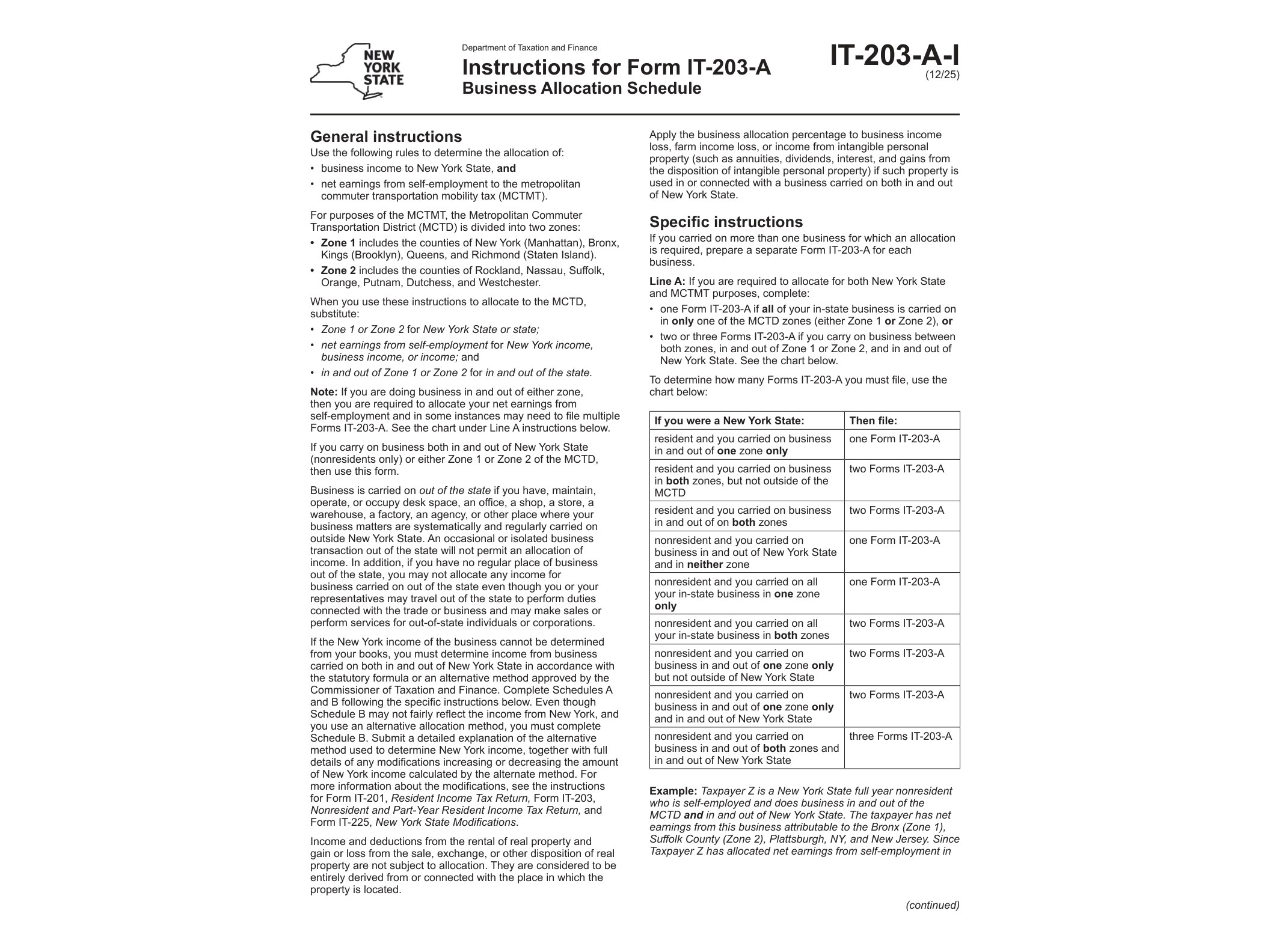
Form IT-203-A is the instruction booklet that accompanies the Business Allocation Schedule filed by nonresidents and part-year residents of New York State who carry on a trade, profession, or business both inside and outside the state. If you’re a sole proprietor, partner, or self-employed individual whose business activity isn’t confined entirely to New York, this schedule is what tells the New York State Department of Taxation and Finance how much of your business income should actually be taxed there.
The form itself works alongside Form IT-203, the nonresident and part-year resident income tax return. While IT-203 reports your total income, the IT-203-A schedule breaks down the portion of your business income that’s connected to New York versus income earned elsewhere. This matters because New York can only tax the share of your business income that’s fairly attributable to activity conducted within its borders — not your entire nationwide or worldwide earnings.
Who Needs to File This Schedule
You’ll need Form IT-203-A if you meet all of these conditions: you’re a nonresident or part-year resident of New York State, you operate a business, trade, or profession, and that business has locations or activity both inside and outside New York. Common examples include consultants who serve clients in multiple states, contractors with job sites across state lines, or business owners who maintain an office in New York but also operate branches elsewhere.
If your business operates exclusively within New York State, you generally don’t need this allocation schedule — all your business income would be taxable by New York anyway. The schedule exists specifically for situations where income needs to be divided between New York and other jurisdictions.
How the Allocation Works
The instructions walk filers through a three-factor formula that New York uses to determine the business allocation percentage. This typically involves comparing the value of real and tangible personal property within New York against property everywhere, wages and other compensation paid in New York versus everywhere, and gross sales or receipts from New York versus everywhere. Each factor produces a percentage, and these percentages are averaged to arrive at the final business allocation percentage applied to your business income.
The December 2025 revision of these instructions reflects updated guidance from the Department of Taxation and Finance, so filers who used older versions of this form in previous tax years should review the current instructions carefully rather than relying on memory from prior filings. Tax rules around allocation percentages and reporting thresholds can shift from year to year.
How to Get and Complete the Form
Form IT-203-A instructions are not fillable online — this is a document you’ll need to print and complete by hand. The official PDF is available directly from the New York State Department of Taxation and Finance website. Once printed, you’ll work through the property, payroll, and sales factors mentioned above, using your business records to fill in the New York and everywhere columns accurately.
Because this schedule deals with business allocation rather than general personal income, it pairs conceptually with other New York business-related filings. If your business also involves property tax considerations, you might find it useful to look at resources covering commercial property tax exemptions or exemptions tied to economic transformation areas, since business owners often need to navigate multiple state tax forms simultaneously.
Keep in mind that accuracy matters here — an incorrect allocation percentage can lead to either overpaying or underpaying New York state tax, both of which create complications down the line. If your business structure involves cooperative arrangements or similar entities, it’s also worth checking whether filings like the cooperative housing corporation information return apply to your situation.
Once completed, the IT-203-A schedule gets submitted along with your IT-203 nonresident return, not filed separately. Retain copies of your supporting business records — property values, payroll figures, and sales data — in case the Department of Taxation and Finance requests documentation supporting the percentages you calculated.
Download Official Form IT203AI (PDF)
Opens the official government PDF in a new tab