
Download Official Form TP588 (PDF)
Opens the official government PDF in a new tab
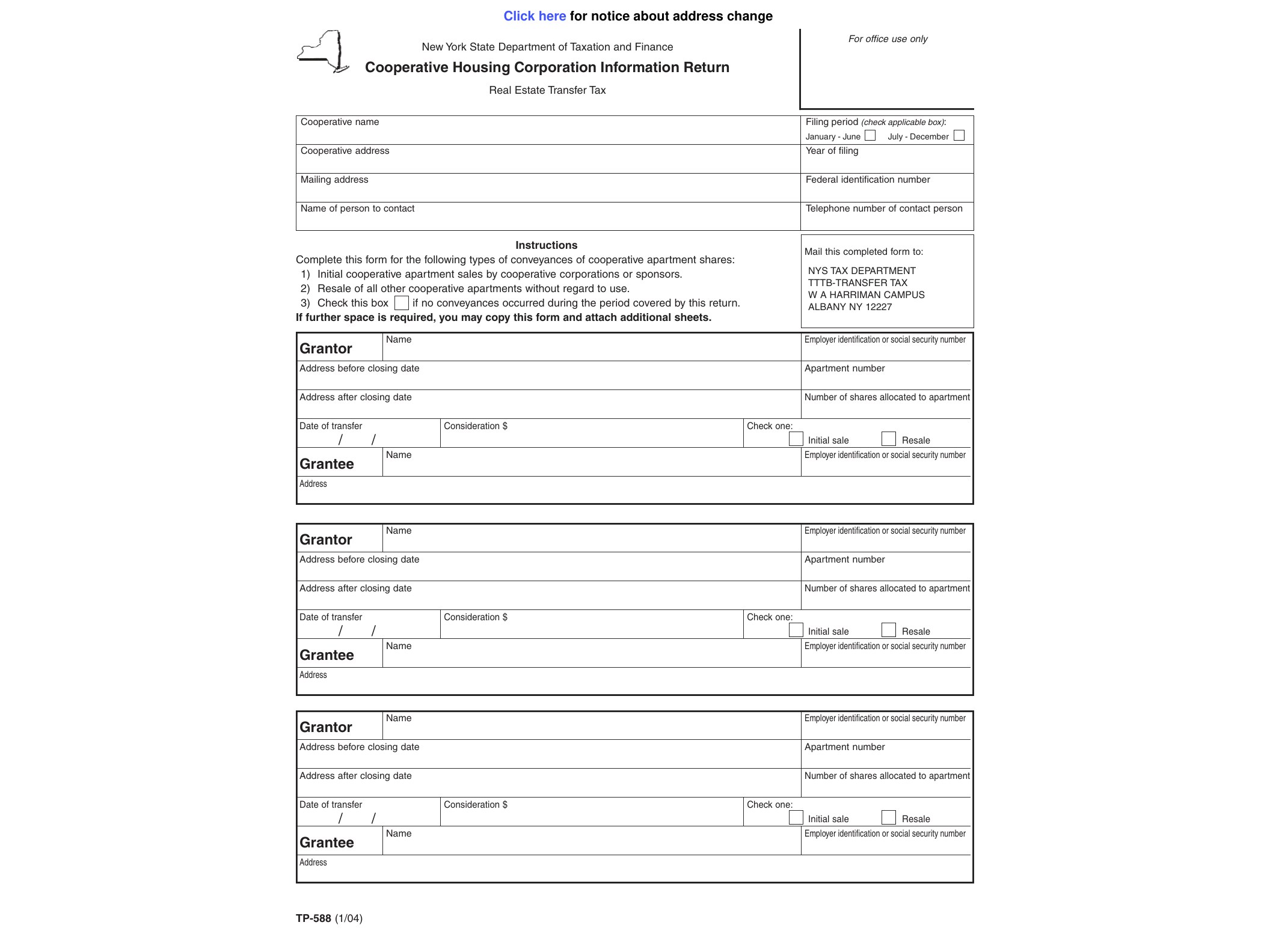
Form TP-588 is an annual information return required by the New York State Department of Taxation and Finance for cooperative housing corporations. Unlike many property tax forms that apply to commercial owners seeking exemptions, this one exists purely to collect financial and structural data from co-op corporations so that local assessors and the state can verify how these entities are valued and taxed under New York’s unique cooperative housing rules.
Cooperative housing in New York operates differently from a typical apartment building or condo complex. The corporation itself owns the real property, and shareholders own shares tied to a proprietary lease for their unit rather than owning real estate directly. Because of this structure, local assessors need specific financial information from the corporation itself to properly determine assessed value, especially for buildings that qualify under certain valuation methods tied to comparable rental income or original cost.
Who Needs to File TP-588
Any cooperative housing corporation organized under New York’s Business Corporation Law or a similar statute, and that holds title to residential real property occupied by shareholders, generally falls under this filing requirement. This includes older co-op conversions in New York City as well as co-op buildings in other parts of the state. The obligation typically falls on the corporation’s board, management company, or a designated officer who handles tax and financial reporting.
If your building recently converted from rental to cooperative ownership, or if you’re on a co-op board and haven’t dealt with this form before, it’s worth checking with your managing agent or accountant to confirm whether your specific corporation has a standing filing obligation with the local assessor’s office.
When and Why This Return Is Used
Form TP-588 is generally requested by local assessors as part of the assessment roll process. Assessors use the data submitted, things like income and expense figures, unit counts, common charges, and corporate structure, to support how they value the property for tax purposes. Because cooperative apartment buildings are assessed differently than condos or standard multi-family rentals, this documentation helps ensure assessments reflect actual financial conditions rather than assumptions based on comparable sales.
Filing is typically tied to the local assessment calendar, so timing can vary by municipality. Some assessors request this information annually, while others may only request it periodically or when reassessment work is underway. Co-op boards should confirm the applicable deadline directly with their local assessor’s office rather than assuming a fixed statewide date, since property tax administration in New York is largely handled at the local level even though the form itself is a state document.
How to Complete and Submit the Form
The PDF version of TP-588 is fillable directly on a computer, which makes it easier for co-op boards or their accountants to complete the return without printing blank paper copies first. The form asks for identifying information about the corporation, details about the number of shares and units, income and expense breakdowns, and other financial specifics tied to the building’s operation.
Because the figures required often mirror what’s already prepared for annual financial statements, many boards coordinate with their accountant or property manager to pull the numbers directly from existing records rather than recalculating them separately. Once completed, the form is typically submitted to the local assessor’s office rather than mailed to the state tax department, so double-checking the correct recipient address before submission is a good practice.
Cooperative boards dealing with property tax questions may also find it useful to understand how commercial exemption programs work more broadly, even though co-ops fall under a different framework. Reviewing how exemptions like Form RP-485-B or Form RP-485-P apply to other property types can help board members better understand how New York structures its various property assessment and exemption programs, even when those specific forms don’t apply directly to cooperative housing corporations.
Download Official Form TP588 (PDF)
Opens the official government PDF in a new tab