
Download Official Form IT203FI (PDF)
Opens the official government PDF in a new tab
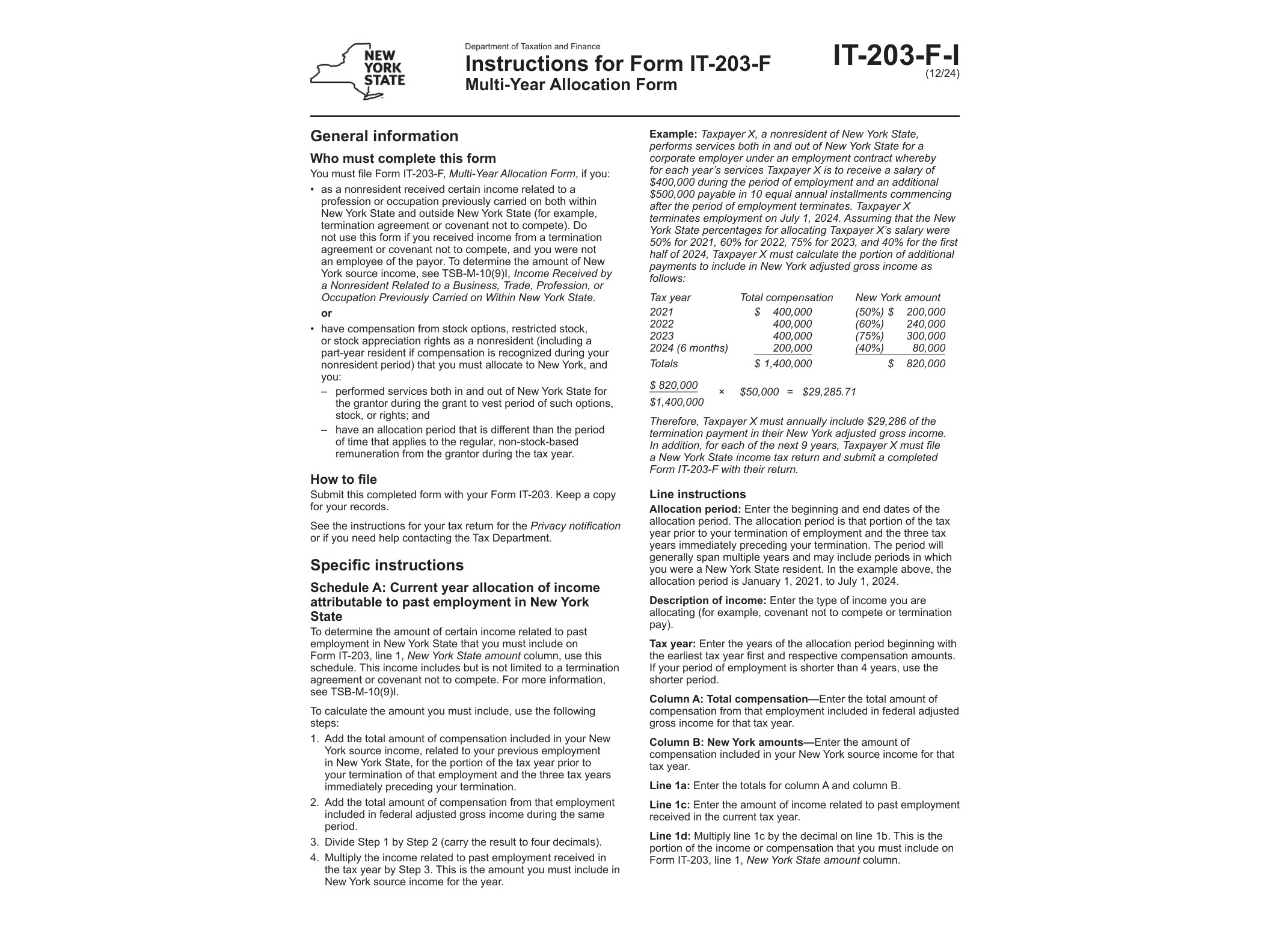
Form IT-203-F-I contains the instructions for New York State’s Form IT-203-F, the Multi-Year Allocation Form. If you’re a nonresident or part-year resident of New York who earned compensation tied to work performed over more than one tax year—think stock options, restricted stock units, deferred bonuses, or other multi-year compensation arrangements—this is the guidance document you need to correctly split that income between New York and everywhere else you worked.
The New York State Department of Taxation and Finance issues this form because compensation like stock options doesn’t always get taxed the year you receive the cash or shares. Often, the income relates to services performed across several years, and some of those years you might have worked in New York while others you didn’t. Without a proper allocation method, you’d either overpay or underpay New York tax on income that partly belongs to other states. Form IT-203-F-I walks you through the calculations needed to figure out exactly what portion of that multi-year income New York can tax.
Who Actually Needs This Form
This isn’t a form for the average W-2 employee filing a simple return. It’s aimed specifically at nonresidents and part-year residents who received one or more of the following during the tax year:
- Stock options exercised after vesting over multiple years
- Restricted stock or restricted stock units (RSUs) that vested based on a multi-year schedule
- Deferred compensation earned over more than one tax year
- Other compensation arrangements where the earning period spans multiple years and multiple work locations
If you fall into any of these categories and you worked in New York for only part of the period the income covers, you’ll need to attach Form IT-203-F to your nonresident return, and the IT-203-F-I instructions tell you exactly how to do the math behind it.
When You’ll Use It
You’ll typically use this form when filing your New York nonresident income tax return, Form IT-203, for a year in which you exercised stock options, had RSUs vest, or received deferred compensation tied to work performed in multiple years and multiple jurisdictions. The allocation you calculate using these instructions determines the New York-source portion of that income, which then flows into your IT-203 filing.
Timing matters here because the allocation period isn’t always the calendar year you received the income—it’s often the period during which the compensation was actually earned, which could stretch back several years. The instructions explain how to identify that earning period and apply the right allocation percentage for each year involved.
How to Get and Complete the Form
Form IT-203-F-I is not an interactive PDF. It’s a print-and-fill document, meaning you’ll need to download it, print it out, and complete it by hand alongside the corresponding Form IT-203-F. There’s no digital fill-in option available directly on the New York State Tax Department’s site for this particular set of instructions.
Because the calculations involve breaking down income by allocation period and applying New York workday ratios for each relevant year, it helps to have your employment records, W-2s, and any stock option or RSU vesting schedules on hand before you start. The instructions include worked examples that mirror common scenarios, which makes it easier to follow along even if you’ve never dealt with multi-year allocation before.
If you’re also amending a previous New York return because you discovered an allocation error from a prior year, you might find it useful to review the Form IT-201-X instructions for amended resident returns, since correcting multi-year income allocations sometimes triggers the need to amend a prior filing. And if your situation involves other New York-specific compliance forms tied to specialized income or business activity, it’s worth browsing related guidance like the Form CG-89 wholesale dealer return or the Form AU-67 waiver instructions for other state filing requirements that might apply to your circumstances.
Given the complexity of multi-year allocation calculations, many taxpayers dealing with significant stock compensation choose to work with a tax professional familiar with New York’s nonresident allocation rules, particularly when the earning period spans several states with different tax treatments.
Download Official Form IT203FI (PDF)
Opens the official government PDF in a new tab