
Download Official Form CT183M (PDF)
Opens the official government PDF in a new tab
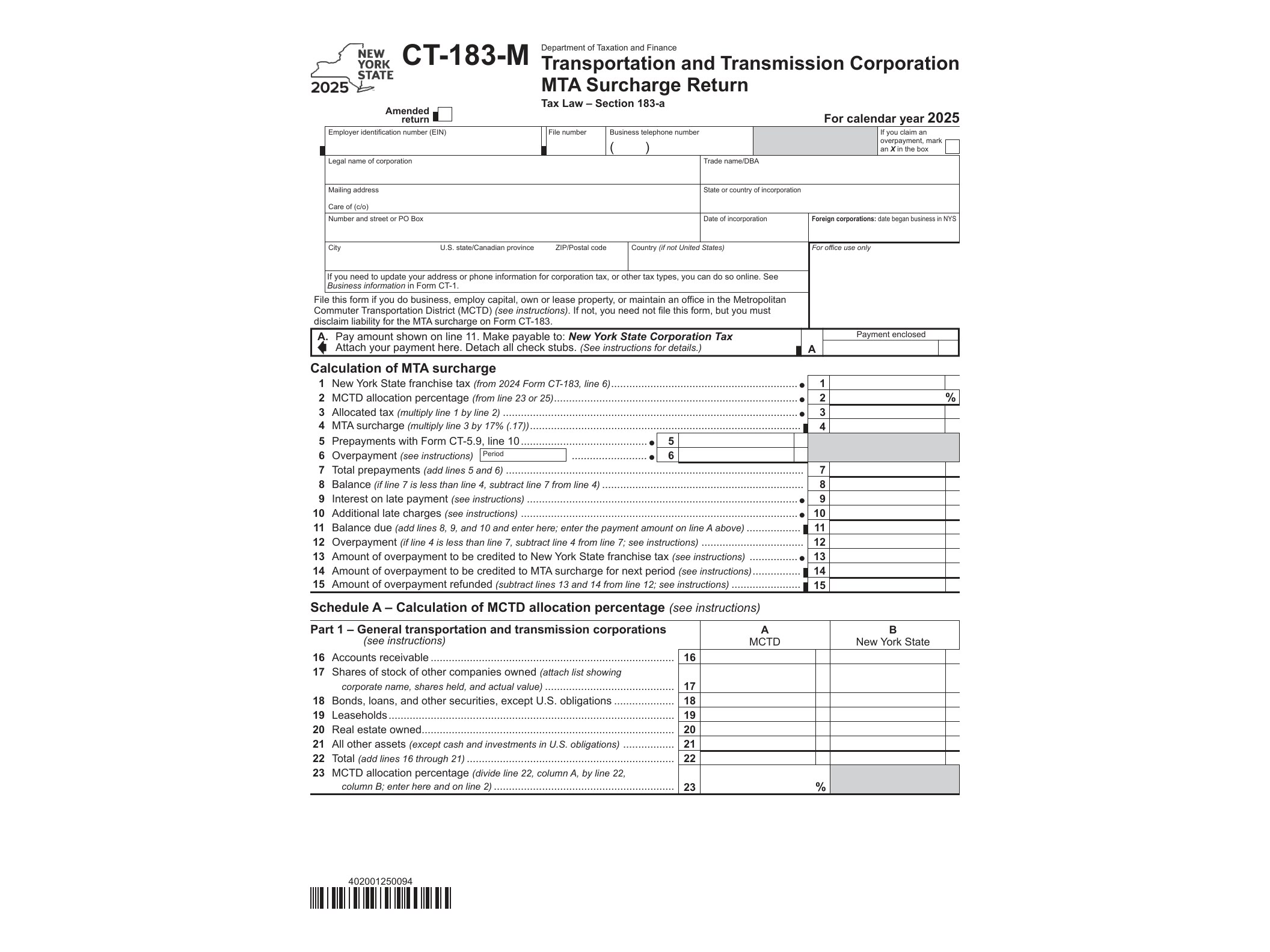
Form CT-183-M is the MTA surcharge return that certain transportation and transmission corporations file alongside their New York State franchise tax filing. It’s issued by the New York State Department of Taxation and Finance and applies specifically to businesses operating within the Metropolitan Commuter Transportation District (MCTD), which covers New York City and several surrounding counties.
If your business is subject to the franchise tax under Article 9 as a transportation or transmission corporation, and part of your operations fall within the MCTD, you likely owe an additional surcharge on top of your regular franchise tax liability. That surcharge is what Form CT-183-M calculates and reports.
Who Needs to File This Form
Form CT-183-M is required for transportation and transmission corporations — think companies involved in trucking, busing, pipeline transmission, or similar regulated transport activities — that conduct business within the MCTD. The surcharge doesn’t replace your base franchise tax obligation; it’s calculated as a percentage of the tax already computed on your main return.
This form works in tandem with Form CT-183, the primary franchise tax return for this category of corporation. If you’re filing CT-183 and your business has a presence in the MCTD, you’ll almost certainly need to attach CT-183-M as well. The two forms are meant to be filed together, not as substitutes for one another.
It’s worth noting there’s a parallel structure for corporations that fall under a different franchise tax base. Companies that file Form CT-184, the franchise tax return based on capital stock, use Form CT-184-M for their MTA surcharge instead. Make sure you’re matching the correct surcharge form to the correct base return — filing the wrong pairing is a common mistake that can delay processing.
When the Form Is Used
Form CT-183-M for tax year 2025 applies to corporations with a fiscal or calendar year that falls within that reporting period. Like most corporate tax filings in New York, the due date generally aligns with your federal filing deadline, adjusted for New York’s specific corporate tax calendar. Corporations should check the instructions packet issued with the form each year, since due dates and surcharge rates can shift slightly from one tax year to the next.
You’ll need this form even if your surcharge liability turns out to be minimal or zero, as long as your business meets the threshold for MCTD activity. The Department of Taxation and Finance expects the return to be filed as part of your complete corporate tax package, not as an optional add-on.
How to Get and Complete the Form
Form CT-183-M is available directly from the New York State Department of Taxation and Finance website as a fillable PDF. Because it’s built as an AcroForm, you can type your figures directly into the document using standard PDF software rather than printing it out and filling it in by hand. This makes it easier to keep a clean digital copy for your records and reduces transcription errors when double-checking your numbers.
Before you start, have your completed CT-183 franchise tax calculation on hand, since the surcharge figures on CT-183-M are derived directly from those numbers. You’ll need your apportionment percentage for MCTD activity, your base tax figure, and any prior payments or credits that might apply against the surcharge.
Once completed, the form gets filed together with your CT-183 return according to the instructions for that tax year. If your business operates in multiple counties or has a complex apportionment situation, it may be worth having your accountant review both forms together before submission, since errors in the base return will carry directly into the surcharge calculation.
Keep a signed copy along with your other corporate tax records for at least the standard retention period recommended by the state, in case of a future audit or amended return.
Download Official Form CT183M (PDF)
Opens the official government PDF in a new tab