
Download Official Form RP469 (PDF)
Opens the official government PDF in a new tab
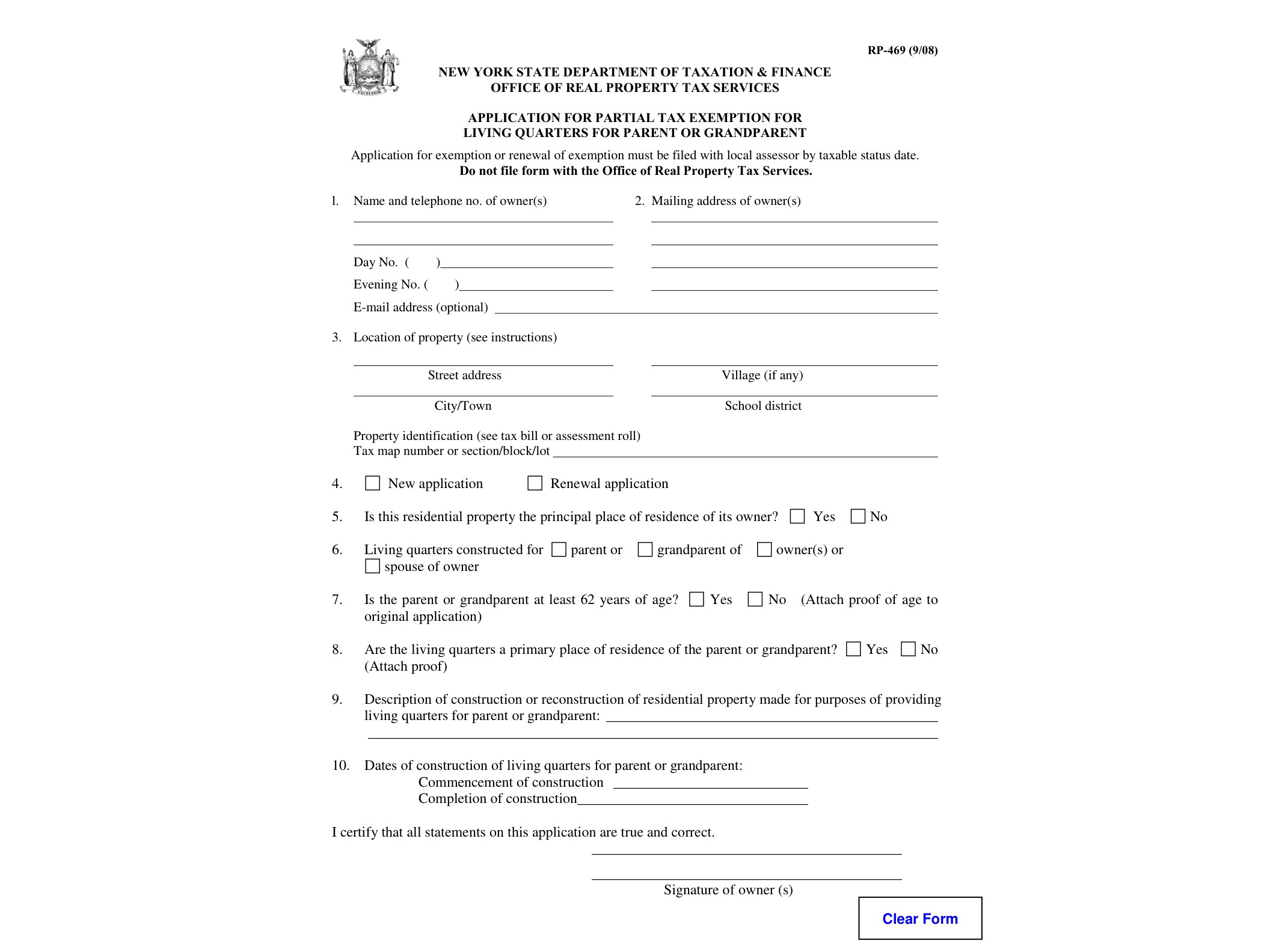
Form RP-469, officially titled Application for Partial Tax Exemption for Living Quarters for Parent or Grandparent, is issued by the New York State Department of Taxation and Finance. It allows homeowners who add or reconstruct living space specifically to house a parent or grandparent to receive a partial exemption from increased property taxes tied to that improvement. In plain terms, if you built or converted part of your home so an elderly parent or grandparent could live with you, this form lets you avoid paying full property taxes on the added value that improvement created.
This exemption exists because New York recognizes that many families take on the cost of caring for aging relatives at home rather than relying on assisted living or nursing facilities. Construction or renovation work done to accommodate a parent or grandparent typically raises a home’s assessed value, which in turn increases property taxes. Form RP-469 offsets that increase by exempting the added assessed value attributable to the new living quarters, as long as certain conditions are met.
Who Needs This Form
You may qualify for this exemption if you own residential property in a municipality that has opted into this exemption program (it’s not automatically available statewide—local governments must adopt it by local law, ordinance, or resolution), and you’ve constructed or reconstructed part of your home to create separate living quarters for a parent or grandparent who is at least 62 years old. The living quarters must be a genuine addition or conversion tied to accommodating the relative, not simply a general home renovation.
It’s worth checking with your local assessor’s office before filling out the form to confirm your municipality actually offers this exemption, since not every county, city, town, or village has adopted it. If your locality hasn’t opted in, this particular form won’t apply to you, and you’ll need to look at other property tax relief options available in your area.
When to File Form RP-469
The application is typically filed with your local assessor after the construction or reconstruction work creating the parent/grandparent living quarters is completed. Timing matters here—municipalities generally have a taxable status date each year, and you’ll need to submit the form before that deadline to have the exemption reflected in the corresponding tax roll. Missing that window usually means waiting until the next assessment cycle, so it helps to file as soon as the improvement is finished rather than waiting.
Keep in mind this exemption applies only to the value added by the specific construction project. It doesn’t exempt the entire property from taxes, and it doesn’t apply retroactively to improvements made years earlier unless your local rules specifically allow it.
How to Complete and Submit the Form
Form RP-469 is available as a fillable PDF (AcroForm), meaning you can type your information directly into the document on a computer before printing it for signature and submission. The form asks for basic property identification details, information about the parent or grandparent who will occupy the new living quarters, a description of the construction or reconstruction work performed, and the estimated cost or value of that work.
Once completed, the form goes to your local assessor’s office rather than the state tax department, since property assessment and exemption administration happen at the municipal level in New York. Your assessor will review the application, verify eligibility based on local law, and determine the exempt portion of the assessment.
If you’re navigating other New York housing-related tax matters, it may help to look at related programs too. For instance, property owners or developers involved in affordable housing projects sometimes deal with the Claim for Low-Income Housing Credit, while those managing credit allocations across multiple years might reference the Low-Income Housing Credit Allocation and Certification form. Owners tracking annual compliance on housing credits may also need the Low-Income Housing Credit Annual Statement. These are separate programs from RP-469, but they show how New York structures various housing-related tax benefits depending on the situation.
Before submitting Form RP-469, double-check with your assessor about any documentation they want attached, such as building permits, cost estimates, or proof of the relative’s age and relationship to you. Requirements can vary slightly by municipality, so a quick call ahead of filing can save you a resubmission later.
Download Official Form RP469 (PDF)
Opens the official government PDF in a new tab