
Download Official Form 1024 (PDF)
Opens the official government PDF in a new tab
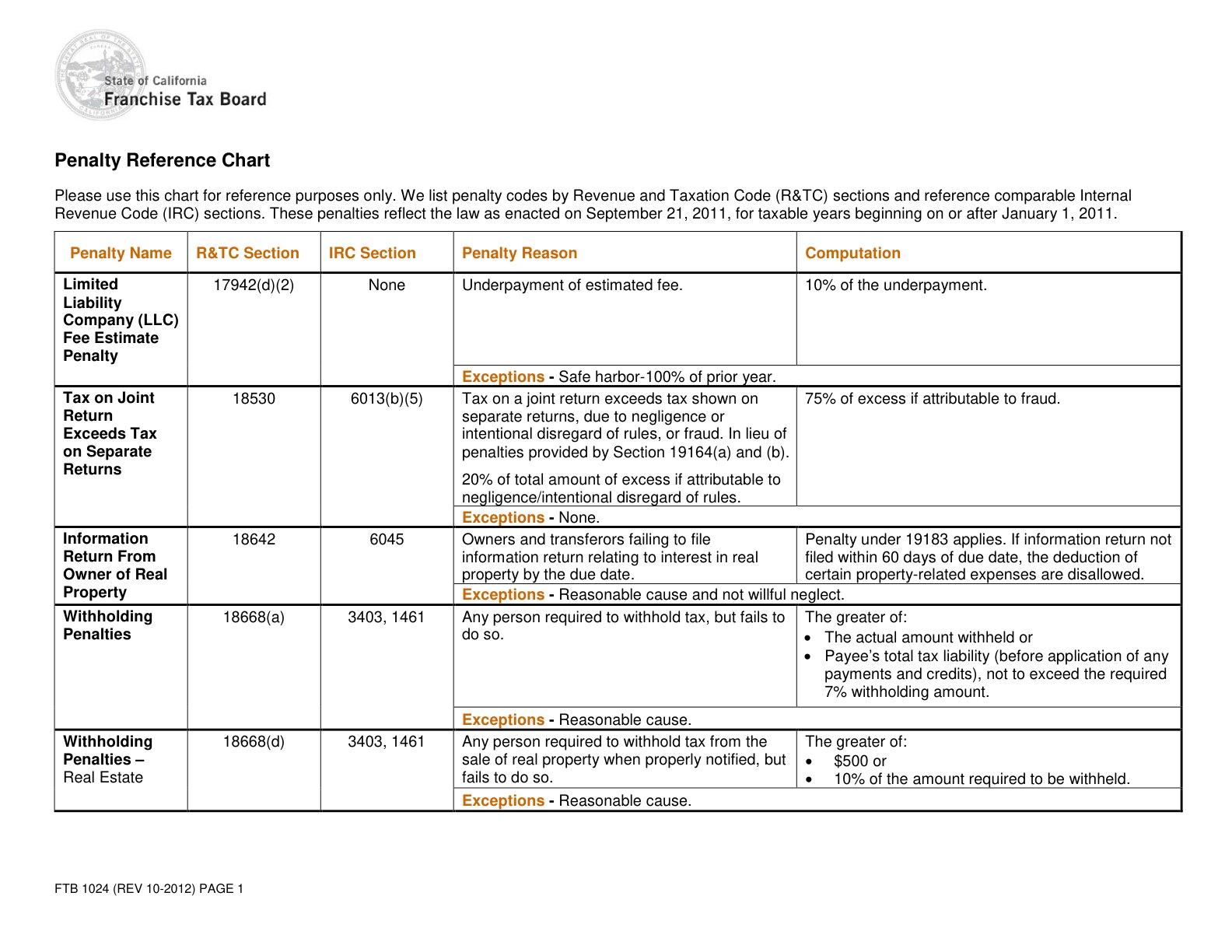
FTB 1024 is not a form you fill out and send to the California Franchise Tax Board. It’s a reference document — a chart published by the FTB that lists the penalties the state can assess against individual and business taxpayers, along with the code section that authorizes each penalty, a short description of what triggers it, and how the penalty amount is calculated. Think of it as a lookup table rather than a filing.
If you’ve ever received a notice from the FTB with a penalty code on it, or you’re trying to figure out why your balance due suddenly includes an extra charge, FTB 1024 is the document that explains what that charge actually is. It covers a wide range of situations: late filing, late payment, underpayment of estimated tax, accuracy-related penalties, fraud penalties, frivolous return penalties, and dozens of more specific business-entity penalties tied to LLCs, corporations, and partnerships registered in California.
Who Needs This Chart
FTB 1024 is most useful for a few specific groups of people:
- Individual taxpayers who received an FTB notice with a penalty they don’t recognize and want to understand the legal basis for it.
- Tax preparers and accountants who need a quick reference to explain penalty assessments to clients or to double-check that a penalty was calculated correctly.
- Business owners — especially those running LLCs, S-corps, or partnerships in California — who face entity-level penalties that individual taxpayers rarely encounter, like penalties for late filing of information returns or failure to provide required schedules.
- Attorneys or representatives handling penalty abatement requests, who need to cite the correct code section when arguing that a penalty was assessed incorrectly or should be waived for reasonable cause.
In short, anyone dealing with California state tax penalties — as opposed to IRS federal penalties — will eventually need to cross-reference FTB 1024 to understand what they’re looking at.
When It’s Used
There’s no deadline attached to FTB 1024 because it isn’t a filing. You’d typically pull it up in a few scenarios: after receiving a Notice of Proposed Assessment that includes penalty language, while preparing a reasonable cause or penalty abatement request, during an audit when penalties are being discussed, or simply as part of routine tax planning to understand what penalties could apply if a return is filed late or a payment is missed.
Some preparers also keep it on hand as a teaching tool for clients — it’s much easier to point to a specific line in the chart than to explain from memory how California’s failure-to-file penalty differs from its failure-to-pay penalty, or how the accuracy-related penalty percentage changes depending on the type of understatement.
How to Get and Use FTB 1024
Because FTB 1024 has no fillable fields, there’s nothing to complete on the document itself. You download it, print it if you want a physical copy for your files, and use it as a reference alongside your notice or return. There’s no signature required and no submission process — it’s purely informational.
When reviewing the chart, match the penalty code shown on your FTB notice to the corresponding row in the document. That row will tell you the statutory basis for the penalty and generally how the amount is calculated, which is useful whether you’re confirming the FTB’s math or building a case that a penalty shouldn’t apply.
State-level penalty and credit rules vary quite a bit from state to state, and California’s system doesn’t map directly onto other states’ frameworks. If you also deal with New York tax matters, you’ll find similar levels of specificity in credit-focused guidance like the Hire a Veteran Credit (Form IT-643) or the Workers with Disabilities Tax Credit (Form IT-644), both of which show how differently each state structures its own tax incentives and penalty rules compared to California.
Keep in mind that FTB updates this chart periodically as penalty amounts or code sections change, so it’s worth confirming you’re looking at the current version rather than relying on an old printout, especially if you’re using it to support a formal abatement request.
Download Official Form 1024 (PDF)
Opens the official government PDF in a new tab