
Download Official Form IT238I (PDF)
Opens the official government PDF in a new tab
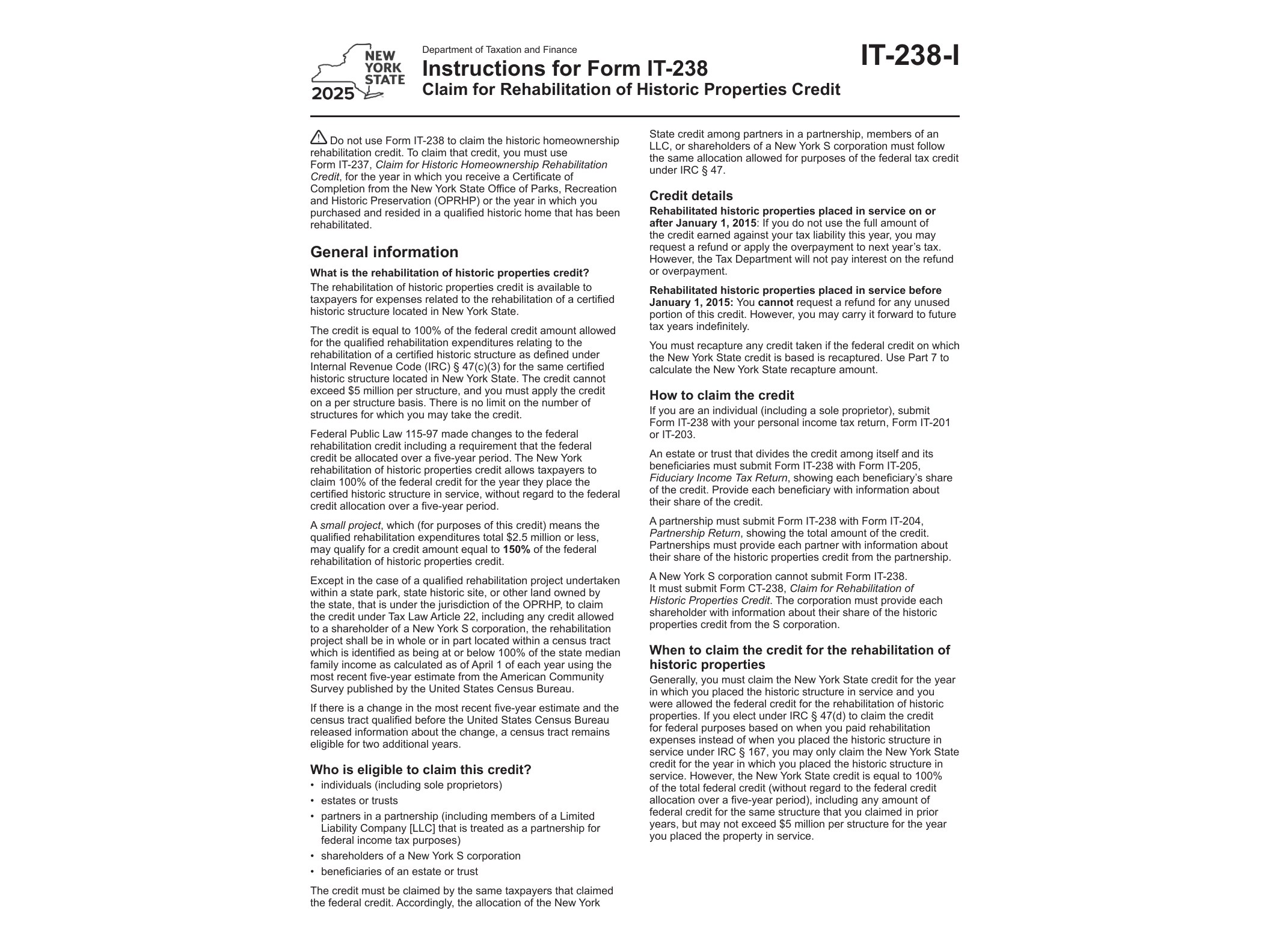
Form IT-238 is the claim form New York State uses for the Rehabilitation of Historic Properties Credit. If you own a historic residential building in New York and you’ve spent money bringing it back to life, this credit can offset a meaningful chunk of your state tax bill. The IT238I document from the New York State Department of Taxation and Finance walks you through exactly how to fill out the form line by line for tax year 2025.
This credit isn’t for just any home renovation. It’s specifically designed for owners of certified historic structures — properties listed individually on the State or National Register of Historic Places, or located within a registered historic district and certified as contributing to that district’s historic character. The rehabilitation work also has to meet certain standards set by the State Historic Preservation Office, and the property generally needs to qualify for the related federal rehabilitation credit for the New York credit to apply.
Who actually needs this form? Typically it’s individual homeowners, though it can also apply to trusts, estates, and certain business entities that pass the credit through to partners or shareholders. If you completed a substantial rehabilitation project on a qualified historic home during the tax year, and your project met the certification requirements from the state’s preservation office, you’re a candidate for this credit. Landlords and owners of income-producing historic properties may also use related credits, but IT-238 specifically covers the residential version tied to personal income tax returns.
Timing matters here. You use Form IT-238 for the tax year in which the rehabilitation work was completed and certified, not necessarily the year you started construction. If your project spans multiple years, you’ll want to track expenses carefully and only claim the credit once the work is finished and properly certified. The credit amount is generally calculated as a percentage of your qualified rehabilitation expenditures, subject to a cap, so keeping thorough documentation of costs is essential before you even open the form.
Filling out IT-238 requires some preparation beyond the form itself. You’ll need documentation proving the property’s historic certification status, records of qualified expenditures, and in many cases confirmation that the project has already been approved through the appropriate historic preservation review process. The instructions in IT238I break down each line of the form, explain how to calculate the credit percentage, and clarify how the credit interacts with other state credits you might be claiming in the same filing. If you’re also claiming credits like the ones described in the IT-228 instructions for contributions to certain funds, you’ll want to review how multiple credits stack on your return before finalizing numbers.
One thing to keep in mind: this form isn’t fillable online. You’ll need to print it out and complete it by hand before attaching it to your New York state income tax return. That means it helps to gather all your supporting numbers and certification paperwork ahead of time, so you’re not stopping mid-form to track down a figure. Double-check your math since handwritten forms are more prone to small arithmetic errors that can delay processing.
If you’re working through several New York credit forms this season, it’s worth comparing how each one handles documentation and calculation. For example, families claiming child care costs often reference the IT-216 instructions for the Child and Dependent Care Credit, while property owners dealing with depreciation schedules may need the IT-211 special depreciation schedule instructions alongside IT-238 if the historic property also generates rental income.
Once you’ve completed the form using the official instructions, attach it to your New York State personal income tax return for the applicable year. Keep copies of your certification documents and expenditure records on file, since the state may request supporting evidence for the rehabilitation costs claimed. Getting this credit right can mean a substantial tax savings for property owners who’ve invested in preserving New York’s historic housing stock, so it’s worth taking the extra time to get every line accurate.
Download Official Form IT238I (PDF)
Opens the official government PDF in a new tab