
Download Official Form IT260 (PDF)
Opens the official government PDF in a new tab
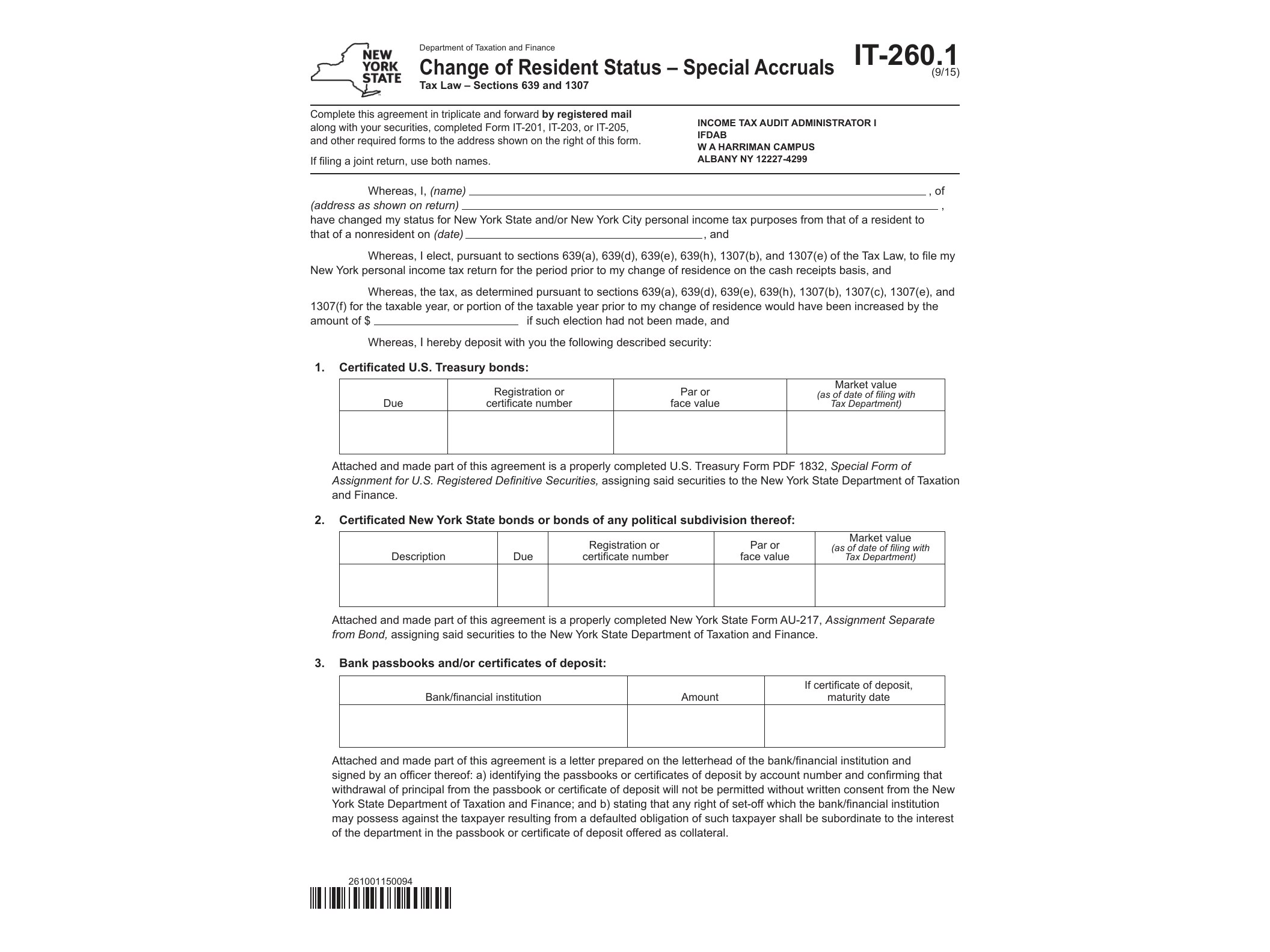
Form IT-260.1, issued by the New York State Department of Taxation and Finance, is a supplemental schedule used when a taxpayer changes their New York residency status during the tax year. Specifically, it deals with what the state calls “special accruals” — income or deduction items that must be recognized in a different way because of the shift between resident and nonresident status.
This form doesn’t stand alone. It’s filed alongside your main New York income tax return (typically Form IT-203 for part-year residents) as an attachment that details the accrual adjustments the state requires when someone moves into or out of New York during the year.
What Are Special Accruals, Exactly?
Under New York tax law, when you stop being a resident or become one partway through the year, certain items of income and deduction that would normally be reported using your regular accounting method (cash or accrual) may need to be accelerated or deferred. This prevents income from escaping New York taxation entirely, or from being taxed twice across two different residency periods.
Common items that trigger special accruals include:
- Installment sale income
- Accrued interest or dividends not yet received
- Deferred compensation arrangements
- Certain business income reported on the cash basis
If any of these apply to your situation in the year you changed residency, Form IT-260.1 is where you calculate and report the adjustment.
Who Needs to File This Form?
You need IT-260.1 if you meet both of these conditions during the tax year:
- You changed your New York resident status — either moving into the state and becoming a resident, or leaving and becoming a nonresident (or part-year resident).
- You have income or deduction items subject to the special accrual rules, such as those listed above.
Most taxpayers who simply move without complex income streams won’t need this form. It’s primarily relevant for people with installment sales, deferred compensation, investment income accruing over time, or business income reported on a cash basis rather than accrual basis.
If you’re unfamiliar with how New York treats supplemental schedules tied to specific tax credits or situations, it can help to see how other specialized forms work. For example, our overview of Form IT-256 for the Special Additional Mortgage Recording Tax Credit shows how New York often requires separate schedules to isolate specific calculations from the main return.
When Should You Use It?
You’ll complete IT-260.1 in the same tax year that your residency status changes. The form asks you to identify the accrual date — generally the day before you changed your status — and to calculate the income or deductions that must be accrued as of that date rather than when they’d normally be recognized under your regular accounting method.
Timing matters here because the special accrual rules exist specifically to match income recognition with the period in which you were actually a New York resident (or nonresident), avoiding gaps or overlaps in taxation.
How to Get and Complete the Form
Form IT-260.1 is available directly from the New York State Department of Taxation and Finance as a fillable PDF, which means you can type your entries directly into the document before printing or attaching it electronically to your e-filed return. The form isn’t lengthy, but the calculations behind it can get complicated depending on how many accrual items you’re reporting.
Before filling it out, gather documentation on each accrual item: contracts for installment sales, statements showing accrued but unpaid interest or dividends, and records of deferred compensation agreements. You’ll need exact dates and amounts to complete the schedule correctly.
Because this form deals with a fairly narrow tax situation, it’s worth double-checking the instructions that accompany it each year, since accrual rules and reporting thresholds can shift. If you’re also navigating other state-specific credit or certification forms — similar in spirit to schedules like California’s Form FTB 3504 for tribal member certification — it helps to treat each supplemental form as its own mini-return, with its own supporting documentation kept separately from your main filing.
Once completed, attach IT-260.1 to your New York return for the year of the residency change. Keep a copy along with your supporting records in case the Department of Taxation and Finance requests verification of the accrual calculations later.
Download Official Form IT260 (PDF)
Opens the official government PDF in a new tab