
Download Official Form IT2664I (PDF)
Opens the official government PDF in a new tab
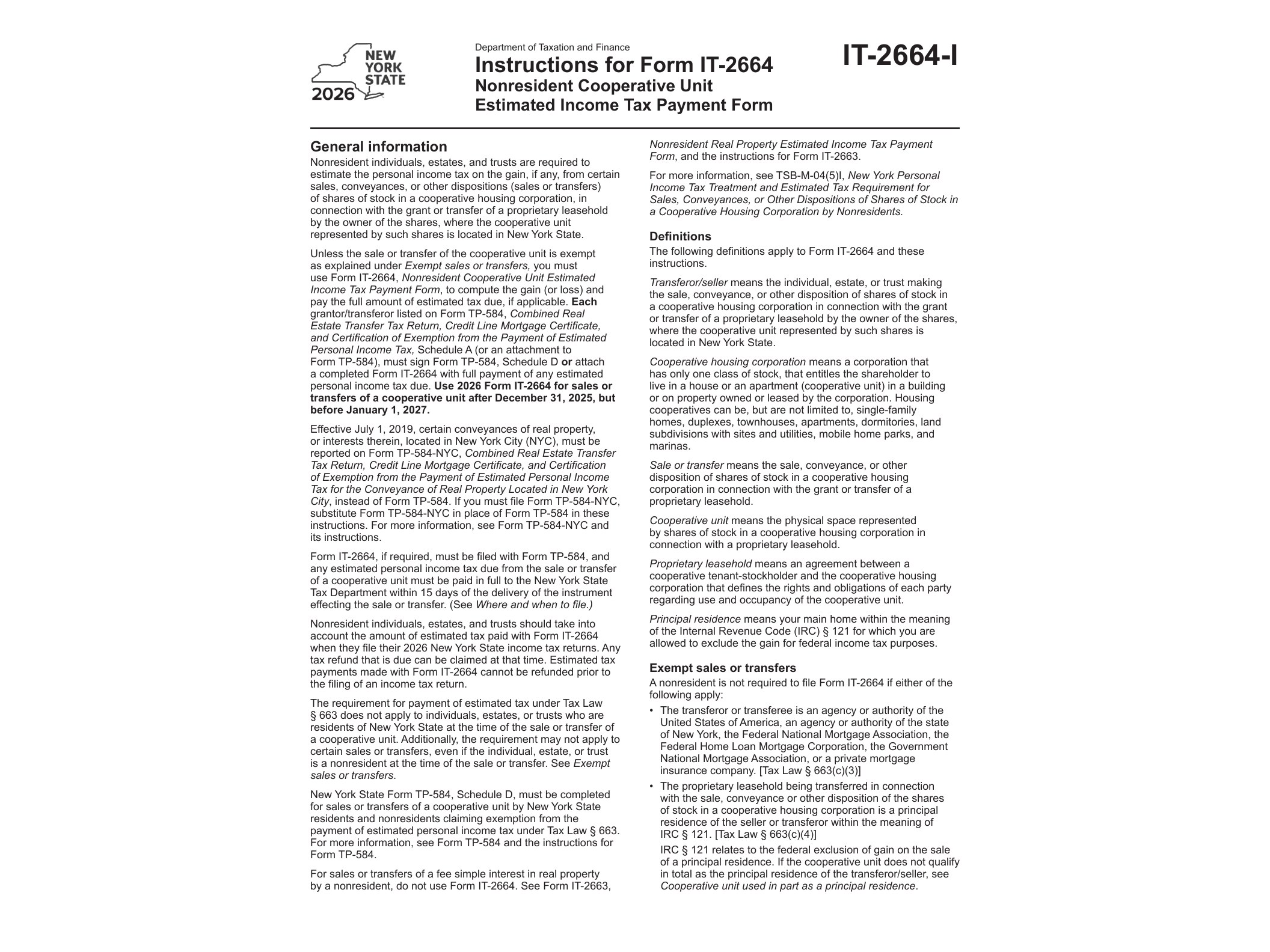
Form IT-2664I contains the instructions that accompany Form IT-2664, the Nonresident Cooperative Unit Estimated Income Tax Payment Form used by the New York State Department of Taxation and Finance. This form applies specifically to nonresident individuals, estates, or trusts selling or transferring shares of stock in a cooperative housing corporation that entitle them to occupy a unit in New York State. It’s essentially New York’s way of collecting estimated tax upfront on gains from co-op sales made by people who don’t live in the state and might otherwise have no ongoing tax presence there.
If you’re a nonresident seller of a cooperative unit, the buyer’s closing agent or attorney typically requires this form to be completed before the transaction can close. The form calculates the estimated personal income tax due on the gain from the sale, and payment must generally be made at or before closing. This mirrors similar requirements for real property transfers under Form TP-584 and related nonresident withholding rules, but it’s tailored specifically to co-op share transfers, which are treated differently under New York tax law than direct real estate transactions.
Who Needs to File Form IT-2664
You need this form if you are a nonresident of New York State (or a nonresident estate or trust) selling, assigning, or transferring stock in a cooperative housing corporation. Residents of New York are generally exempt from this requirement since their tax obligations are already accounted for through regular filing. The form doesn’t apply to resident sellers, and certain exemptions exist for transfers where no gain is realized, transfers between spouses, or other specific situations outlined in the instructions.
Estates and trusts that qualify as nonresidents for New York tax purposes also fall under this requirement when they’re disposing of cooperative unit shares. The instructions walk through how to determine residency status for these entities, which isn’t always straightforward, especially for trusts with multiple beneficiaries in different states.
When and How This Form Is Used
Form IT-2664 is used at the time of a cooperative unit sale closing. The seller (or their representative) completes the form to estimate the tax due on the gain from the transaction, then submits payment along with the form. This isn’t a substitute for the seller’s annual New York State income tax return—it’s a prepayment mechanism. The seller will still need to reconcile the actual tax liability when filing their regular nonresident income tax return for the year, using the estimated payment as a credit against the final amount owed.
The IT2664I instructions detail how to calculate the gain, determine the applicable tax rate, and figure out any adjustments or exemptions that might reduce the estimated payment. There’s also guidance on what happens if the sale results in a loss rather than a gain, in which case no payment is typically required, though the form may still need to be filed to document the exemption.
Getting and Completing the Form
Form IT-2664 is not available as a fillable digital form—you’ll need to download the PDF, print it, and complete it by hand. This is fairly common with New York State tax forms tied to real estate and cooperative transactions, since they often require original signatures and are submitted as part of a closing package rather than filed electronically.
Once printed, fill in the seller’s identifying information, details about the cooperative unit being transferred, and the calculation of estimated tax based on the worksheet provided in the instructions. Double-check the figures against your closing statement, since errors here can delay the transaction or create discrepancies when you file your annual return later.
For sellers juggling multiple New York tax obligations in the same year, it’s worth reviewing other state-specific forms that might apply to your situation. If you’re also dealing with credits or modifications on your New York return, resources like the instructions for Form IT-225 can help clarify how various adjustments interact with your overall filing. Similarly, if energy or production-related credits factor into your tax picture, the guidance for Form IT-253 or Form IT-261 might be relevant depending on your circumstances.
Keep a copy of the completed IT-2664 and proof of payment for your records, since you’ll need to reference these figures when filing your New York nonresident income tax return for the year the sale occurred.
Download Official Form IT2664I (PDF)
Opens the official government PDF in a new tab