
Download Official Form RP305 (PDF)
Opens the official government PDF in a new tab
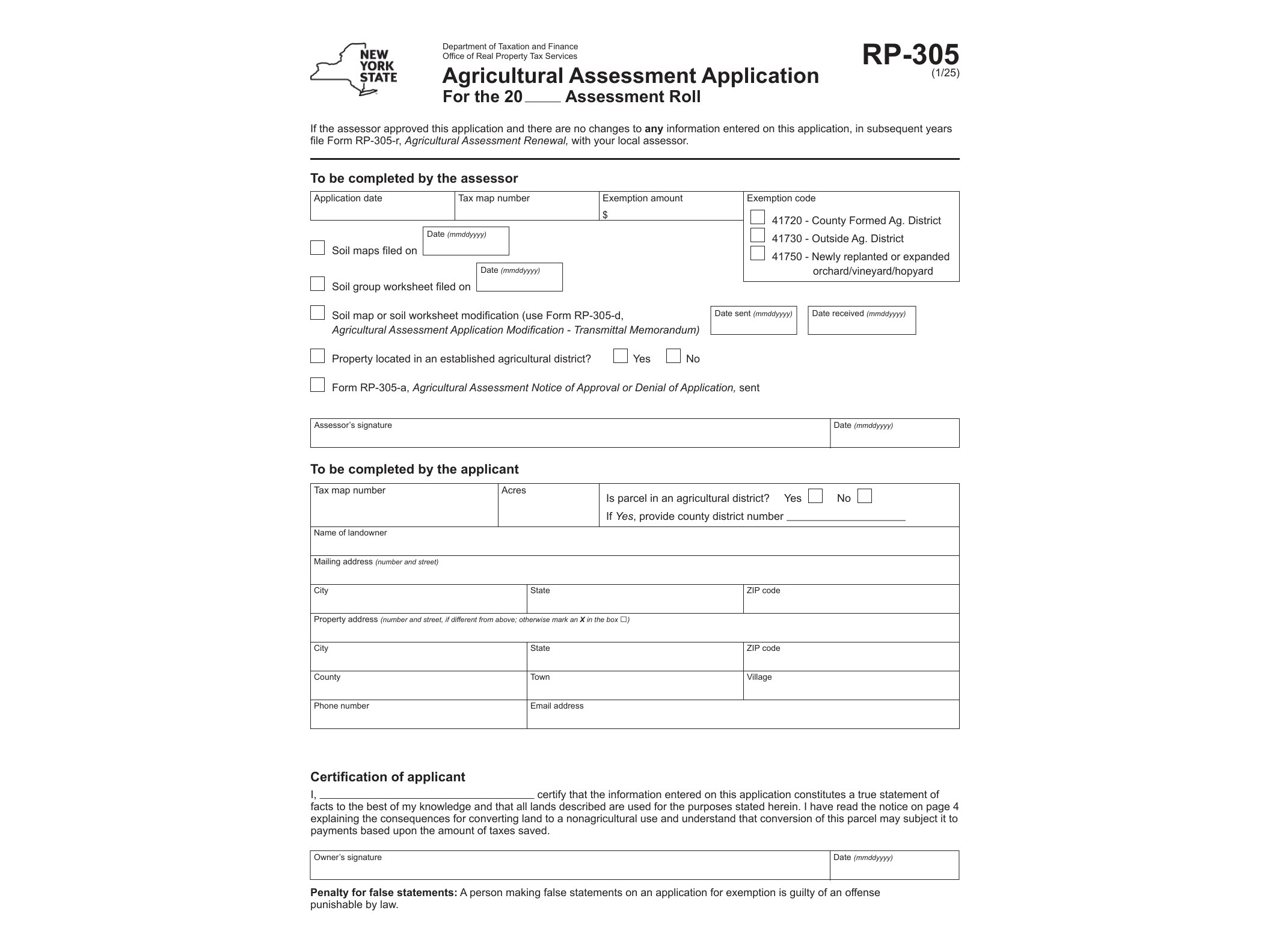
Form RP-305, issued by the New York State Department of Taxation and Finance, is the application farmers and agricultural landowners use to request an agricultural assessment on their property. This assessment lowers the taxable value of qualifying farmland, which in turn reduces the property tax burden on land actively used for agricultural production. The current revision dates to January 2025, and the form is available as a fillable PDF, meaning you can complete it digitally before printing and submitting it to your local assessor.
The Agricultural Assessment Program exists because farmland is often taxed based on its potential value for development rather than its actual use for farming. Without some kind of relief, that gap can push property taxes so high that farming becomes financially unsustainable. Form RP-305 is the mechanism that lets eligible landowners apply for a valuation based on agricultural production rather than market speculation.
Who Needs to File Form RP-305
This form is for owners of land that is actively used for agricultural production and that meets New York State’s eligibility thresholds. Generally, that means at least seven acres of land used in the preceding two years for raising crops, livestock, or livestock products for sale, with gross sales averaging a minimum amount set by the state. Landowners with fewer than seven acres may still qualify under a rented-land provision or through a minimum gross sales requirement, so it’s worth reviewing the instructions on the form carefully before assuming you don’t qualify.
New applicants filing for the first time need to submit RP-305 to establish eligibility. Landowners who already have an agricultural assessment and experience no changes to their land use typically don’t need to refile every year, but any change in acreage, ownership, or use usually triggers a new filing requirement. If you’ve purchased land that already carries an agricultural assessment, or if your farming operation has expanded or contracted, this is the form that needs updating.
When to Submit the Form
Form RP-305 must be filed with the local assessor on or before the taxable status date of the municipality where the property is located. This date varies by locality, so checking with your local assessor’s office is the safest way to avoid missing the deadline. Filing late can mean losing the agricultural assessment for that tax year entirely, so it’s not a form to leave until the last minute.
Assessors who handle these applications alongside other property classification matters often deal with related certification processes, such as those described in our overview of Form RP-3002 for assessing unit certification. Understanding how assessing units operate can give landowners useful context on how their agricultural assessment application will actually be reviewed at the local level.
How to Fill Out and Submit Form RP-305
Since this is an AcroForm-enabled PDF, you can type your information directly into the fields using Adobe Acrobat Reader or a similar PDF program rather than filling it out by hand. The form asks for details including the property’s tax map number, the total acreage involved, the type of agricultural production taking place, gross sales figures, and information about any rented land included in the calculation.
Once completed, the form is not sent to the Department of Taxation and Finance directly. Instead, it goes to the assessor in the city or town where the property sits. Keep a copy for your own records, since you may need to reference prior filings if your land use changes in future years or if a school district requests documentation, similar to the kind of verification process covered in our explanation of Form RP-10 for school district income verification.
If your farming operation also involves separate tax filings related to utilities or other business activities, it’s worth noting that agricultural assessments only affect property tax, not other state tax obligations like those described in our guide to Form CT-186-E for telecommunications and utility taxes. Keeping these filings separate in your recordkeeping avoids confusion at tax time.
Landowners who are unsure whether their property qualifies, or who have questions about acreage calculations and rented land provisions, should reach out to their local assessor’s office before the taxable status date. Getting the application right the first time avoids delays and ensures the reduced assessment applies for the correct tax year.
Download Official Form RP305 (PDF)
Opens the official government PDF in a new tab