
Download Official Form RP485V (PDF)
Opens the official government PDF in a new tab
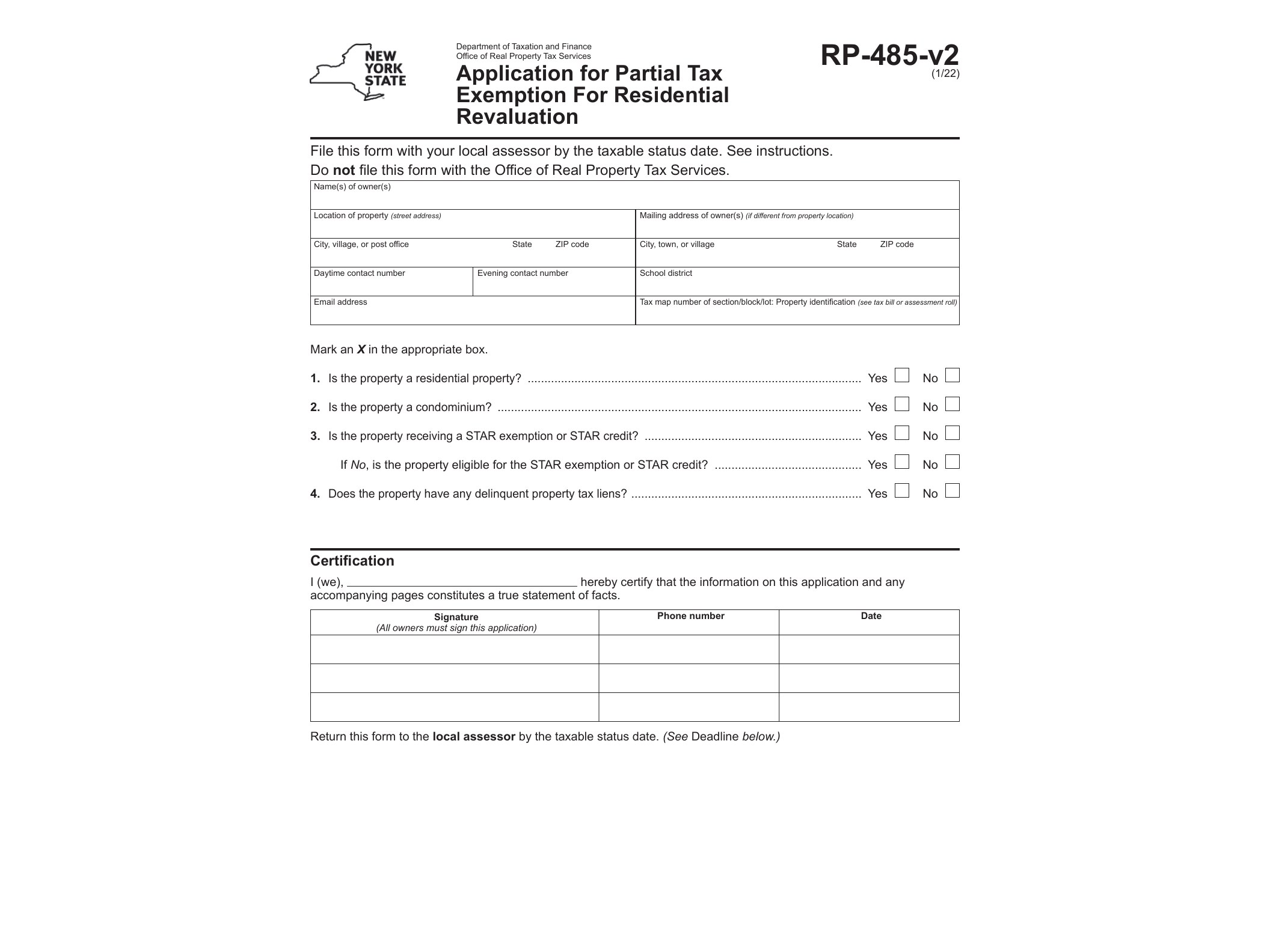
Form RP-485-v2, issued by the New York State Department of Taxation and Finance, is the application homeowners use to request a partial property tax exemption after their municipality conducts a revaluation that raises the assessed value of their home. When a town, city, or county updates its assessment roll and property values jump as a result, this form lets qualifying homeowners phase in the increased tax burden gradually rather than absorbing the full hike immediately.
The exemption exists because revaluations, while meant to make assessments more accurate and equitable, can sometimes create sudden and steep tax increases for homeowners who haven’t sold or improved their property. Form RP-485-v2 gives eligible owners a way to spread that increase over several years, easing the financial shock of a reassessment that reflects rising market values rather than any change made to the home itself.
Who Needs Form RP-485-v2
This form applies specifically to owners of residential property located in a taxing jurisdiction that has just completed a revaluation or update of its assessment roll. If your local assessor’s office notified you that your home’s assessed value increased due to a townwide or citywide revaluation project, and that increase pushed your taxable value up significantly, you may be eligible to apply for this partial exemption.
It’s worth noting that this exemption is separate from other residential property tax relief programs tied to specific improvements or investments. For example, homeowners who added new construction or made substantial investments in their residence might instead look at programs like the RP-485-J exemption for residential investment property in Amsterdam or the similar RP-485-K exemption available in the Utica School District. Those forms address value increases from renovations or new investment, while RP-485-v2 addresses value increases coming purely from a municipal revaluation of existing property.
When to File
Timing matters with this application. Local assessors typically set a specific window after a revaluation project during which homeowners can submit Form RP-485-v2. This window is often tied to the same taxable status date and filing deadlines used for other exemption applications in that jurisdiction, so it pays to check with your local assessor’s office as soon as you receive notice of a revaluation-driven increase. Missing the filing deadline usually means waiting until the next assessment cycle to apply, so acting promptly protects your ability to phase in the tax increase.
What the Form Requires
Form RP-485-v2 asks for standard identifying information: the property’s location, tax map or parcel number, the owner’s name and mailing address, and details about the assessed value before and after the revaluation. Because this is an AcroForm PDF, you can fill in all these fields directly on your computer using Adobe Reader or similar software before printing a final copy for signature and submission. This makes the process considerably faster than filling out a paper form by hand, and it reduces the chance of illegible entries that could delay processing at the assessor’s office.
Once completed, the form generally needs to be signed and filed with the assessor in the city, town, or county where the property is located — not mailed to the state Department of Taxation and Finance. Local assessors review the application, confirm the property’s eligibility based on the revaluation records, and calculate the phased exemption amount according to state guidelines.
If your property also involved infrastructure work tied to a development project, it may be worth checking whether the RP-485-G exemption for infrastructure improvements applies to your situation as well, since some properties qualify for more than one type of relief depending on the circumstances behind the assessment change.
Homeowners unsure whether their situation qualifies should contact their local assessor’s office directly. Assessors handle these applications on a case-by-case basis and can confirm eligibility, the applicable filing deadline, and how the phase-in schedule would affect a specific tax bill.
Download Official Form RP485V (PDF)
Opens the official government PDF in a new tab