
Download Official Form RP5217PDF (PDF)
Opens the official government PDF in a new tab
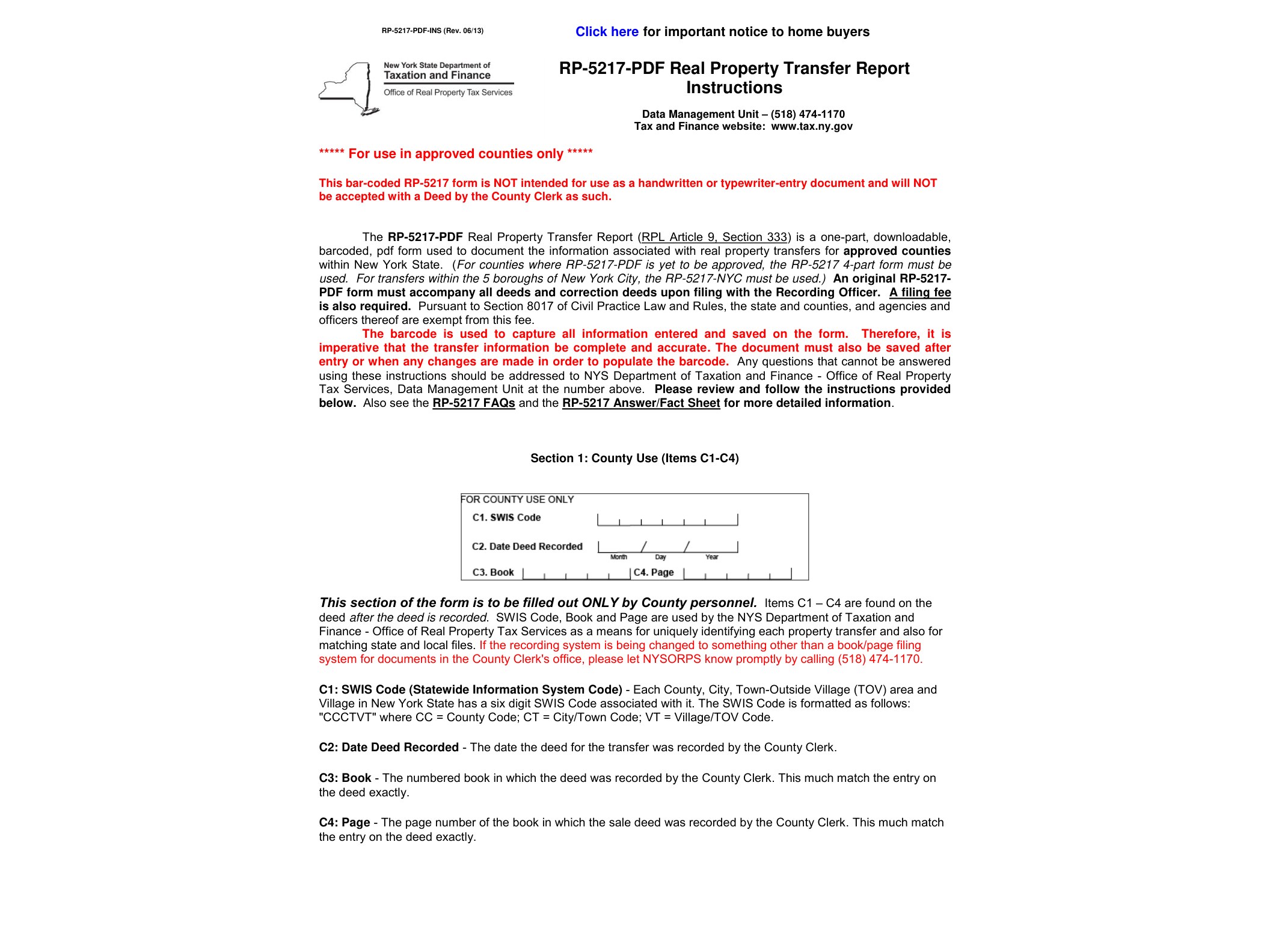
Every time real property changes hands in New York State, the transaction needs to be reported to the county clerk and, eventually, to the New York State Department of Taxation and Finance. The form that captures this information is RP-5217-PDF, commonly known as the Real Property Transfer Report. The document you’re looking at here, RP-5217-PDF-INS, isn’t the form itself but the official instruction booklet that walks filers through each section of that report.
If you’ve ever tried to fill out RP-5217-PDF without guidance, you know it’s not as intuitive as it looks. The form asks for parcel identifiers, sale price breakdowns, property classification codes, and buyer/seller information that has to match county records exactly. Small mistakes—like using the wrong property class code or leaving a required field blank—can delay the recording of a deed. That’s exactly why the Department of Taxation and Finance publishes this separate instructions document alongside the fillable AcroForm version of RP-5217-PDF.
Who Actually Needs This Document
The instructions are meant for anyone responsible for preparing the Real Property Transfer Report, which typically includes:
- Attorneys handling real estate closings in New York State
- Title companies and escrow agents processing deed transfers
- County clerks’ office staff who review submissions for accuracy
- Buyers or sellers completing the transfer themselves without legal representation
- Assessors’ offices that rely on the data for property valuation updates
Because the underlying RP-5217-PDF form feeds directly into the state’s assessment and equalization systems, accuracy matters well beyond the closing table. Local assessors use this data throughout the year, which ties into broader issues around property assessment review—similar to what’s discussed in our breakdown of Form RP-552, which covers how assessors verify statements before a Board of Assessment Review.
When You’ll Need to Reference the Instructions
You’ll want this instruction booklet open any time you’re preparing RP-5217-PDF for an actual property conveyance—not just residential sales, but also commercial transfers, transfers between family members, and even certain non-sale transfers like corrections of deeds or transfers into trusts. The instructions clarify which transfer types are exempt from certain fields and which require full disclosure of consideration paid.
The guidance is particularly useful when dealing with less common scenarios: partial interests in property, multiple parcels sold together, or transfers where the sale price doesn’t reflect fair market value (such as transfers between relatives). Each of these situations has specific coding requirements that the instructions spell out step by step.
How to Get and Use the Form
RP-5217-PDF-INS is published directly by the New York State Department of Taxation and Finance and is available as a free PDF download. The instructions are designed to be used side by side with the fillable RP-5217-PDF form, which has AcroForm fields that let you type information directly into the document before printing it for filing with the county clerk.
To use it effectively, download both documents together. Start with the instructions to identify which sections apply to your specific transaction type, then move to the fillable form to enter the data. Pay close attention to the property classification codes listed in the instructions—these determine how the sale gets categorized in state assessment data, and getting them wrong is one of the most common reasons filings get sent back for correction.
Once completed, RP-5217-PDF is typically filed at the same time as the deed, at the county clerk’s office where the property is located. It is not mailed separately to the state; the county forwards the data electronically. If your transaction also involves questions about how the property’s assessed value might be challenged later, it may help to review related procedural forms like Form RP-523-Dcl or Form RP-553, both of which come into play during the assessment review process that follows a property transfer.
Keep a copy of the completed form and instructions for your own records after filing. If a question ever comes up about how a transfer was classified or valued, having the original instructions on hand makes it much easier to explain the reasoning behind the entries.
Download Official Form RP5217PDF (PDF)
Opens the official government PDF in a new tab