
Download Official Form DTF625I (PDF)
Opens the official government PDF in a new tab
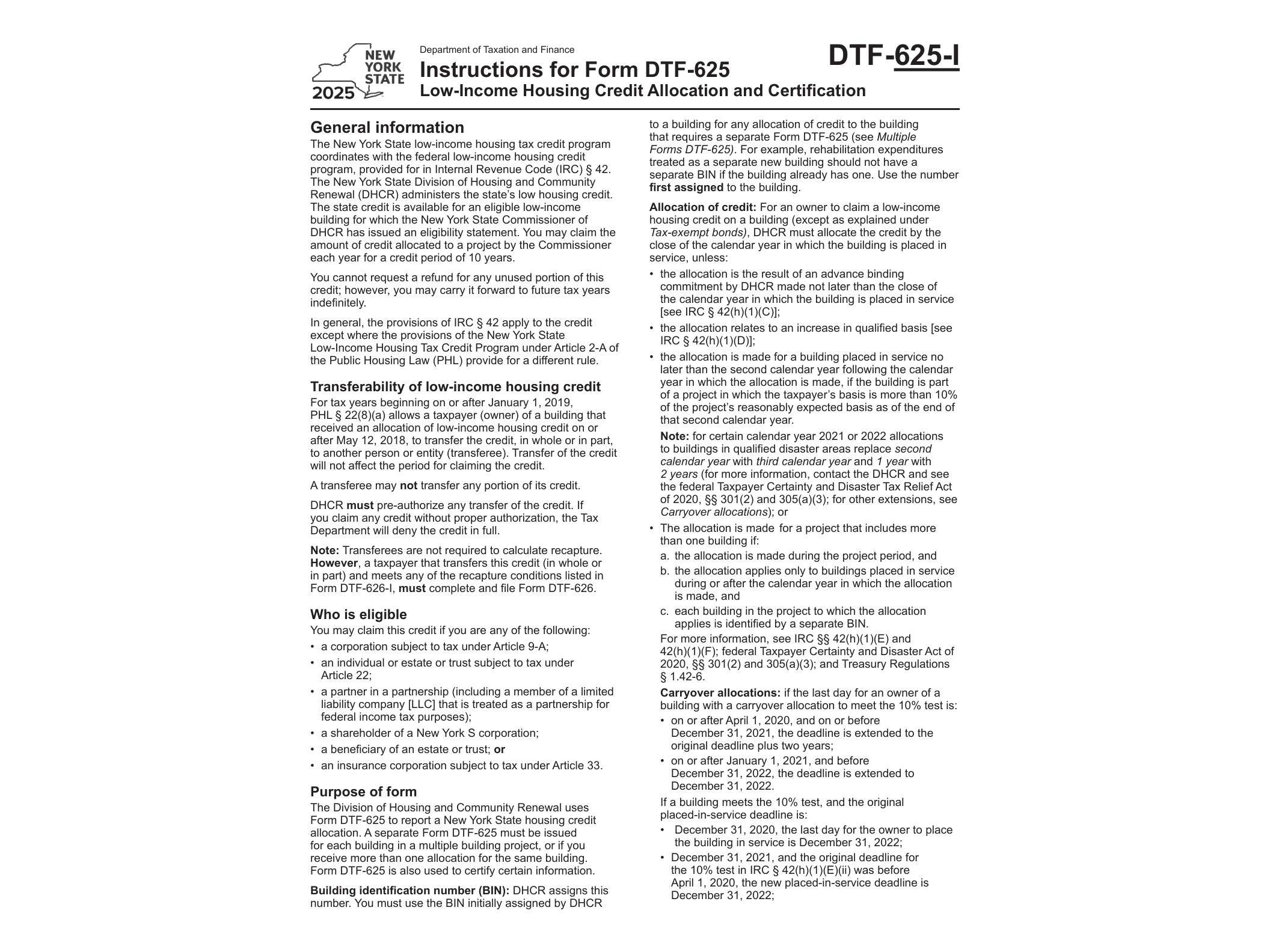
Form DTF-625-I is the instruction booklet published by the New York State Department of Taxation and Finance to accompany Form DTF-625, Low-Income Housing Credit Allocation and Certification. This document walks through how housing project sponsors, credit agencies, and building owners should fill out the underlying certification form, which confirms that a specific building qualifies for New York’s low-income housing credit for a given tax year.
The DTF-625 itself is issued by the New York State Division of Housing and Community Renewal (DHCR) or a local agency administering the credit program on behalf of a project. It certifies details like the building’s identification number, the amount of credit allocated, the compliance period, and other project-specific figures that a taxpayer will later need to claim the credit on their New York return. The instructions in DTF-625-I explain each line of that certification, clarify definitions used throughout the form, and describe how allocating agencies should report changes such as credit recapture events or adjustments to a building’s qualified basis.
Who Needs This Form
These instructions are primarily useful for two groups. First, the housing agencies and credit-allocating bodies responsible for issuing the DTF-625 certification to a building owner need the guidance to complete the form accurately and consistently across projects. Second, accountants, tax preparers, and property owners who receive a completed DTF-625 from an agency often reference the instructions to understand what each entry on the certification means before they use those numbers to file a related claim.
If you’re the taxpayer actually claiming the credit rather than the agency issuing the certification, you’ll typically pair the information from DTF-625 with Form DTF-624, the Claim for Low-Income Housing Credit, which is the form actually filed with your New York tax return to calculate and claim the credit amount for the year.
When This Form Is Used
DTF-625 and its instructions apply during the compliance period of a qualified low-income housing project, which generally spans 15 years after a building is placed in service. Each year within that period, the certifying agency may need to issue or update a DTF-625 to reflect the building’s continued eligibility, changes in ownership, or adjustments in the credit amount. Tax year 2025 instructions reflect any updates to line items, credit percentages, or reporting requirements that the Department of Taxation and Finance has made for filings related to that tax year.
Property owners involved in affordable housing developments sometimes deal with multiple state-level housing benefits at once. For instance, someone managing a multi-generational household arrangement alongside a low-income housing project might also want to review Form RP-469, which covers a partial property tax exemption for living quarters built for a parent or grandparent. And individual homeowners or renters looking for a separate, more general property tax benefit may find Form IT-214 instructions relevant, since that credit serves a different population than the low-income housing credit but often comes up in the same tax planning conversations.
How to Get and Complete the Form
Form DTF-625-I is available directly from the New York State Department of Taxation and Finance website as a PDF. Note that this form is not fillable digitally — you’ll need to print it out and complete it by hand, then keep it with your records or submit it according to the certifying agency’s instructions.
Before filling anything out, read through the full instruction booklet once to understand the sequence of certification steps. Agencies issuing the certification should have supporting documentation on the building’s qualified basis, unit mix, and compliance status ready before transcribing figures onto the form. Building owners receiving a completed DTF-625 should verify the building identification number and credit amounts against their own project records, since these figures flow directly into any credit claim filed with the state. If anything looks inconsistent, it’s worth contacting the issuing agency before filing season rather than after.
Download Official Form DTF625I (PDF)
Opens the official government PDF in a new tab